Grade 8 · Social StudiesCIV.8.3Premium
From a Gunshot to a Law: Field Notes on the Pendleton Act
Grade 8 civics: a historian's field notes trace the Pendleton Civil Service Act from bill to law, with a jury trial, petitions, letters and the 1882 vote.
Preview
OwlSheets.com
From a Gunshot to a Law: Field Notes on the Pendleton Act
Follow a historian through the records of 1881–1883 to see how a bill became law and how citizens took part.
The field notes
Dr. Rosalind Okoye is a historian studying how the Pendleton Act became law. Read her field notes. Then answer the questions.
Field Notes: The Pendleton Act, 1881–1883
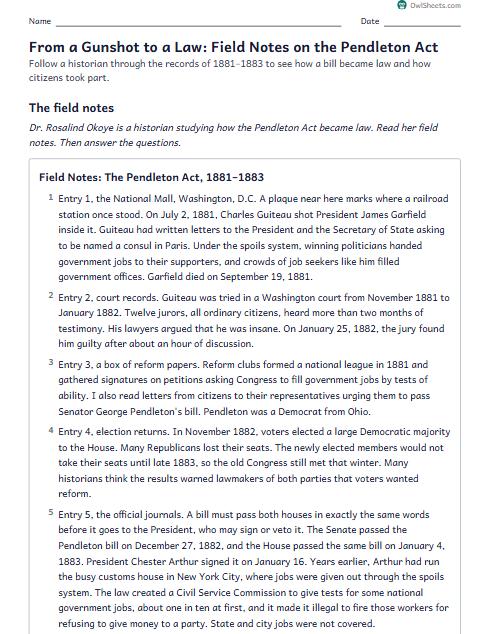
1Entry 1, the National Mall, Washington, D.C. A plaque near here marks where a railroad station once stood. On July 2, 1881, Charles Guiteau shot President James Garfield inside it. Guiteau had written letters to the President and the Secretary of State asking to be named a consul in Paris. Under the spoils system, winning politicians handed government jobs to their supporters, and crowds of job seekers like him filled government offices. Garfield died on September 19, 1881.
2Entry 2, court records. Guiteau was tried in a Washington court from November 1881 to January 1882. Twelve jurors, all ordinary citizens, heard more than two months of testimony. His lawyers argued that he was insane. On January 25, 1882, the jury found him guilty after about an hour of discussion.
3Entry 3, a box of reform papers. Reform clubs formed a national league in 1881 and gathered signatures on petitions asking Congress to fill government jobs by tests of ability. I also read letters from citizens to their representatives urging them to pass Senator George Pendleton's bill. Pendleton was a Democrat from Ohio.
4Entry 4, election returns. In November 1882, voters elected a large Democratic majority to the House. Many Republicans lost their seats. The newly elected members would not take their seats until late 1883, so the old Congress still met that winter. Many historians think the results warned lawmakers of both parties that voters wanted reform.
5Entry 5, the official journals. A bill must pass both houses in exactly the same words before it goes to the President, who may sign or veto it. The Senate passed the Pendleton bill on December 27, 1882, and the House passed the same bill on January 4, 1883. President Chester Arthur signed it on January 16. Years earlier, Arthur had run the busy customs house in New York City, where jobs were given out through the spoils system. The law created a Civil Service Commission to give tests for some national government jobs, about one in ten at first, and it made it illegal to fire those workers for refusing to give money to a party. State and city jobs were not covered.
| Date | Event | Vote |
|---|---|---|
| July 2, 1881 | Garfield is shot | — |
| Sept. 19, 1881 | Garfield dies | — |
| Jan. 25, 1882 | Jury finds Guiteau guilty | 12 jurors agree |
| Nov. 1882 | Midterm elections | — |
| Dec. 27, 1882 | Senate passes Pendleton bill | 38 yes, 5 no |
| Jan. 4, 1883 | House passes the same bill | 155 yes, 47 no |
| Jan. 16, 1883 | President Arthur signs it | — |
- A. Arthur could sign it at once, since both houses had voted on it.
- B. The Civil Service Commission would have to test the new sentence.
- C. The Senate would have to pass the bill with the new sentence too.
- D. Voters would have to approve the new sentence in an election.
The preview shows the first questions. Unlock the worksheet to see all of it.
Related worksheets
Free Land at Last? The Homestead Bill in the News, 1862
Grade 8 · CIV.8.3
14 questionsPremium
Petition, Ballot or Letter? A Town Meeting on the Homestead Bill, 1860
Grade 8 · CIV.8.3
14 questionsPremium
Rates and Rights: An Exhibit on the Interstate Commerce Act
Grade 8 · CIV.8.3
14 questionsPremium
One Day, Six Stops: Following a Bill Across Washington
Grade 8 · CIV.8.3
14 questionsPremium
Over the President's Veto: The Civil Rights Act of 1866
Grade 8 · CIV.8.3
11 questionsPremium
Silenced Petitions: The Gag Rule and Angelina Grimké, 1836–1844
Grade 8 · CIV.8.3
11 questionsPremium