Grade 8 · Social StudiesCIV.8.3Premium
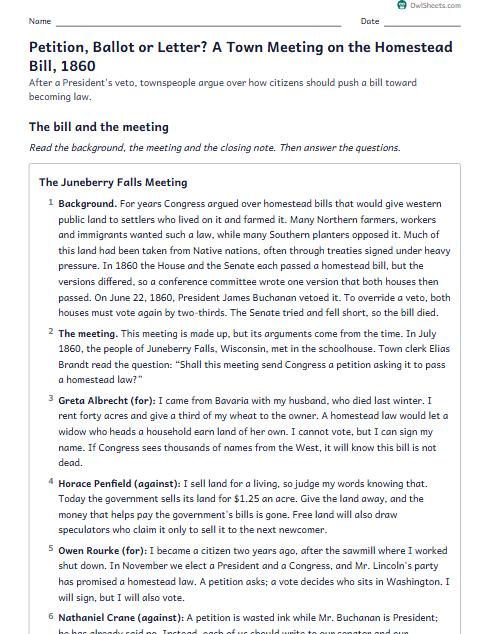
Petition, Ballot or Letter? A Town Meeting on the Homestead Bill, 1860
Grade 8 civics: after Buchanan's 1860 homestead veto, a town meeting debates petitions, votes, letters and jury duty on the road to the 1862 law.
Preview
OwlSheets.com
Petition, Ballot or Letter? A Town Meeting on the Homestead Bill, 1860
After a President's veto, townspeople argue over how citizens should push a bill toward becoming law.
The bill and the meeting
Read the background, the meeting and the closing note. Then answer the questions.
The Juneberry Falls Meeting
1Background. For years Congress argued over homestead bills that would give western public land to settlers who lived on it and farmed it. Many Northern farmers, workers and immigrants wanted such a law, while many Southern planters opposed it. Much of this land had been taken from Native nations, often through treaties signed under heavy pressure. In 1860 the House and the Senate each passed a homestead bill, but the versions differed, so a conference committee wrote one version that both houses then passed. On June 22, 1860, President James Buchanan vetoed it. To override a veto, both houses must vote again by two-thirds. The Senate tried and fell short, so the bill died.
2The meeting. This meeting is made up, but its arguments come from the time. In July 1860, the people of Juneberry Falls, Wisconsin, met in the schoolhouse. Town clerk Elias Brandt read the question: “Shall this meeting send Congress a petition asking it to pass a homestead law?”
3Greta Albrecht (for): I came from Bavaria with my husband, who died last winter. I rent forty acres and give a third of my wheat to the owner. A homestead law would let a widow who heads a household earn land of her own. I cannot vote, but I can sign my name. If Congress sees thousands of names from the West, it will know this bill is not dead.
4Horace Penfield (against): I sell land for a living, so judge my words knowing that. Today the government sells its land for $1.25 an acre. Give the land away, and the money that helps pay the government's bills is gone. Free land will also draw speculators who claim it only to sell it to the next newcomer.
5Owen Rourke (for): I became a citizen two years ago, after the sawmill where I worked shut down. In November we elect a President and a Congress, and Mr. Lincoln's party has promised a homestead law. A petition asks; a vote decides who sits in Washington. I will sign, but I will also vote.
6Nathaniel Crane (against): A petition is wasted ink while Mr. Buchanan is President; he has already said no. Instead, each of us should write to our senator and our representative by name. A letter from a voter in his own district tells a lawmaker whose votes he will need in November.
7The vote. Before the vote, Mr. Brandt said that he and three other men present had been called to serve as jurors at the county court next week. Two neighbors both claim the same 160 acres, and the twelve jurors will hear both sides and decide whose claim the evidence supports. The meeting then voted 41 to 17 to send the petition.
8Closing note. Lincoln won the election of 1860. Congress passed a new homestead bill, and Lincoln signed the Homestead Act on May 20, 1862. Starting January 1, 1863, a head of a household or a person 21 or older could claim up to 160 acres if he or she was a citizen or had declared the intent to become one and had never fought against the United States. A settler who lived on and farmed the land for five years and paid small fees then owned it.
- A. The Supreme Court ruled that the bill broke the Constitution.
- B. The President vetoed it, and the override fell short of two-thirds.
- C. The conference committee voted the bill down after it passed.
- D. The states voted against it before the President could sign it.
- A. Houses pass different bills → conference writes one version → President vetoes → override fails
- B. Houses pass different bills → conference writes one version → override fails → President vetoes
- C. Houses pass different bills → President vetoes → conference writes one version → override fails
- D. Conference writes one version → houses pass different bills → President vetoes → override fails
The preview shows the first questions. Unlock the worksheet to see all of it.
Related worksheets
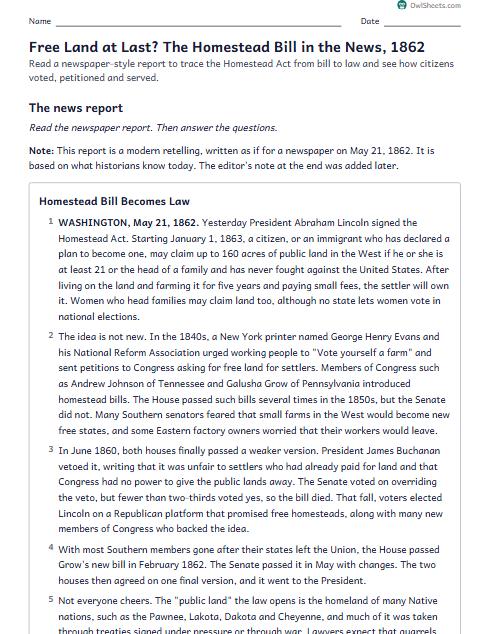
Free Land at Last? The Homestead Bill in the News, 1862
Grade 8 · CIV.8.3
14 questionsPremium
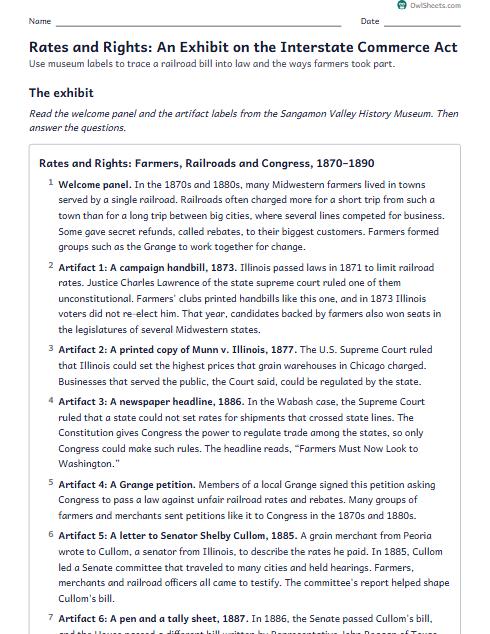
Rates and Rights: An Exhibit on the Interstate Commerce Act
Grade 8 · CIV.8.3
14 questionsPremium
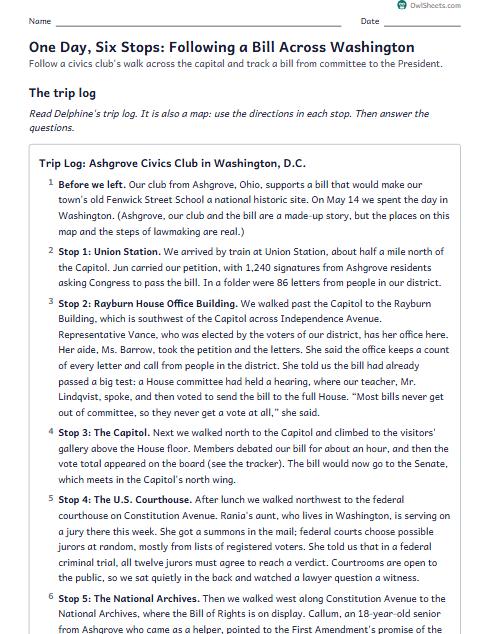
One Day, Six Stops: Following a Bill Across Washington
Grade 8 · CIV.8.3
14 questionsPremium
From a Gunshot to a Law: Field Notes on the Pendleton Act
Grade 8 · CIV.8.3
12 questionsPremium
Over the President's Veto: The Civil Rights Act of 1866
Grade 8 · CIV.8.3
11 questionsPremium
Silenced Petitions: The Gag Rule and Angelina Grimké, 1836–1844
Grade 8 · CIV.8.3
11 questionsPremium