Grade 8 · Social StudiesCIV.8.3Premium
Free Land at Last? The Homestead Bill in the News, 1862
Grade 8 civics: a modern news retelling follows the Homestead Act from petitions and a veto to Lincoln's signature, with voting, juries and other voices.
Preview
OwlSheets.com
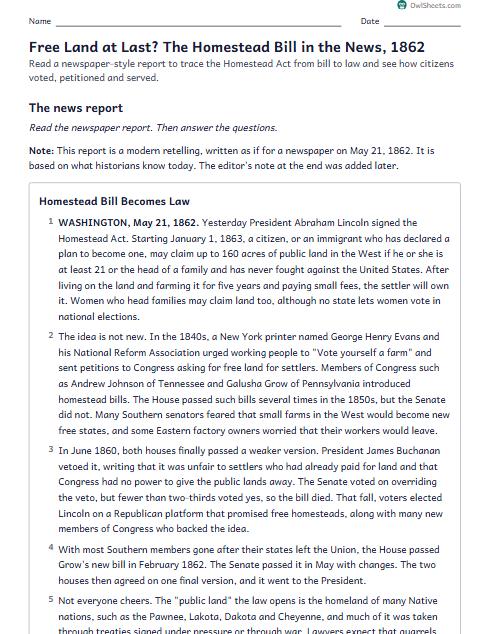
Free Land at Last? The Homestead Bill in the News, 1862
Read a newspaper-style report to trace the Homestead Act from bill to law and see how citizens voted, petitioned and served.
The news report
Read the newspaper report. Then answer the questions.
Homestead Bill Becomes Law
1WASHINGTON, May 21, 1862. Yesterday President Abraham Lincoln signed the Homestead Act. Starting January 1, 1863, a citizen, or an immigrant who has declared a plan to become one, may claim up to 160 acres of public land in the West if he or she is at least 21 or the head of a family and has never fought against the United States. After living on the land and farming it for five years and paying small fees, the settler will own it. Women who head families may claim land too, although no state lets women vote in national elections.
2The idea is not new. In the 1840s, a New York printer named George Henry Evans and his National Reform Association urged working people to "Vote yourself a farm" and sent petitions to Congress asking for free land for settlers. Members of Congress such as Andrew Johnson of Tennessee and Galusha Grow of Pennsylvania introduced homestead bills. The House passed such bills several times in the 1850s, but the Senate did not. Many Southern senators feared that small farms in the West would become new free states, and some Eastern factory owners worried that their workers would leave.
3In June 1860, both houses finally passed a weaker version. President James Buchanan vetoed it, writing that it was unfair to settlers who had already paid for land and that Congress had no power to give the public lands away. The Senate voted on overriding the veto, but fewer than two-thirds voted yes, so the bill died. That fall, voters elected Lincoln on a Republican platform that promised free homesteads, along with many new members of Congress who backed the idea.
4With most Southern members gone after their states left the Union, the House passed Grow's new bill in February 1862. The Senate passed it in May with changes. The two houses then agreed on one final version, and it went to the President.
5Not everyone cheers. The "public land" the law opens is the homeland of many Native nations, such as the Pawnee, Lakota, Dakota and Cheyenne, and much of it was taken through treaties signed under pressure or through war. Lawyers expect that quarrels over claims will often end up in local courts, where juries of neighbors will decide whose story the evidence supports. Some editors warn that settlers will still need money for tools, seed and lumber that free land does not supply.
6Editor's note from today: On January 1, 1863, Daniel Freeman filed a claim near Beatrice, Nebraska, that is often called the first. Many others filed claims that same day, and the story that Freeman was first grew in later years. Historians estimate that about 1.6 million homestead claims were approved by the 1930s.
- A. A 19-year-old single man who wants to farm 160 acres in Kansas
- B. A family that wants to claim 640 acres of public land for free
- C. A 30-year-old immigrant who has declared a plan to become a citizen
- D. A man who fought in the Confederate army and now wants a farm
The preview shows the first questions. Unlock the worksheet to see all of it.
Related worksheets
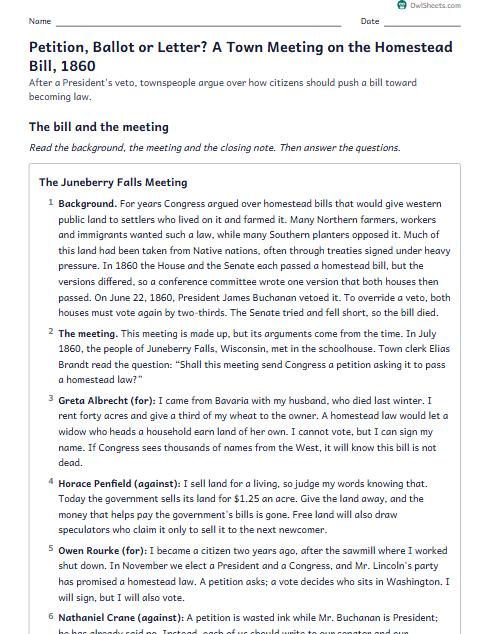
Petition, Ballot or Letter? A Town Meeting on the Homestead Bill, 1860
Grade 8 · CIV.8.3
14 questionsPremium
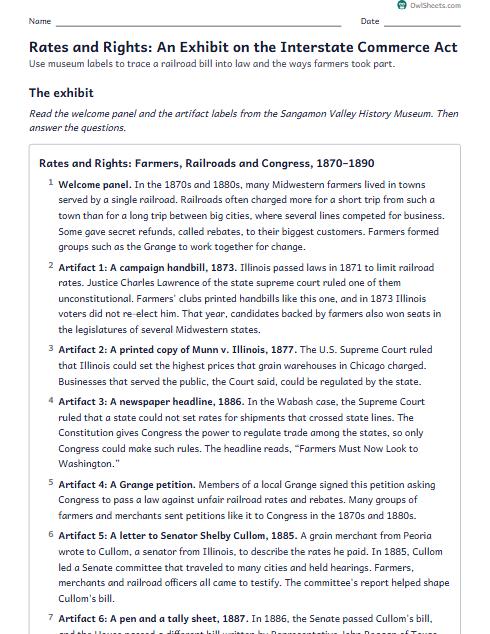
Rates and Rights: An Exhibit on the Interstate Commerce Act
Grade 8 · CIV.8.3
14 questionsPremium
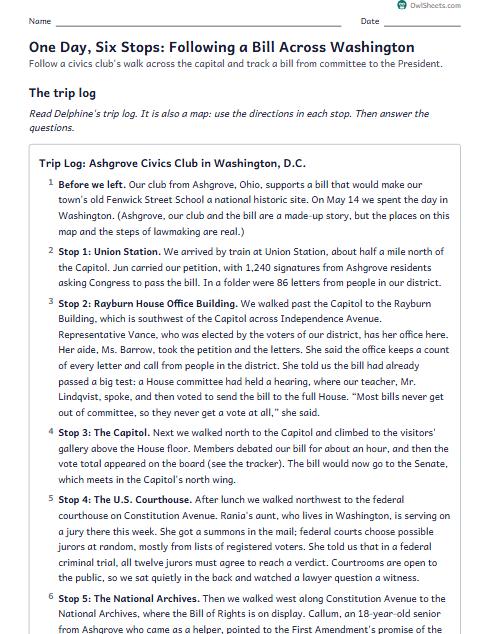
One Day, Six Stops: Following a Bill Across Washington
Grade 8 · CIV.8.3
14 questionsPremium
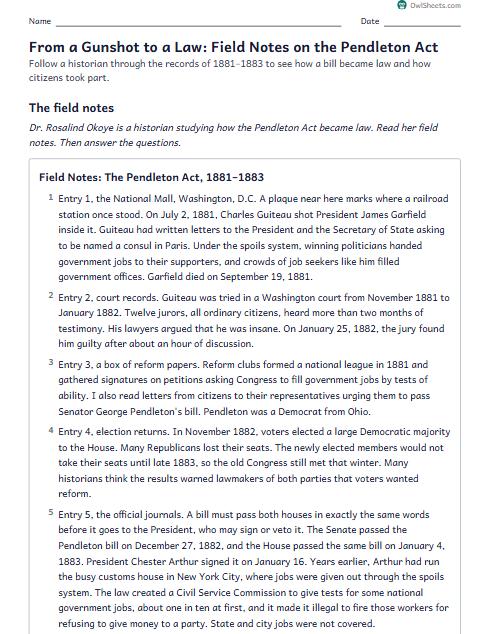
From a Gunshot to a Law: Field Notes on the Pendleton Act
Grade 8 · CIV.8.3
12 questionsPremium
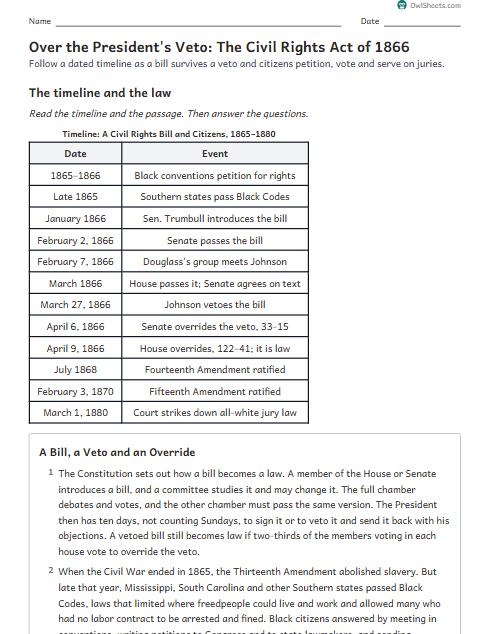
Over the President's Veto: The Civil Rights Act of 1866
Grade 8 · CIV.8.3
11 questionsPremium
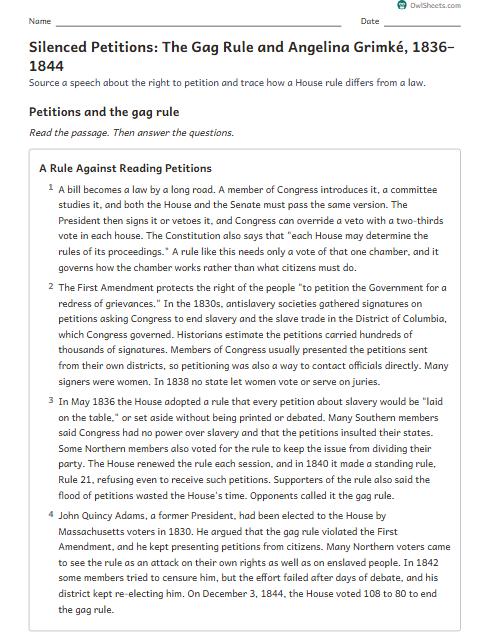
Silenced Petitions: The Gag Rule and Angelina Grimké, 1836–1844
Grade 8 · CIV.8.3
11 questionsPremium