Grade 8 · Social StudiesCIV.8.3Premium
Rates and Rights: An Exhibit on the Interstate Commerce Act
Grade 8 civics: museum labels follow farmers' votes, petitions, letters and juries and the Interstate Commerce Act of 1887 from two bills to law.
Preview
OwlSheets.com
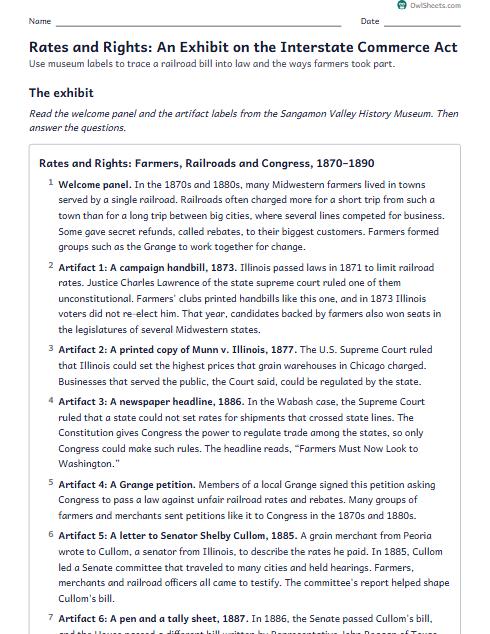
Rates and Rights: An Exhibit on the Interstate Commerce Act
Use museum labels to trace a railroad bill into law and the ways farmers took part.
The exhibit
Read the welcome panel and the artifact labels from the Sangamon Valley History Museum. Then answer the questions.
Rates and Rights: Farmers, Railroads and Congress, 1870–1890
1Welcome panel. In the 1870s and 1880s, many Midwestern farmers lived in towns served by a single railroad. Railroads often charged more for a short trip from such a town than for a long trip between big cities, where several lines competed for business. Some gave secret refunds, called rebates, to their biggest customers. Farmers formed groups such as the Grange to work together for change.
2Artifact 1: A campaign handbill, 1873. Illinois passed laws in 1871 to limit railroad rates. Justice Charles Lawrence of the state supreme court ruled one of them unconstitutional. Farmers' clubs printed handbills like this one, and in 1873 Illinois voters did not re-elect him. That year, candidates backed by farmers also won seats in the legislatures of several Midwestern states.
3Artifact 2: A printed copy of Munn v. Illinois, 1877. The U.S. Supreme Court ruled that Illinois could set the highest prices that grain warehouses in Chicago charged. Businesses that served the public, the Court said, could be regulated by the state.
4Artifact 3: A newspaper headline, 1886. In the Wabash case, the Supreme Court ruled that a state could not set rates for shipments that crossed state lines. The Constitution gives Congress the power to regulate trade among the states, so only Congress could make such rules. The headline reads, “Farmers Must Now Look to Washington.”
5Artifact 4: A Grange petition. Members of a local Grange signed this petition asking Congress to pass a law against unfair railroad rates and rebates. Many groups of farmers and merchants sent petitions like it to Congress in the 1870s and 1880s.
6Artifact 5: A letter to Senator Shelby Cullom, 1885. A grain merchant from Peoria wrote to Cullom, a senator from Illinois, to describe the rates he paid. In 1885, Cullom led a Senate committee that traveled to many cities and held hearings. Farmers, merchants and railroad officers all came to testify. The committee's report helped shape Cullom's bill.
7Artifact 6: A pen and a tally sheet, 1887. In 1886, the Senate passed Cullom's bill, and the House passed a different bill written by Representative John Reagan of Texas. Because a bill must pass both houses in exactly the same form, members of both houses met in a conference committee and wrote one version. In January 1887, the Senate approved it 43 to 15 and the House 219 to 41. President Grover Cleveland signed it on February 4, 1887. The law said rates must be “reasonable and just,” banned secret rebates, made railroads publish their rates, and created a five-member Interstate Commerce Commission to watch over the railroads.
8Artifact 7: A juror's summons, 1890. This summons called a farmer to serve on a jury in the federal court in Springfield. Under the 1887 law, a person harmed by an unlawful rate could sue a railroad in federal court for damages, and a jury could hear the evidence and decide the facts of the case.
- A. Grain shipped a short way had to be packed in costlier bags.
- B. No other line competed for his business, but lines did in cities.
- C. Congress had set higher rates for small towns to help cities.
- D. Long trips cost the railroads less fuel than short trips did.
- A. Voters could pass a railroad law without the legislature.
- B. Voters could choose the justices of the U.S. Supreme Court.
- C. Voters could overturn a court ruling by signing a handbill.
- D. Voters could replace officials whose decisions they opposed.
The preview shows the first questions. Unlock the worksheet to see all of it.
Related worksheets
Free Land at Last? The Homestead Bill in the News, 1862
Grade 8 · CIV.8.3
14 questionsPremium
Petition, Ballot or Letter? A Town Meeting on the Homestead Bill, 1860
Grade 8 · CIV.8.3
14 questionsPremium
One Day, Six Stops: Following a Bill Across Washington
Grade 8 · CIV.8.3
14 questionsPremium
From a Gunshot to a Law: Field Notes on the Pendleton Act
Grade 8 · CIV.8.3
12 questionsPremium
Over the President's Veto: The Civil Rights Act of 1866
Grade 8 · CIV.8.3
11 questionsPremium
Silenced Petitions: The Gag Rule and Angelina Grimké, 1836–1844
Grade 8 · CIV.8.3
11 questionsPremium