Grade 8 · Social StudiesCIV.8.3Premium
One Day, Six Stops: Following a Bill Across Washington
Grade 8 civics: a club's described walk across Washington, D.C., and a bill tracker show how a bill becomes law and how citizens vote, serve and petition.
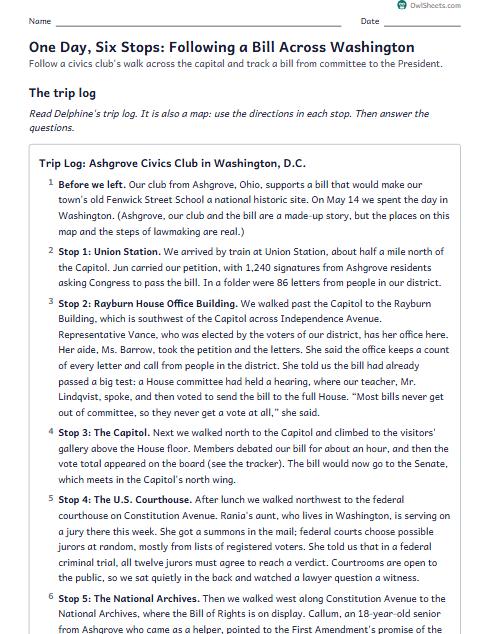
Preview
OwlSheets.com
One Day, Six Stops: Following a Bill Across Washington
Follow a civics club's walk across the capital and track a bill from committee to the President.
The trip log
Read Delphine's trip log. It is also a map: use the directions in each stop. Then answer the questions.
Trip Log: Ashgrove Civics Club in Washington, D.C.
1Before we left. Our club from Ashgrove, Ohio, supports a bill that would make our town's old Fenwick Street School a national historic site. On May 14 we spent the day in Washington. (Ashgrove, our club and the bill are a made-up story, but the places on this map and the steps of lawmaking are real.)
2Stop 1: Union Station. We arrived by train at Union Station, about half a mile north of the Capitol. Jun carried our petition, with 1,240 signatures from Ashgrove residents asking Congress to pass the bill. In a folder were 86 letters from people in our district.
3Stop 2: Rayburn House Office Building. We walked past the Capitol to the Rayburn Building, which is southwest of the Capitol across Independence Avenue. Representative Vance, who was elected by the voters of our district, has her office here. Her aide, Ms. Barrow, took the petition and the letters. She said the office keeps a count of every letter and call from people in the district. She told us the bill had already passed a big test: a House committee had held a hearing, where our teacher, Mr. Lindqvist, spoke, and then voted to send the bill to the full House. “Most bills never get out of committee, so they never get a vote at all,” she said.
4Stop 3: The Capitol. Next we walked north to the Capitol and climbed to the visitors' gallery above the House floor. Members debated our bill for about an hour, and then the vote total appeared on the board (see the tracker). The bill would now go to the Senate, which meets in the Capitol's north wing.
5Stop 4: The U.S. Courthouse. After lunch we walked northwest to the federal courthouse on Constitution Avenue. Rania's aunt, who lives in Washington, is serving on a jury there this week. She got a summons in the mail; federal courts choose possible jurors at random, mostly from lists of registered voters. She told us that in a federal criminal trial, all twelve jurors must agree to reach a verdict. Courtrooms are open to the public, so we sat quietly in the back and watched a lawyer question a witness.
6Stop 5: The National Archives. Then we walked west along Constitution Avenue to the National Archives, where the Bill of Rights is on display. Callum, an 18-year-old senior from Ashgrove who came as a helper, pointed to the First Amendment's promise of the right of the people “to petition the Government for a redress of grievances.” A panel nearby explained the Twenty-sixth Amendment of 1971: citizens who are 18 or older cannot be denied the vote because of their age. Callum registered to vote in Ashgrove last month.
7Stop 6: The White House. Our last stop was outside the White House, farther west. Mr. Lindqvist explained the final step. While Congress is meeting, the President has ten days, not counting Sundays, to sign or veto a bill. If he does neither, it becomes law without his signature. If he vetoes it, it can still become law if two-thirds of the members voting in each house vote to override the veto.
- A. Southwest
- B. Southeast
- C. Northwest
- D. Northeast
- A. East
- B. North
- C. South
- D. West
The preview shows the first questions. Unlock the worksheet to see all of it.
Related worksheets
Free Land at Last? The Homestead Bill in the News, 1862
Grade 8 · CIV.8.3
14 questionsPremium
Petition, Ballot or Letter? A Town Meeting on the Homestead Bill, 1860
Grade 8 · CIV.8.3
14 questionsPremium
Rates and Rights: An Exhibit on the Interstate Commerce Act
Grade 8 · CIV.8.3
14 questionsPremium
From a Gunshot to a Law: Field Notes on the Pendleton Act
Grade 8 · CIV.8.3
12 questionsPremium
Over the President's Veto: The Civil Rights Act of 1866
Grade 8 · CIV.8.3
11 questionsPremium
Silenced Petitions: The Gag Rule and Angelina Grimké, 1836–1844
Grade 8 · CIV.8.3
11 questionsPremium