Grade 7 · Social StudiesCIV.7.2Premium
Warsaw, 3 May 1791: A Constitution on the Timeline
Grade 7 civics: follow a timeline from Hobbes and Locke to Poland's 1791 constitution and the partitions to see Enlightenment ideas challenge absolute rule.
Preview
OwlSheets.com
Warsaw, 3 May 1791: A Constitution on the Timeline
Trace Poland's Constitution of 3 May on a dated timeline to see Enlightenment ideas challenge absolute rule.
Ideas and an old system
Read the timeline and the passage. Then answer the questions.
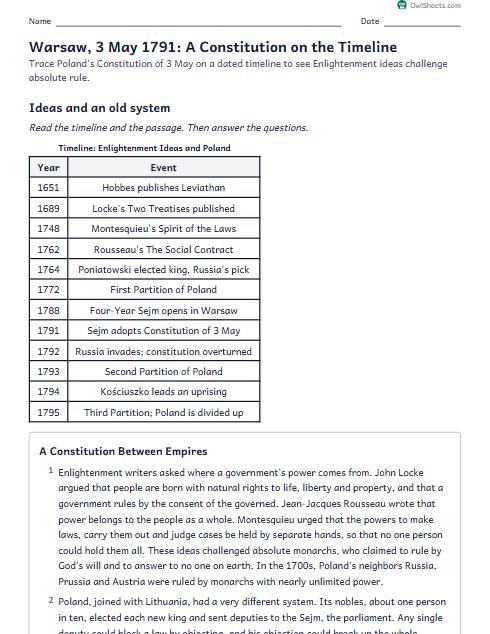
| Year | Event |
|---|---|
| 1651 | Hobbes publishes Leviathan |
| 1689 | Locke's Two Treatises published |
| 1748 | Montesquieu's Spirit of the Laws |
| 1762 | Rousseau's The Social Contract |
| 1764 | Poniatowski elected king, Russia's pick |
| 1772 | First Partition of Poland |
| 1788 | Four-Year Sejm opens in Warsaw |
| 1791 | Sejm adopts Constitution of 3 May |
| 1792 | Russia invades; constitution overturned |
| 1793 | Second Partition of Poland |
| 1794 | Kościuszko leads an uprising |
| 1795 | Third Partition; Poland is divided up |
A Constitution Between Empires
1Enlightenment writers asked where a government's power comes from. John Locke argued that people are born with natural rights to life, liberty and property, and that a government rules by the consent of the governed. Jean-Jacques Rousseau wrote that power belongs to the people as a whole. Montesquieu urged that the powers to make laws, carry them out and judge cases be held by separate hands, so that no one person could hold them all. These ideas challenged absolute monarchs, who claimed to rule by God's will and to answer to no one on earth. In the 1700s, Poland's neighbors Russia, Prussia and Austria were ruled by monarchs with nearly unlimited power.
2Poland, joined with Lithuania, had a very different system. Its nobles, about one person in ten, elected each new king and sent deputies to the Sejm, the parliament. Any single deputy could block a law by objecting, and his objection could break up the whole session. Townspeople had little say, and most peasants were serfs, bound to work their lords' land. Because the government could rarely act, its neighbors found it easy to meddle. In 1772, Russia, Prussia and Austria seized nearly a third of Poland's land.
3In 1788, a Sejm opened in Warsaw that met for four years, while Russia was busy fighting wars elsewhere. On 3 May 1791, while many deputies who opposed reform were away for Easter, its supporters passed a new constitution, often called the first modern written national constitution in Europe. Article V declared that "all power in civil society should be derived from the will of the people." It divided the government into three parts: the Sejm would make laws, the king and a council called the Guardians of the Laws would carry them out, and courts would judge cases. The Sejm would decide by majority vote, and the throne would pass within one family instead of by election. Townspeople gained the right to buy land and to hold some public offices. Peasants were placed under the protection of the law, but most stayed serfs, bound to work their lords' land.
4Catherine II of Russia saw the constitution as a danger. In 1792, Polish nobles who opposed it asked for her help, and her army invaded. The constitution was overturned, and Russia and Prussia took more land in 1793. In 1794, Tadeusz Kościuszko, who had fought in the American Revolution, led an uprising and promised serfs more freedom and lighter work for their lords. It was crushed, and by 1795 Poland's neighbors had divided all of its land. Poles still celebrate 3 May as a national holiday today.
- A. Rousseau's idea that power belongs to the people as a whole
- B. Montesquieu's idea that the powers of government should be split up
- C. The claim that monarchs answer to God and to no one on earth
- D. Locke's idea that each person is born with a right to property
The preview shows the first questions. Unlock the worksheet to see all of it.
Related worksheets
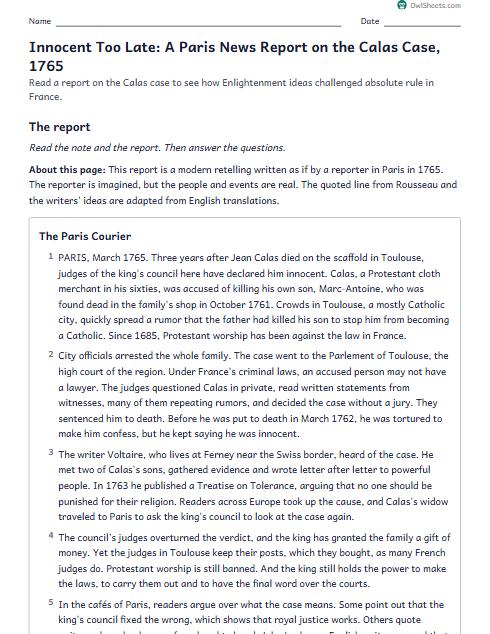
Innocent Too Late: A Paris News Report on the Calas Case, 1765
Grade 7 · CIV.7.2
13 questionsPremium
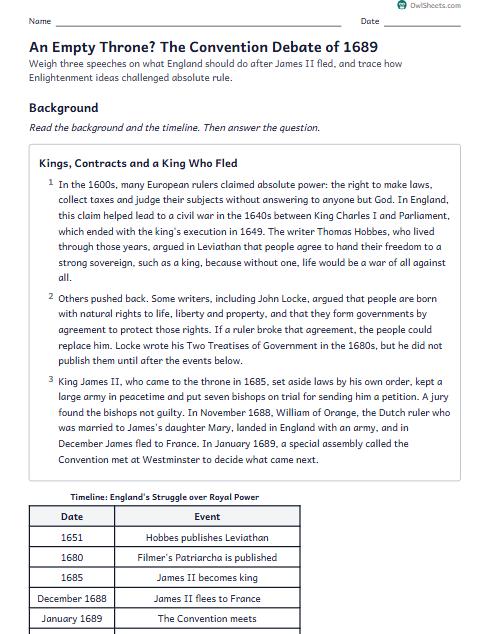
An Empty Throne? The Convention Debate of 1689
Grade 7 · CIV.7.2
14 questionsPremium
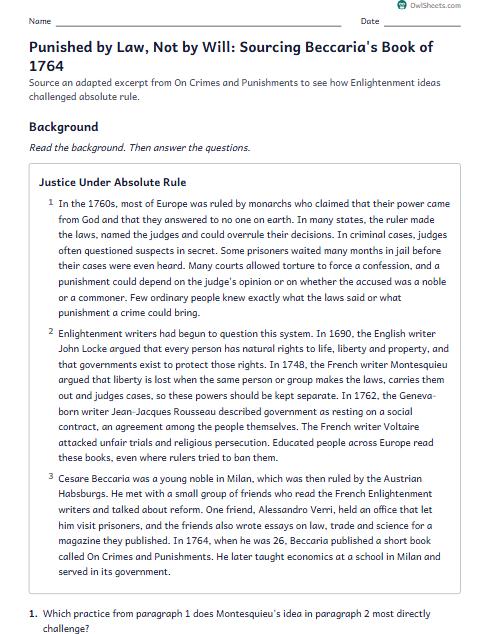
Punished by Law, Not by Will: Sourcing Beccaria's Book of 1764
Grade 7 · CIV.7.2
15 questionsPremium
One Ruler or the People? Catherine's Instruction and Diderot's Reply
Grade 7 · CIV.7.2
13 questionsPremium
One Vote per Estate or One per Deputy? Versailles, 1789
Grade 7 · CIV.7.2
11 questionsPremium
Rights on the Press: Sourcing the Declaration of 1789
Grade 7 · CIV.7.2
10 questionsFree