Grade 7 · Social StudiesCIV.7.2Premium
One Ruler or the People? Catherine's Instruction and Diderot's Reply
Grade 7 civics: compare Catherine the Great's 1767 Instruction with Diderot's private reply to see how Enlightenment ideas met absolute rule.
Preview
OwlSheets.com
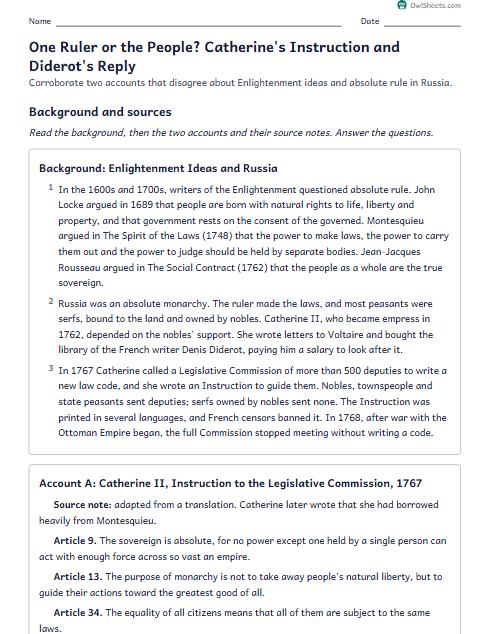
One Ruler or the People? Catherine's Instruction and Diderot's Reply
Corroborate two accounts that disagree about Enlightenment ideas and absolute rule in Russia.
Background and sources
Read the background, then the two accounts and their source notes. Answer the questions.
Background: Enlightenment Ideas and Russia
1In the 1600s and 1700s, writers of the Enlightenment questioned absolute rule. John Locke argued in 1689 that people are born with natural rights to life, liberty and property, and that government rests on the consent of the governed. Montesquieu argued in The Spirit of the Laws (1748) that the power to make laws, the power to carry them out and the power to judge should be held by separate bodies. Jean-Jacques Rousseau argued in The Social Contract (1762) that the people as a whole are the true sovereign.
2Russia was an absolute monarchy. The ruler made the laws, and most peasants were serfs, bound to the land and owned by nobles. Catherine II, who became empress in 1762, depended on the nobles' support. She wrote letters to Voltaire and bought the library of the French writer Denis Diderot, paying him a salary to look after it.
3In 1767 Catherine called a Legislative Commission of more than 500 deputies to write a new law code, and she wrote an Instruction to guide them. Nobles, townspeople and state peasants sent deputies; serfs owned by nobles sent none. The Instruction was printed in several languages, and French censors banned it. In 1768, after war with the Ottoman Empire began, the full Commission stopped meeting without writing a code.
Account A: Catherine II, Instruction to the Legislative Commission, 1767
Source note: adapted from a translation. Catherine later wrote that she had borrowed heavily from Montesquieu.
Article 9. The sovereign is absolute, for no power except one held by a single person can act with enough force across so vast an empire.
Article 13. The purpose of monarchy is not to take away people's natural liberty, but to guide their actions toward the greatest good of all.
Article 34. The equality of all citizens means that all of them are subject to the same laws.
Article 194. No person should be treated as guilty before a judge has given a sentence.
Account B: Denis Diderot, Observations on the Instruction, 1774
Source note: adapted and shortened from a translation. Diderot wrote these notes after a five-month stay at Catherine's court. He kept them private; they were found among his papers after he died, and Catherine is reported to have dismissed them when she read them.
There is no true sovereign except the nation; there can be no true lawmaker except the people. If all citizens must obey the same laws, as the Instruction says, then the ruler must obey them too. The first line of a good code should bind the ruler, who must swear with the people to keep the laws. The Empress of Russia is certainly a despot; her Instruction speaks of liberty but leaves every power in her hands.
The preview shows the first questions. Unlock the worksheet to see all of it.
Related worksheets
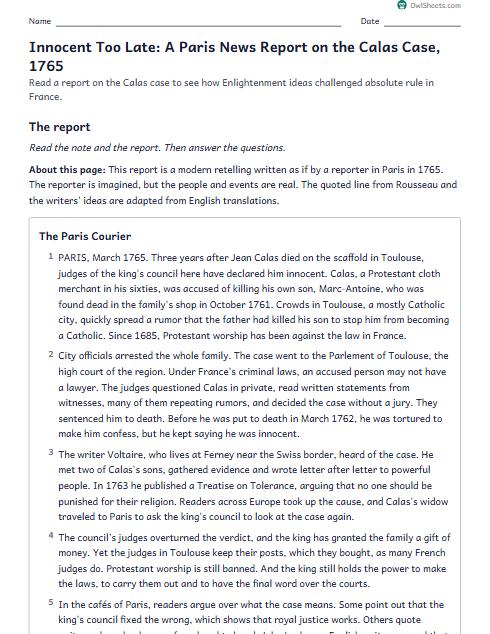
Innocent Too Late: A Paris News Report on the Calas Case, 1765
Grade 7 · CIV.7.2
13 questionsPremium
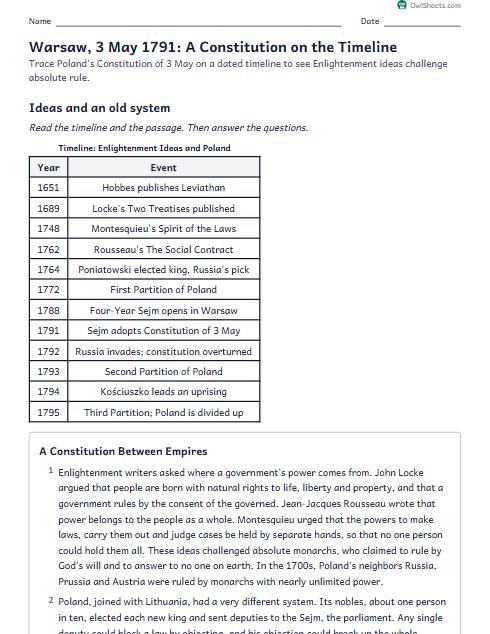
Warsaw, 3 May 1791: A Constitution on the Timeline
Grade 7 · CIV.7.2
15 questionsPremium
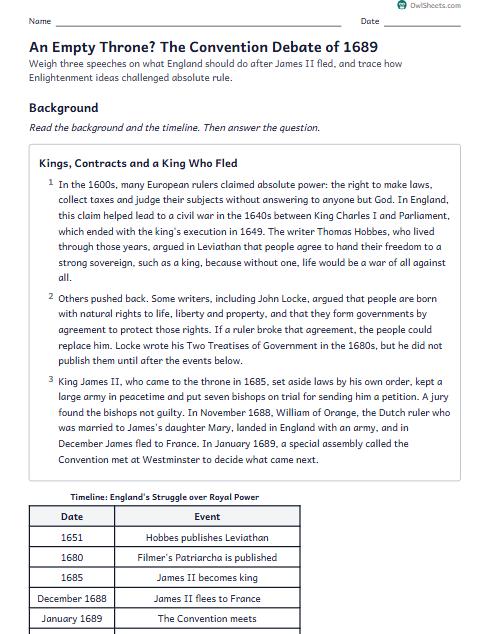
An Empty Throne? The Convention Debate of 1689
Grade 7 · CIV.7.2
14 questionsPremium
Punished by Law, Not by Will: Sourcing Beccaria's Book of 1764
Grade 7 · CIV.7.2
15 questionsPremium
One Vote per Estate or One per Deputy? Versailles, 1789
Grade 7 · CIV.7.2
11 questionsPremium
Rights on the Press: Sourcing the Declaration of 1789
Grade 7 · CIV.7.2
10 questionsFree