Grade 7 · Social StudiesCIV.7.2Premium
Punished by Law, Not by Will: Sourcing Beccaria's Book of 1764
Grade 7 civics: source Beccaria's On Crimes and Punishments to see how natural rights, the social contract and separate powers challenged absolute rule.
Preview
OwlSheets.com
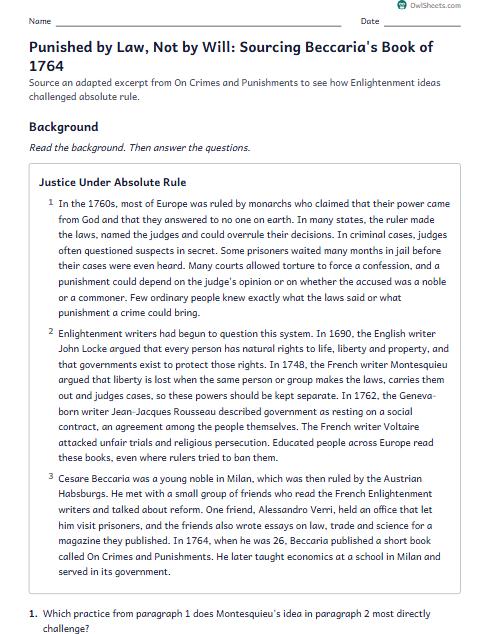
Punished by Law, Not by Will: Sourcing Beccaria's Book of 1764
Source an adapted excerpt from On Crimes and Punishments to see how Enlightenment ideas challenged absolute rule.
Background
Read the background. Then answer the questions.
Justice Under Absolute Rule
1In the 1760s, most of Europe was ruled by monarchs who claimed that their power came from God and that they answered to no one on earth. In many states, the ruler made the laws, named the judges and could overrule their decisions. In criminal cases, judges often questioned suspects in secret. Some prisoners waited many months in jail before their cases were even heard. Many courts allowed torture to force a confession, and a punishment could depend on the judge's opinion or on whether the accused was a noble or a commoner. Few ordinary people knew exactly what the laws said or what punishment a crime could bring.
2Enlightenment writers had begun to question this system. In 1690, the English writer John Locke argued that every person has natural rights to life, liberty and property, and that governments exist to protect those rights. In 1748, the French writer Montesquieu argued that liberty is lost when the same person or group makes the laws, carries them out and judges cases, so these powers should be kept separate. In 1762, the Geneva-born writer Jean-Jacques Rousseau described government as resting on a social contract, an agreement among the people themselves. The French writer Voltaire attacked unfair trials and religious persecution. Educated people across Europe read these books, even where rulers tried to ban them.
3Cesare Beccaria was a young noble in Milan, which was then ruled by the Austrian Habsburgs. He met with a small group of friends who read the French Enlightenment writers and talked about reform. One friend, Alessandro Verri, held an office that let him visit prisoners, and the friends also wrote essays on law, trade and science for a magazine they published. In 1764, when he was 26, Beccaria published a short book called On Crimes and Punishments. He later taught economics at a school in Milan and served in its government.
- A. Courts that allowed torture to force a suspect to confess
- B. A ruler who made the laws, named the judges and overruled them
- C. Judges who questioned suspects in secret in criminal cases
- D. Punishments that differed for nobles and for commoners
- A. It said a monarch's power came from God through the Church.
- B. It said nobles, not monarchs, should name all of the judges.
- C. It said government rests on the people's agreement, not God's grant.
- D. It said each person's property belongs first to the monarch.
The preview shows the first questions. Unlock the worksheet to see all of it.
Related worksheets
Innocent Too Late: A Paris News Report on the Calas Case, 1765
Grade 7 · CIV.7.2
13 questionsPremium
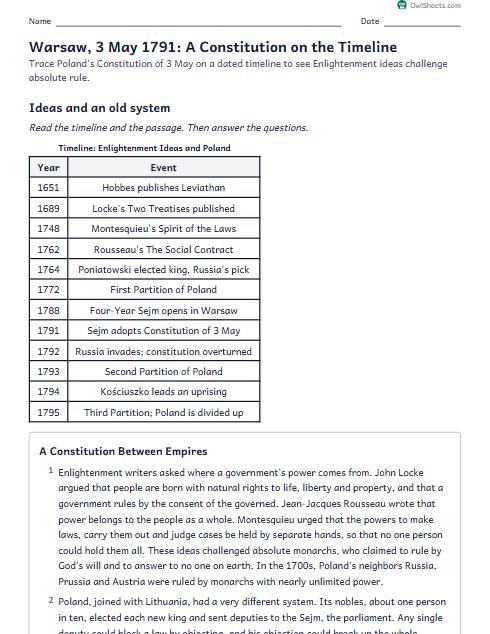
Warsaw, 3 May 1791: A Constitution on the Timeline
Grade 7 · CIV.7.2
15 questionsPremium
An Empty Throne? The Convention Debate of 1689
Grade 7 · CIV.7.2
14 questionsPremium
One Ruler or the People? Catherine's Instruction and Diderot's Reply
Grade 7 · CIV.7.2
13 questionsPremium
One Vote per Estate or One per Deputy? Versailles, 1789
Grade 7 · CIV.7.2
11 questionsPremium
Rights on the Press: Sourcing the Declaration of 1789
Grade 7 · CIV.7.2
10 questionsFree