Grade 7 · Social StudiesCIV.7.2Premium
An Empty Throne? The Convention Debate of 1689
Grade 7 civics: judge a debate at England's Convention of 1689 to study natural rights, the social contract, separation of powers and the Bill of Rights.
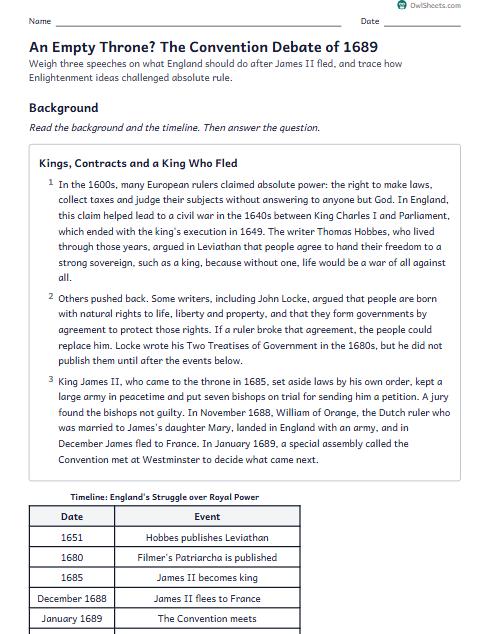
Preview
OwlSheets.com
An Empty Throne? The Convention Debate of 1689
Weigh three speeches on what England should do after James II fled, and trace how Enlightenment ideas challenged absolute rule.
Background
Read the background and the timeline. Then answer the question.
Kings, Contracts and a King Who Fled
1In the 1600s, many European rulers claimed absolute power: the right to make laws, collect taxes and judge their subjects without answering to anyone but God. In England, this claim helped lead to a civil war in the 1640s between King Charles I and Parliament, which ended with the king's execution in 1649. The writer Thomas Hobbes, who lived through those years, argued in Leviathan that people agree to hand their freedom to a strong sovereign, such as a king, because without one, life would be a war of all against all.
2Others pushed back. Some writers, including John Locke, argued that people are born with natural rights to life, liberty and property, and that they form governments by agreement to protect those rights. If a ruler broke that agreement, the people could replace him. Locke wrote his Two Treatises of Government in the 1680s, but he did not publish them until after the events below.
3King James II, who came to the throne in 1685, set aside laws by his own order, kept a large army in peacetime and put seven bishops on trial for sending him a petition. A jury found the bishops not guilty. In November 1688, William of Orange, the Dutch ruler who was married to James's daughter Mary, landed in England with an army, and in December James fled to France. In January 1689, a special assembly called the Convention met at Westminster to decide what came next.
| Date | Event |
|---|---|
| 1651 | Hobbes publishes Leviathan |
| 1680 | Filmer's Patriarcha is published |
| 1685 | James II becomes king |
| December 1688 | James II flees to France |
| January 1689 | The Convention meets |
| December 1689 | The Bill of Rights becomes law |
| 1690 | Date printed on Locke's Two Treatises |
| 1701 | A law protects judges' posts |
| 1748 | Montesquieu, The Spirit of the Laws |
- A. Hobbes wrote that Parliament should share power equally with the king.
- B. Hobbes promised that people would keep their freedom after choosing a ruler.
- C. After years of civil war, a strong ruler could seem the best way to peace.
- D. Hobbes taught that people could replace a ruler who displeased them.
The preview shows the first questions. Unlock the worksheet to see all of it.
Related worksheets
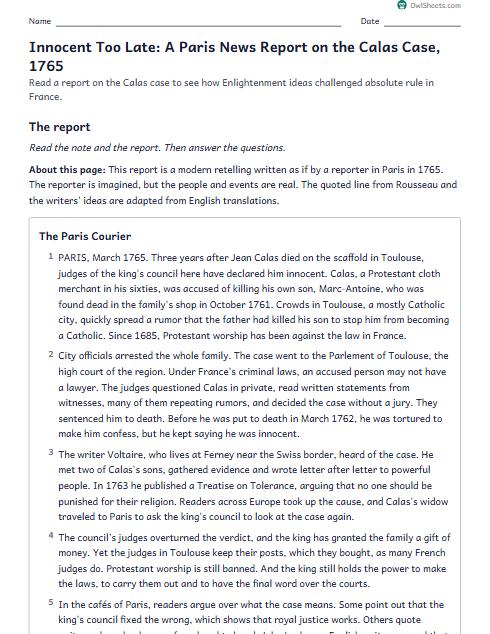
Innocent Too Late: A Paris News Report on the Calas Case, 1765
Grade 7 · CIV.7.2
13 questionsPremium
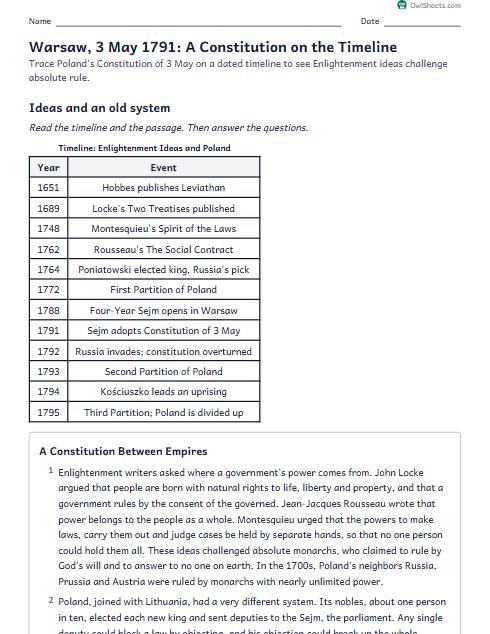
Warsaw, 3 May 1791: A Constitution on the Timeline
Grade 7 · CIV.7.2
15 questionsPremium
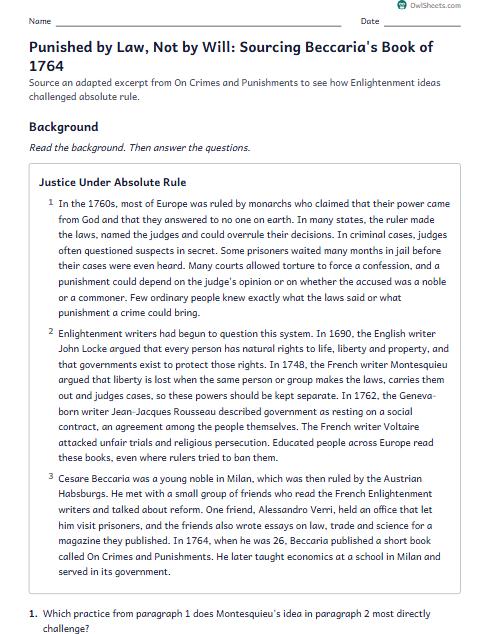
Punished by Law, Not by Will: Sourcing Beccaria's Book of 1764
Grade 7 · CIV.7.2
15 questionsPremium
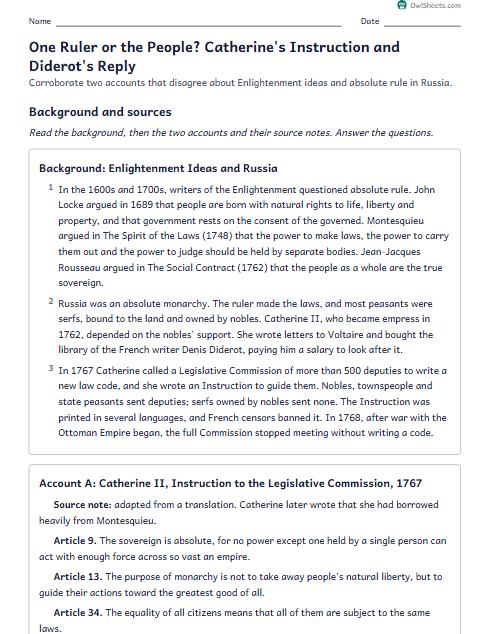
One Ruler or the People? Catherine's Instruction and Diderot's Reply
Grade 7 · CIV.7.2
13 questionsPremium
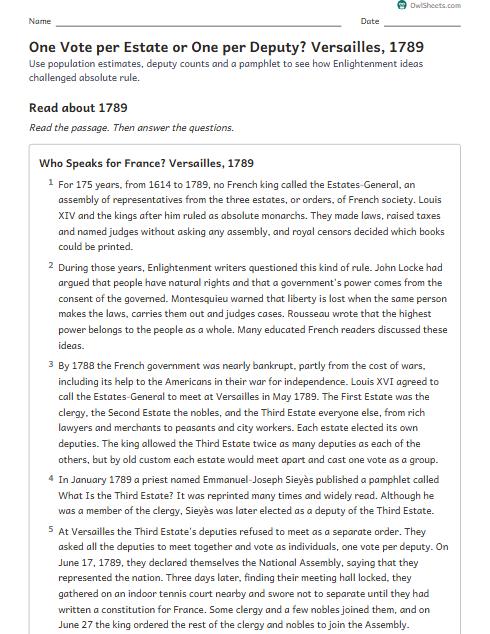
One Vote per Estate or One per Deputy? Versailles, 1789
Grade 7 · CIV.7.2
11 questionsPremium
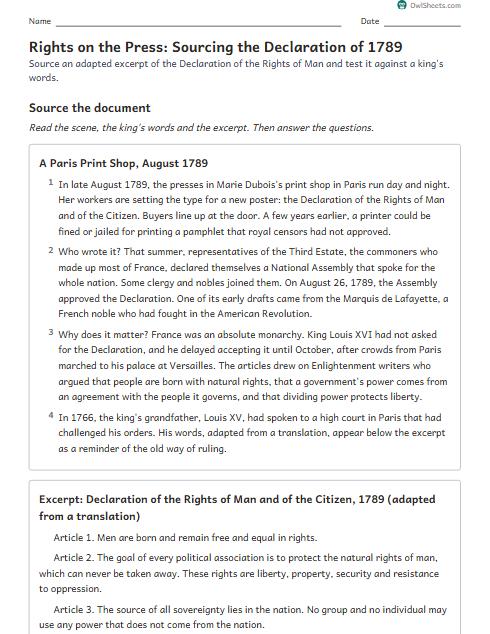
Rights on the Press: Sourcing the Declaration of 1789
Grade 7 · CIV.7.2
10 questionsFree