Grade 7 · Social StudiesCIV.7.2Premium
Innocent Too Late: A Paris News Report on the Calas Case, 1765
Grade 7 civics: a news report on the Calas case of 1762–1765 shows how Locke, Montesquieu, Rousseau and Voltaire challenged France's absolute rule.
Preview
OwlSheets.com
Innocent Too Late: A Paris News Report on the Calas Case, 1765
Read a report on the Calas case to see how Enlightenment ideas challenged absolute rule in France.
The report
Read the note and the report. Then answer the questions.
The Paris Courier
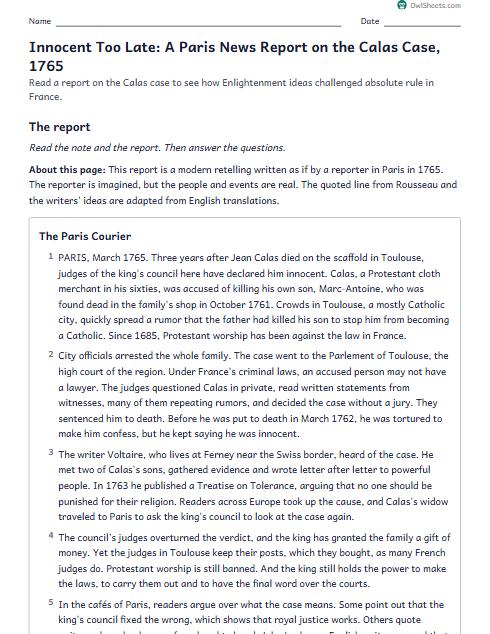
1PARIS, March 1765. Three years after Jean Calas died on the scaffold in Toulouse, judges of the king's council here have declared him innocent. Calas, a Protestant cloth merchant in his sixties, was accused of killing his own son, Marc-Antoine, who was found dead in the family's shop in October 1761. Crowds in Toulouse, a mostly Catholic city, quickly spread a rumor that the father had killed his son to stop him from becoming a Catholic. Since 1685, Protestant worship has been against the law in France.
2City officials arrested the whole family. The case went to the Parlement of Toulouse, the high court of the region. Under France's criminal laws, an accused person may not have a lawyer. The judges questioned Calas in private, read written statements from witnesses, many of them repeating rumors, and decided the case without a jury. They sentenced him to death. Before he was put to death in March 1762, he was tortured to make him confess, but he kept saying he was innocent.
3The writer Voltaire, who lives at Ferney near the Swiss border, heard of the case. He met two of Calas's sons, gathered evidence and wrote letter after letter to powerful people. In 1763 he published a Treatise on Tolerance, arguing that no one should be punished for their religion. Readers across Europe took up the cause, and Calas's widow traveled to Paris to ask the king's council to look at the case again.
4The council's judges overturned the verdict, and the king has granted the family a gift of money. Yet the judges in Toulouse keep their posts, which they bought, as many French judges do. Protestant worship is still banned. And the king still holds the power to make the laws, to carry them out and to have the final word over the courts.
5In the cafés of Paris, readers argue over what the case means. Some point out that the king's council fixed the wrong, which shows that royal justice works. Others quote writers whose books pass from hand to hand. John Locke, an English writer, argued that people have natural rights to life, liberty and property, that they agree to form governments to protect those rights, and that a government that breaks this trust may be changed. Montesquieu, who once sat as a judge in the Parlement of Bordeaux, warned that there is no liberty if the power of judging is not separated from the power to make laws and the power to carry them out. Jean-Jacques Rousseau begins his new book, The Social Contract, with the line "Man is born free, and everywhere he is in chains." He argues that laws are rightful only when they come from the will of the people as a whole.
- A. Royal judges in Paris had already found Calas guilty.
- B. Calas had admitted to the crime in front of his neighbors.
- C. Many Catholics distrusted Protestants, whose worship was banned.
- D. Marc-Antoine had left a letter that blamed his father.
The preview shows the first questions. Unlock the worksheet to see all of it.
Related worksheets
Warsaw, 3 May 1791: A Constitution on the Timeline
Grade 7 · CIV.7.2
15 questionsPremium
An Empty Throne? The Convention Debate of 1689
Grade 7 · CIV.7.2
14 questionsPremium
Punished by Law, Not by Will: Sourcing Beccaria's Book of 1764
Grade 7 · CIV.7.2
15 questionsPremium
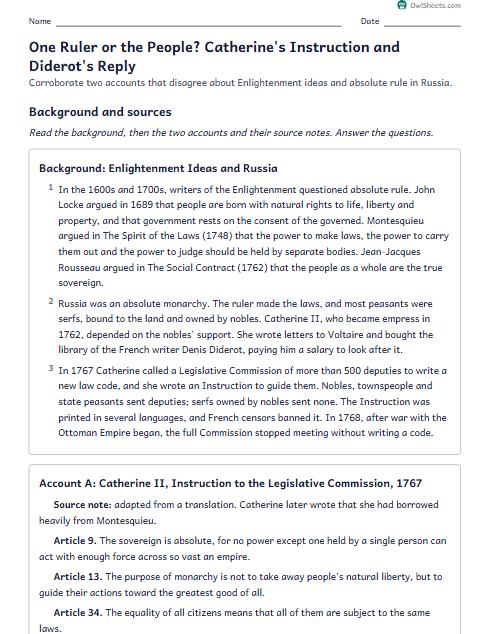
One Ruler or the People? Catherine's Instruction and Diderot's Reply
Grade 7 · CIV.7.2
13 questionsPremium
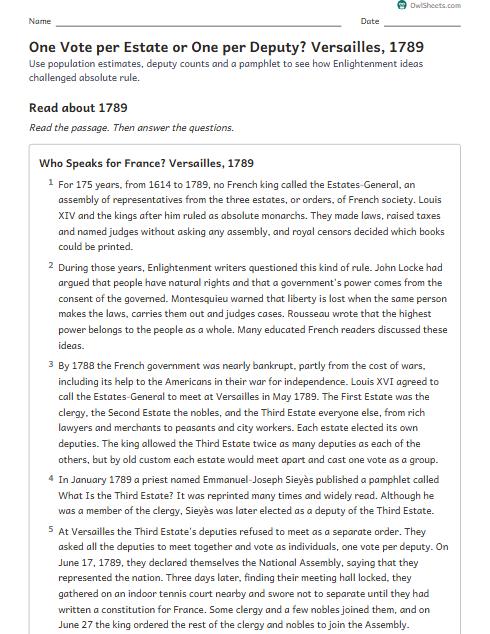
One Vote per Estate or One per Deputy? Versailles, 1789
Grade 7 · CIV.7.2
11 questionsPremium
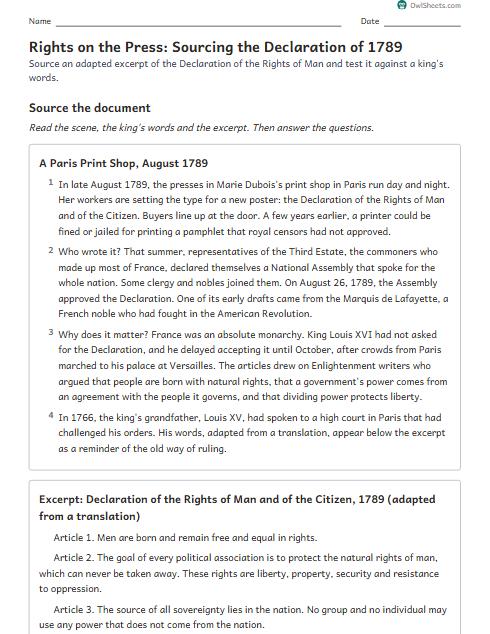
Rights on the Press: Sourcing the Declaration of 1789
Grade 7 · CIV.7.2
10 questionsFree