Grade 6 · Social StudiesHIS.6.6Premium
One Trial, Two Stories: Plato and Xenophon on Socrates, 399 BCE
Grade 6 ancient Greece: compare Plato's and Xenophon's accounts of Socrates' trial to study Athens' juries, Sparta's elders, philosophy, science and comedy.
Preview
OwlSheets.com
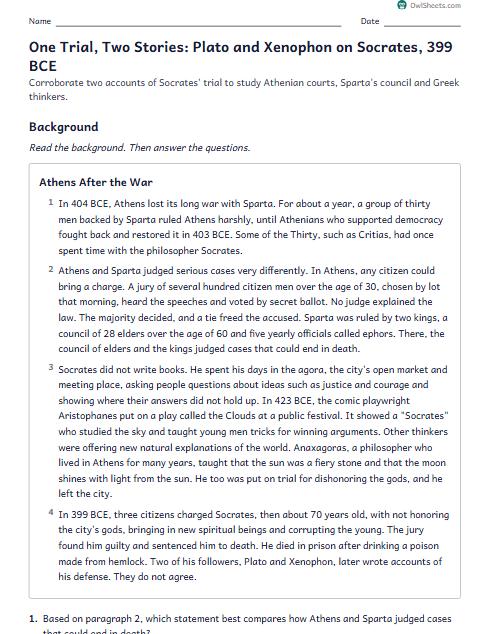
One Trial, Two Stories: Plato and Xenophon on Socrates, 399 BCE
Corroborate two accounts of Socrates' trial to study Athenian courts, Sparta's council and Greek thinkers.
Background
Read the background. Then answer the questions.
Athens After the War
1In 404 BCE, Athens lost its long war with Sparta. For about a year, a group of thirty men backed by Sparta ruled Athens harshly, until Athenians who supported democracy fought back and restored it in 403 BCE. Some of the Thirty, such as Critias, had once spent time with the philosopher Socrates.
2Athens and Sparta judged serious cases very differently. In Athens, any citizen could bring a charge. A jury of several hundred citizen men over the age of 30, chosen by lot that morning, heard the speeches and voted by secret ballot. No judge explained the law. The majority decided, and a tie freed the accused. Sparta was ruled by two kings, a council of 28 elders over the age of 60 and five yearly officials called ephors. There, the council of elders and the kings judged cases that could end in death.
3Socrates did not write books. He spent his days in the agora, the city's open market and meeting place, asking people questions about ideas such as justice and courage and showing where their answers did not hold up. In 423 BCE, the comic playwright Aristophanes put on a play called the Clouds at a public festival. It showed a "Socrates" who studied the sky and taught young men tricks for winning arguments. Other thinkers were offering new natural explanations of the world. Anaxagoras, a philosopher who lived in Athens for many years, taught that the sun was a fiery stone and that the moon shines with light from the sun. He too was put on trial for dishonoring the gods, and he left the city.
4In 399 BCE, three citizens charged Socrates, then about 70 years old, with not honoring the city's gods, bringing in new spiritual beings and corrupting the young. The jury found him guilty and sentenced him to death. He died in prison after drinking a poison made from hemlock. Two of his followers, Plato and Xenophon, later wrote accounts of his defense. They do not agree.
- A. Both cities gave the decision to one judge who was trained in the law.
- B. Athens used hundreds of citizen jurors, and Sparta its elders and kings.
- C. Athens used its two kings, and Sparta used juries chosen by lot.
- D. Both cities used juries of several hundred citizens chosen by lot.
- A. Some of the harsh Thirty had once spent time with him.
- B. He had refused to serve on the city's juries for many years.
- C. He had led part of Sparta's army in the war against Athens.
- D. He had written books that attacked the city's democracy.
The preview shows the first questions. Unlock the worksheet to see all of it.
Related worksheets
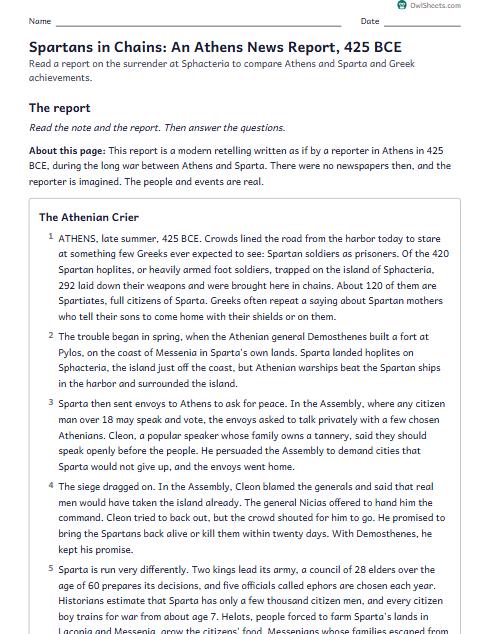
Spartans in Chains: An Athens News Report, 425 BCE
Grade 6 · HIS.6.6
13 questionsPremium
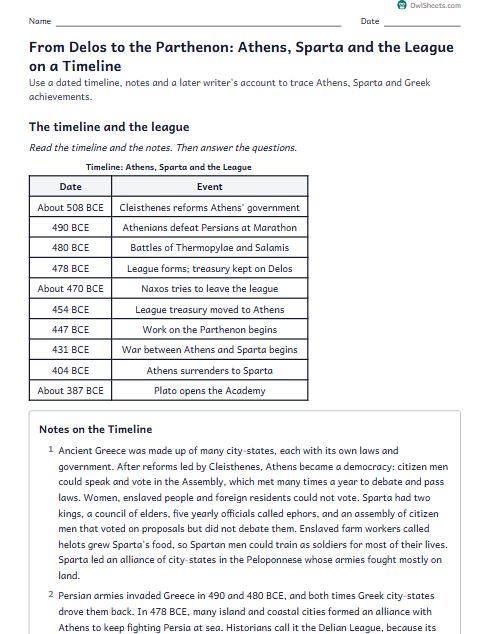
From Delos to the Parthenon: Athens, Sparta and the League on a Timeline
Grade 6 · HIS.6.6
15 questionsPremium
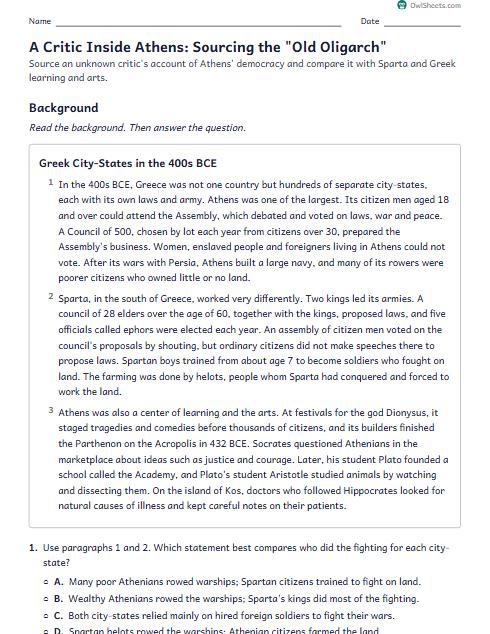
A Critic Inside Athens: Sourcing the "Old Oligarch"
Grade 6 · HIS.6.6
14 questionsPremium
Lots, Plays and Soldiers: Greek City-States in the Data
Grade 6 · HIS.6.6
14 questionsPremium
Water Clocks, Ballots and a Tunnel: An Archaeologist's Greek Notes
Grade 6 · HIS.6.6
12 questionsPremium
A Carver's Road Through Greece, 432 BCE
Grade 6 · HIS.6.6
12 questionsPremium