Grade 6 · Social StudiesHIS.6.6Premium
Lots, Plays and Soldiers: Greek City-States in the Data
Grade 6 ancient Greece: read data on Athenian offices, Spartan citizen numbers and surviving Greek plays to compare city-states and Greek achievements.
Preview
OwlSheets.com
Lots, Plays and Soldiers: Greek City-States in the Data
Use two tables, a bar graph and data notes to compare Athens and Sparta and study Greek achievements.
Athens: who served and how
Read the four data notes and look at Table 2. Then answer the questions.
Data Notes: Greek City-States
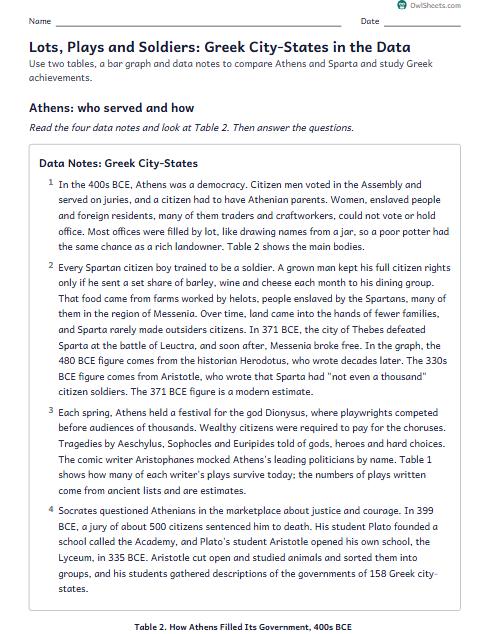
1In the 400s BCE, Athens was a democracy. Citizen men voted in the Assembly and served on juries, and a citizen had to have Athenian parents. Women, enslaved people and foreign residents, many of them traders and craftworkers, could not vote or hold office. Most offices were filled by lot, like drawing names from a jar, so a poor potter had the same chance as a rich landowner. Table 2 shows the main bodies.
2Every Spartan citizen boy trained to be a soldier. A grown man kept his full citizen rights only if he sent a set share of barley, wine and cheese each month to his dining group. That food came from farms worked by helots, people enslaved by the Spartans, many of them in the region of Messenia. Over time, land came into the hands of fewer families, and Sparta rarely made outsiders citizens. In 371 BCE, the city of Thebes defeated Sparta at the battle of Leuctra, and soon after, Messenia broke free. In the graph, the 480 BCE figure comes from the historian Herodotus, who wrote decades later. The 330s BCE figure comes from Aristotle, who wrote that Sparta had "not even a thousand" citizen soldiers. The 371 BCE figure is a modern estimate.
3Each spring, Athens held a festival for the god Dionysus, where playwrights competed before audiences of thousands. Wealthy citizens were required to pay for the choruses. Tragedies by Aeschylus, Sophocles and Euripides told of gods, heroes and hard choices. The comic writer Aristophanes mocked Athens's leading politicians by name. Table 1 shows how many of each writer's plays survive today; the numbers of plays written come from ancient lists and are estimates.
4Socrates questioned Athenians in the marketplace about justice and courage. In 399 BCE, a jury of about 500 citizens sentenced him to death. His student Plato founded a school called the Academy, and Plato's student Aristotle opened his own school, the Lyceum, in 335 BCE. Aristotle cut open and studied animals and sorted them into groups, and his students gathered descriptions of the governments of 158 Greek city-states.
| Body or office | Who could serve | How chosen | Size |
|---|---|---|---|
| Assembly | Citizen men 18 or older | Open to all of them | Thousands at a meeting |
| Council of 500 | Citizen men 30 or older | By lot, for one year | 500, equal from 10 tribes |
| Jury pool | Citizen men 30 or older | By lot, each year | 6,000 |
| Generals | Citizen men | Elected each year | 10 |
- A. Generals served for life, so care was needed.
- B. Drawing lots took too long for so few jobs.
- C. Voters wanted skilled, proven leaders for war.
- D. Only rich men were allowed to command the army.
The preview shows the first questions. Unlock the worksheet to see all of it.
Related worksheets
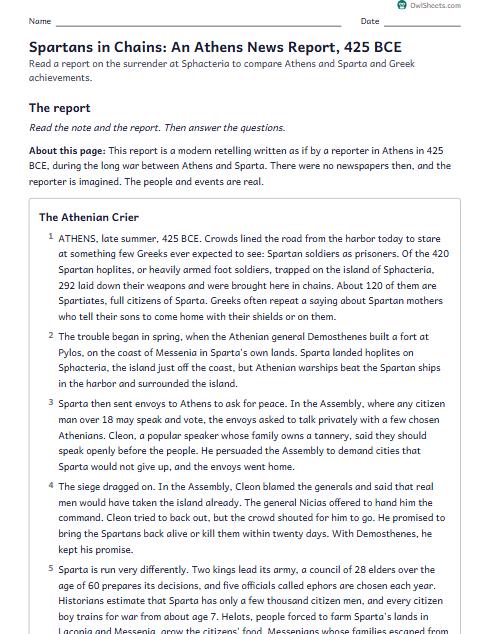
Spartans in Chains: An Athens News Report, 425 BCE
Grade 6 · HIS.6.6
13 questionsPremium
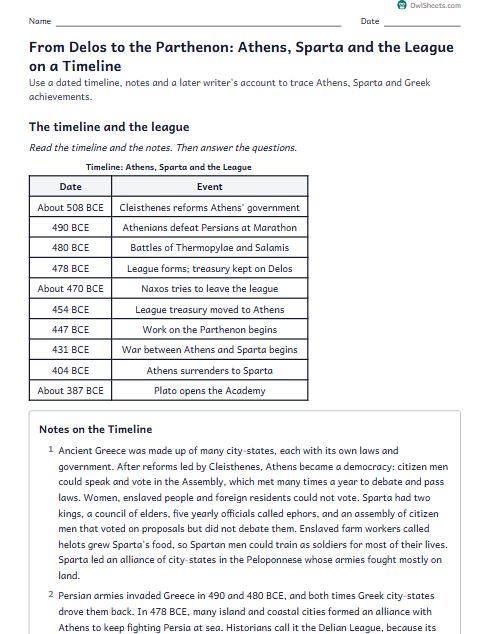
From Delos to the Parthenon: Athens, Sparta and the League on a Timeline
Grade 6 · HIS.6.6
15 questionsPremium
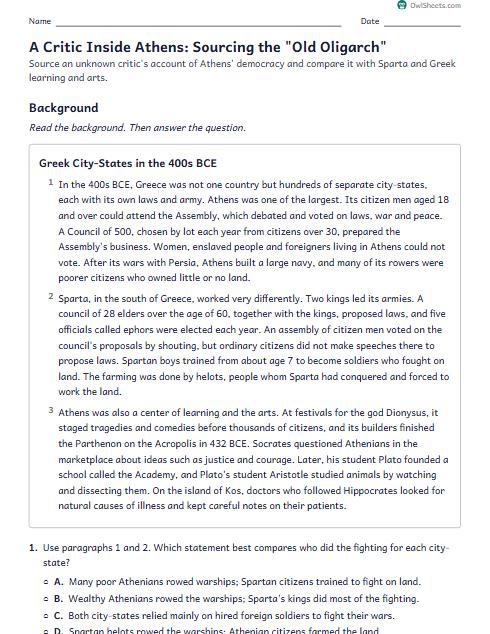
A Critic Inside Athens: Sourcing the "Old Oligarch"
Grade 6 · HIS.6.6
14 questionsPremium
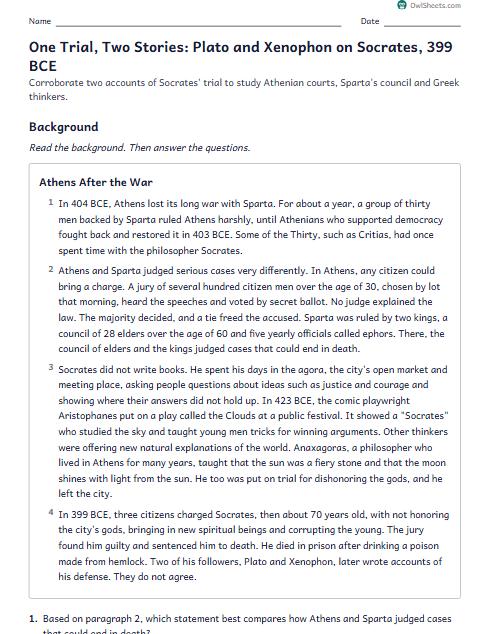
One Trial, Two Stories: Plato and Xenophon on Socrates, 399 BCE
Grade 6 · HIS.6.6
16 questionsPremium
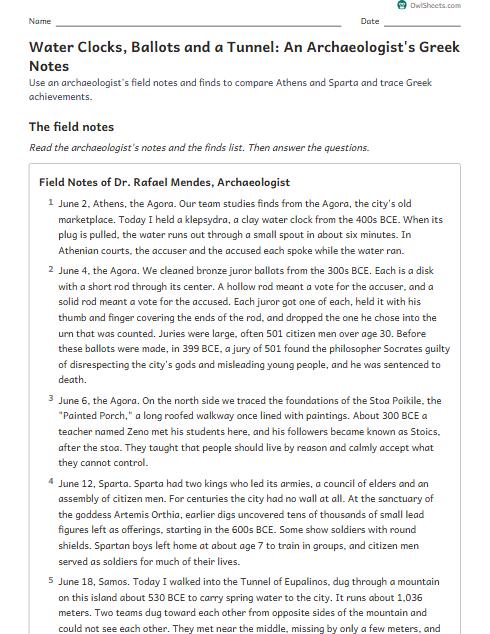
Water Clocks, Ballots and a Tunnel: An Archaeologist's Greek Notes
Grade 6 · HIS.6.6
12 questionsPremium
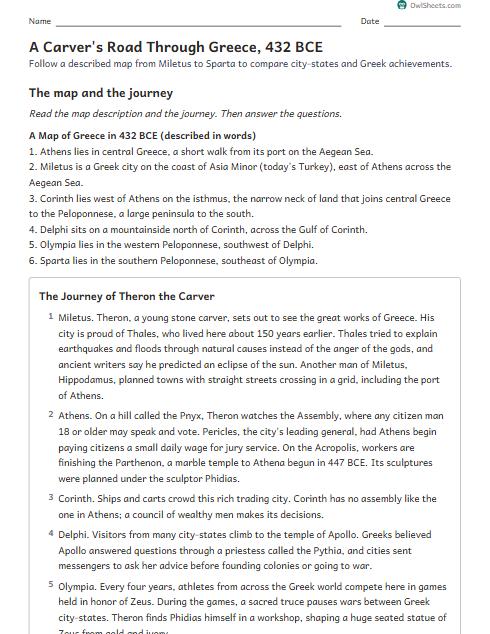
A Carver's Road Through Greece, 432 BCE
Grade 6 · HIS.6.6
12 questionsPremium