Grade 6 · Social StudiesHIS.6.6Premium
From Delos to the Parthenon: Athens, Sparta and the League on a Timeline
Grade 6 ancient Greece: follow a timeline from Cleisthenes to Plato's Academy to see how the Delian League, the Parthenon and war shaped Athens and Sparta.
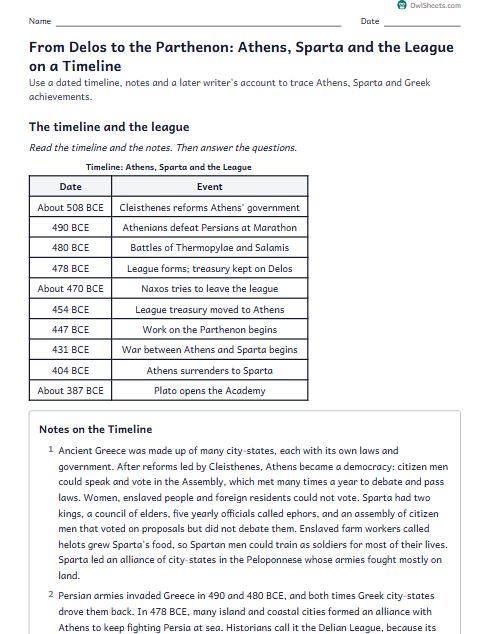
Preview
OwlSheets.com
From Delos to the Parthenon: Athens, Sparta and the League on a Timeline
Use a dated timeline, notes and a later writer's account to trace Athens, Sparta and Greek achievements.
The timeline and the league
Read the timeline and the notes. Then answer the questions.
| Date | Event |
|---|---|
| About 508 BCE | Cleisthenes reforms Athens' government |
| 490 BCE | Athenians defeat Persians at Marathon |
| 480 BCE | Battles of Thermopylae and Salamis |
| 478 BCE | League forms; treasury kept on Delos |
| About 470 BCE | Naxos tries to leave the league |
| 454 BCE | League treasury moved to Athens |
| 447 BCE | Work on the Parthenon begins |
| 431 BCE | War between Athens and Sparta begins |
| 404 BCE | Athens surrenders to Sparta |
| About 387 BCE | Plato opens the Academy |
Notes on the Timeline
1Ancient Greece was made up of many city-states, each with its own laws and government. After reforms led by Cleisthenes, Athens became a democracy: citizen men could speak and vote in the Assembly, which met many times a year to debate and pass laws. Women, enslaved people and foreign residents could not vote. Sparta had two kings, a council of elders, five yearly officials called ephors, and an assembly of citizen men that voted on proposals but did not debate them. Enslaved farm workers called helots grew Sparta's food, so Spartan men could train as soldiers for most of their lives. Sparta led an alliance of city-states in the Peloponnese whose armies fought mostly on land.
2Persian armies invaded Greece in 490 and 480 BCE, and both times Greek city-states drove them back. In 478 BCE, many island and coastal cities formed an alliance with Athens to keep fighting Persia at sea. Historians call it the Delian League, because its treasury was kept on the island of Delos. Each member sent warships or paid silver every year, and Athens commanded the fleet. About 470 BCE, the island of Naxos tried to leave. Athens besieged it and forced it back into the league. After the treasury was moved to Athens, Athens carved on stone slabs the amount it set aside from each ally's payment for the goddess Athena: one-sixtieth.
3In 447 BCE, Athens, led by the general Pericles, began the Parthenon, a marble temple to Athena on the hill called the Acropolis. League silver helped pay for it. The builders curved the floor so that its middle sits slightly higher than its edges, and they tilted the columns a little inward, so the huge building looks straight and balanced to a person standing below. The sculptor Phidias directed the carving of hundreds of figures.
4Sparta and its allies watched Athens grow stronger, and war broke out in 431 BCE. The Athenian historian Thucydides, who served as a general in the war, wrote that its truest cause was the growth of Athenian power and the fear this caused in Sparta. Late in the war, Sparta built a fleet with silver from Persia and destroyed Athens' fleet in 405 BCE. Athens surrendered the next year. In the 400s BCE, the thinker Democritus taught that everything is made of tiny pieces too small to see, which he called atoms, from a Greek word meaning "uncuttable." About 387 BCE, Plato opened a school called the Academy, where students studied mathematics, astronomy and questions about justice.
- A. Athens had conquered them in the years after Marathon.
- B. They wanted Athens' help in a war against Sparta.
- C. They wanted to help pay for building the Parthenon.
- D. They feared more Persian attacks after two invasions.
The preview shows the first questions. Unlock the worksheet to see all of it.
Related worksheets
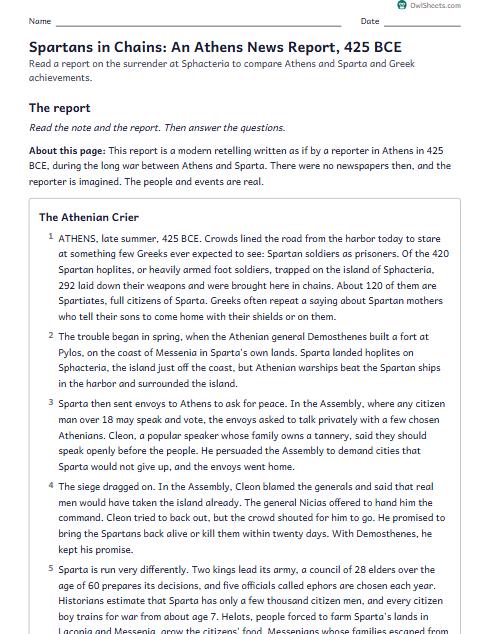
Spartans in Chains: An Athens News Report, 425 BCE
Grade 6 · HIS.6.6
13 questionsPremium
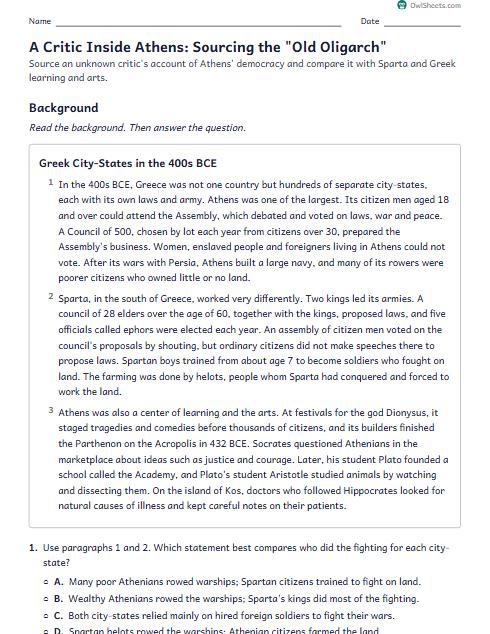
A Critic Inside Athens: Sourcing the "Old Oligarch"
Grade 6 · HIS.6.6
14 questionsPremium
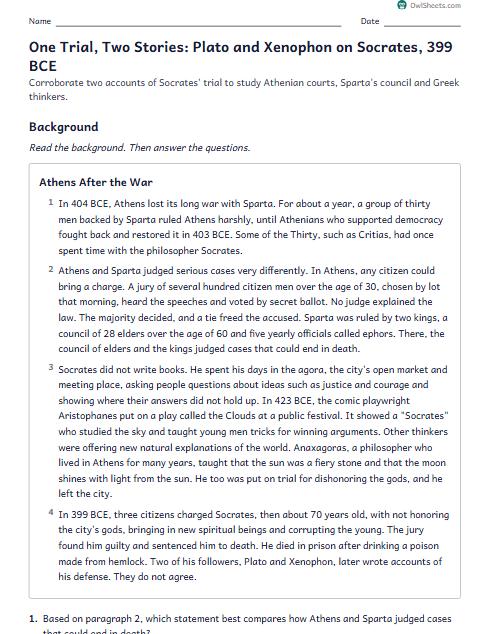
One Trial, Two Stories: Plato and Xenophon on Socrates, 399 BCE
Grade 6 · HIS.6.6
16 questionsPremium
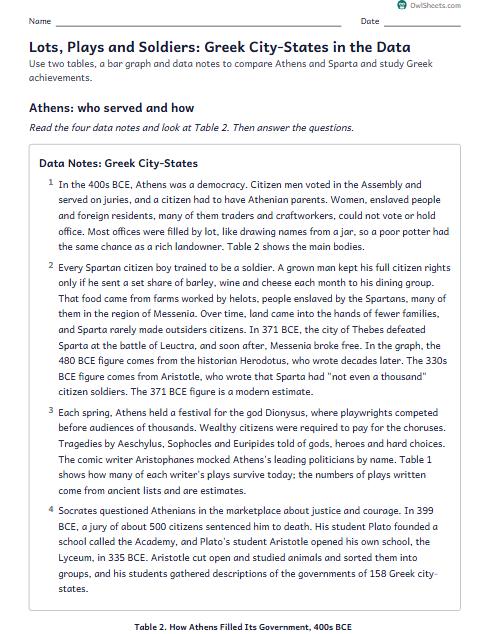
Lots, Plays and Soldiers: Greek City-States in the Data
Grade 6 · HIS.6.6
14 questionsPremium
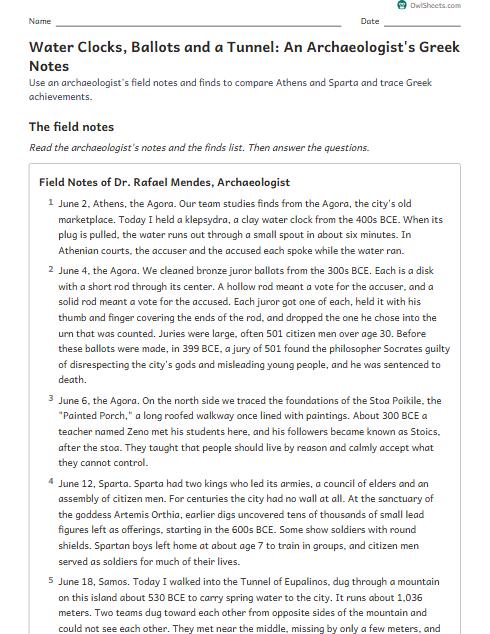
Water Clocks, Ballots and a Tunnel: An Archaeologist's Greek Notes
Grade 6 · HIS.6.6
12 questionsPremium
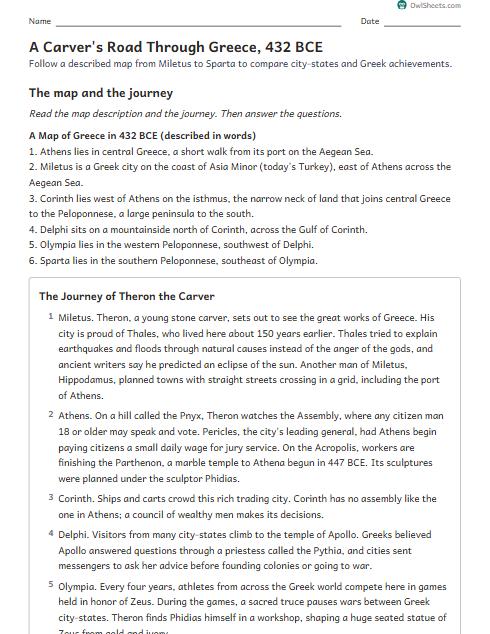
A Carver's Road Through Greece, 432 BCE
Grade 6 · HIS.6.6
12 questionsPremium