Grade 6 · Social StudiesHIS.6.6Premium
A Critic Inside Athens: Sourcing the "Old Oligarch"
Grade 6 ancient Greece: source an adapted excerpt by the unknown "Old Oligarch" to study Athens' democracy, Sparta and Greek thinkers, doctors and festivals.
Preview
OwlSheets.com
A Critic Inside Athens: Sourcing the "Old Oligarch"
Source an unknown critic's account of Athens' democracy and compare it with Sparta and Greek learning and arts.
Background
Read the background. Then answer the question.
Greek City-States in the 400s BCE
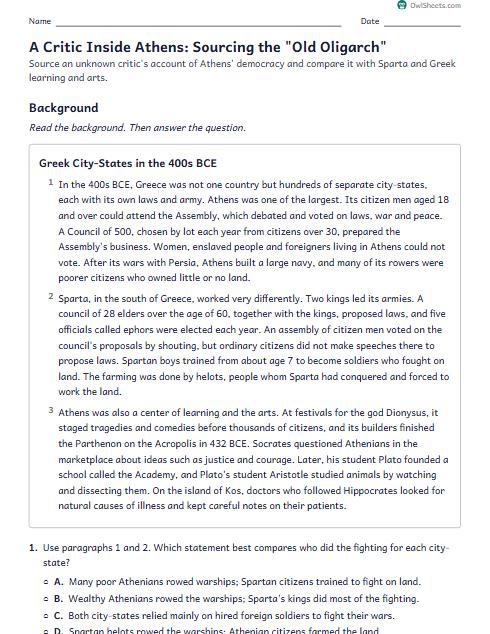
1In the 400s BCE, Greece was not one country but hundreds of separate city-states, each with its own laws and army. Athens was one of the largest. Its citizen men aged 18 and over could attend the Assembly, which debated and voted on laws, war and peace. A Council of 500, chosen by lot each year from citizens over 30, prepared the Assembly's business. Women, enslaved people and foreigners living in Athens could not vote. After its wars with Persia, Athens built a large navy, and many of its rowers were poorer citizens who owned little or no land.
2Sparta, in the south of Greece, worked very differently. Two kings led its armies. A council of 28 elders over the age of 60, together with the kings, proposed laws, and five officials called ephors were elected each year. An assembly of citizen men voted on the council's proposals by shouting, but ordinary citizens did not make speeches there to propose laws. Spartan boys trained from about age 7 to become soldiers who fought on land. The farming was done by helots, people whom Sparta had conquered and forced to work the land.
3Athens was also a center of learning and the arts. At festivals for the god Dionysus, it staged tragedies and comedies before thousands of citizens, and its builders finished the Parthenon on the Acropolis in 432 BCE. Socrates questioned Athenians in the marketplace about ideas such as justice and courage. Later, his student Plato founded a school called the Academy, and Plato's student Aristotle studied animals by watching and dissecting them. On the island of Kos, doctors who followed Hippocrates looked for natural causes of illness and kept careful notes on their patients.
- A. Many poor Athenians rowed warships; Spartan citizens trained to fight on land.
- B. Wealthy Athenians rowed the warships; Sparta's kings did most of the fighting.
- C. Both city-states relied mainly on hired foreign soldiers to fight their wars.
- D. Spartan helots rowed the warships; Athenian citizens farmed the land.
The preview shows the first questions. Unlock the worksheet to see all of it.
Related worksheets
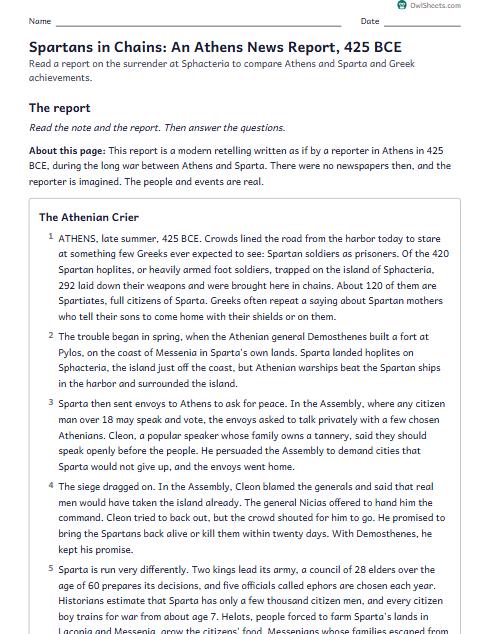
Spartans in Chains: An Athens News Report, 425 BCE
Grade 6 · HIS.6.6
13 questionsPremium
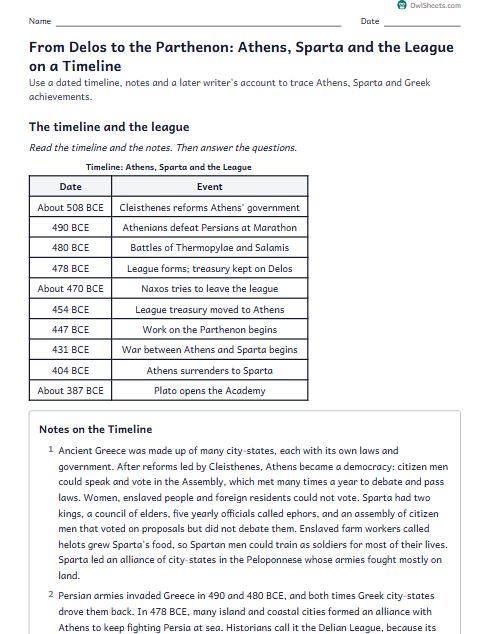
From Delos to the Parthenon: Athens, Sparta and the League on a Timeline
Grade 6 · HIS.6.6
15 questionsPremium
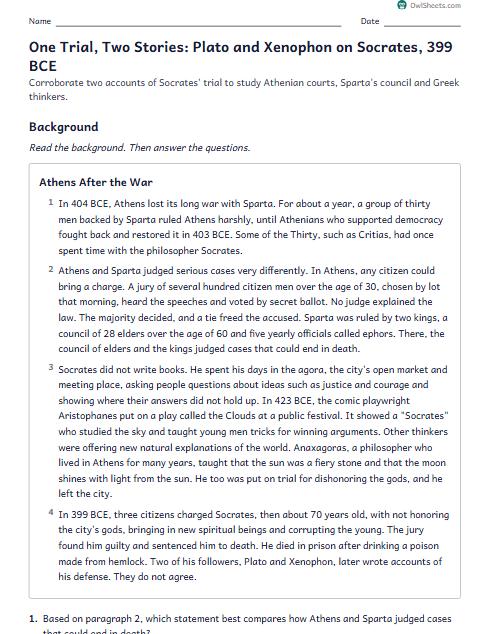
One Trial, Two Stories: Plato and Xenophon on Socrates, 399 BCE
Grade 6 · HIS.6.6
16 questionsPremium
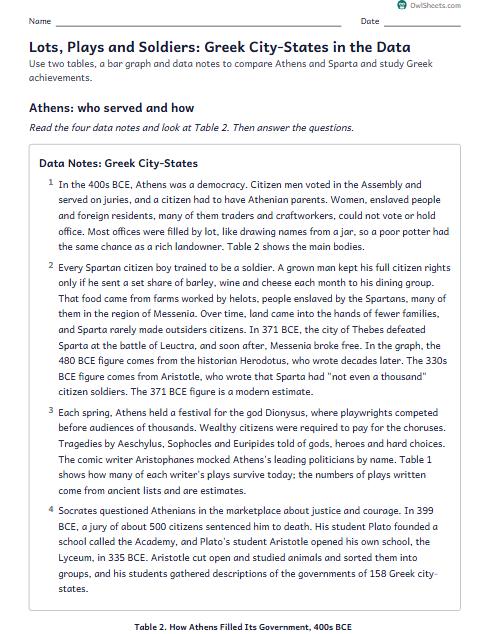
Lots, Plays and Soldiers: Greek City-States in the Data
Grade 6 · HIS.6.6
14 questionsPremium
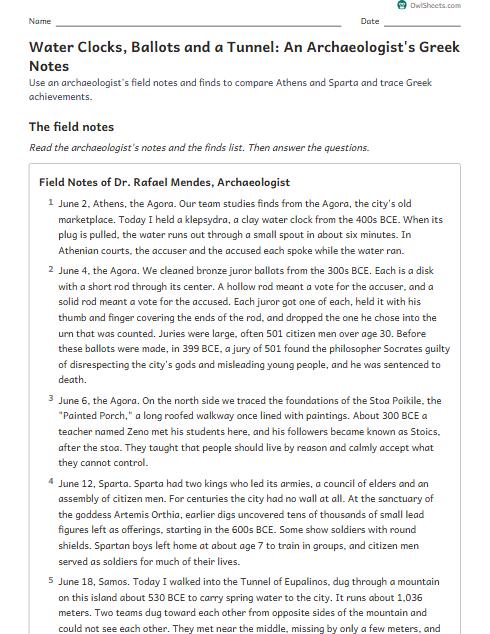
Water Clocks, Ballots and a Tunnel: An Archaeologist's Greek Notes
Grade 6 · HIS.6.6
12 questionsPremium
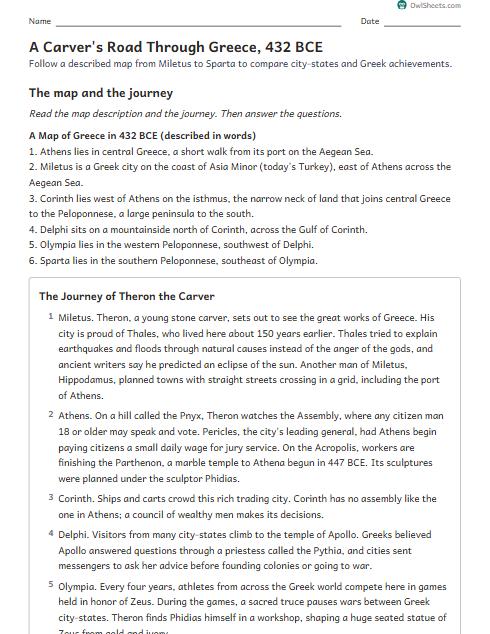
A Carver's Road Through Greece, 432 BCE
Grade 6 · HIS.6.6
12 questionsPremium