Grade 8 · Social StudiesECO.8.2Premium
One Inventor, Two Economies: A Timeline, 1790–1860
Grade 8 economics: a dated timeline from Slater's mill and Whitney's gin to 1860, plus census data, compares Northern and Southern economies.
Preview
OwlSheets.com
One Inventor, Two Economies: A Timeline, 1790–1860
Follow Eli Whitney's gin and armory to compare how the North and the South made a living.
The timeline
Read the timeline. Then answer the questions.
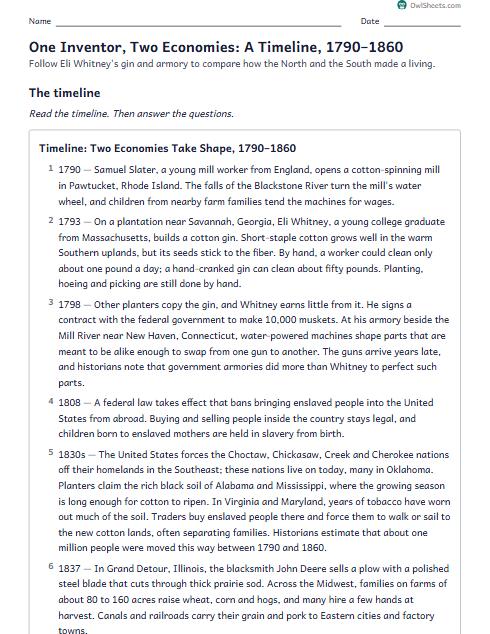
Timeline: Two Economies Take Shape, 1790–1860
11790 — Samuel Slater, a young mill worker from England, opens a cotton-spinning mill in Pawtucket, Rhode Island. The falls of the Blackstone River turn the mill's water wheel, and children from nearby farm families tend the machines for wages.
21793 — On a plantation near Savannah, Georgia, Eli Whitney, a young college graduate from Massachusetts, builds a cotton gin. Short-staple cotton grows well in the warm Southern uplands, but its seeds stick to the fiber. By hand, a worker could clean only about one pound a day; a hand-cranked gin can clean about fifty pounds. Planting, hoeing and picking are still done by hand.
31798 — Other planters copy the gin, and Whitney earns little from it. He signs a contract with the federal government to make 10,000 muskets. At his armory beside the Mill River near New Haven, Connecticut, water-powered machines shape parts that are meant to be alike enough to swap from one gun to another. The guns arrive years late, and historians note that government armories did more than Whitney to perfect such parts.
41808 — A federal law takes effect that bans bringing enslaved people into the United States from abroad. Buying and selling people inside the country stays legal, and children born to enslaved mothers are held in slavery from birth.
51830s — The United States forces the Choctaw, Chickasaw, Creek and Cherokee nations off their homelands in the Southeast; these nations live on today, many in Oklahoma. Planters claim the rich black soil of Alabama and Mississippi, where the growing season is long enough for cotton to ripen. In Virginia and Maryland, years of tobacco have worn out much of the soil. Traders buy enslaved people there and force them to walk or sail to the new cotton lands, often separating families. Historians estimate that about one million people were moved this way between 1790 and 1860.
61837 — In Grand Detour, Illinois, the blacksmith John Deere sells a plow with a polished steel blade that cuts through thick prairie sod. Across the Midwest, families on farms of about 80 to 160 acres raise wheat, corn and hogs, and many hire a few hands at harvest. Canals and railroads carry their grain and pork to Eastern cities and factory towns.
71840s — Factories spread through New England and the Middle Atlantic states: textile mills, shoe shops, ironworks and clock factories. Most workers earn wages, and they can quit or move to another job. After 1845, many Irish people fleeing famine and many Germans land in Northern ports and take jobs in factories, on the docks and on railroad crews.
81850s — Cotton prices rise. Planters in the Deep South buy more land and more enslaved workers. Merchants, banks and shipping firms in New York handle much of the cotton trade, lending money to planters and carrying bales to Britain, which buys most of the crop. Mills in New England spin much of the rest.
91860 — Cotton is the nation's leading export. The census counts nearly 4 million enslaved people, almost all of them in the South. The Northern states have most of the nation's factories and more than two-thirds of its railroad miles.
- A. A long growing season that kept workers busy all year
- B. Rich black soil that could feed many mill workers
- C. Thick prairie sod that steel blades could cut
- D. Rivers with falling water that could turn a wheel
- A. He could plant far more cotton, since cleaning no longer held back his crop.
- B. He could free most of his workers, since the gin also picked the cotton.
- C. He could switch to tobacco, since the gin had made cotton too cheap to grow.
- D. He could stop growing cotton, since Northern mills now cleaned it for him.
The preview shows the first questions. Unlock the worksheet to see all of it.
Related worksheets
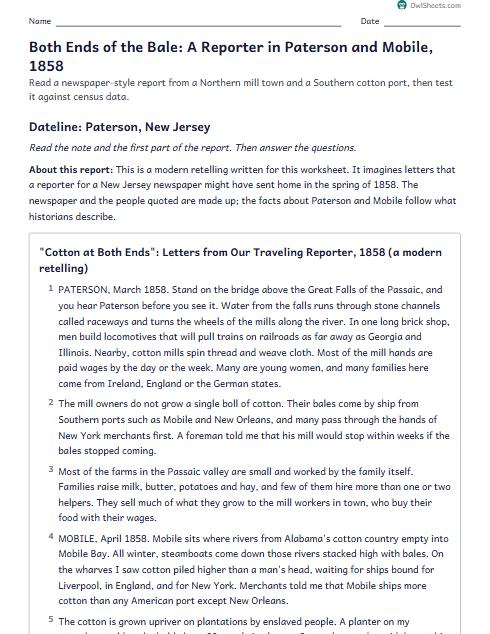
Both Ends of the Bale: A Reporter in Paterson and Mobile, 1858
Grade 8 · ECO.8.2
15 questionsPremium
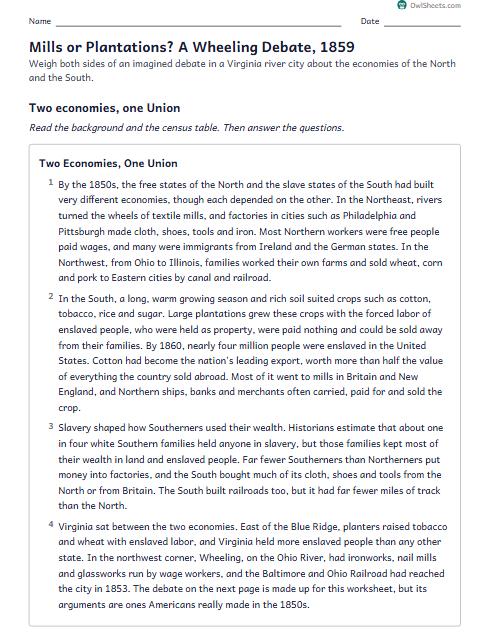
Mills or Plantations? A Wheeling Debate, 1859
Grade 8 · ECO.8.2
14 questionsPremium
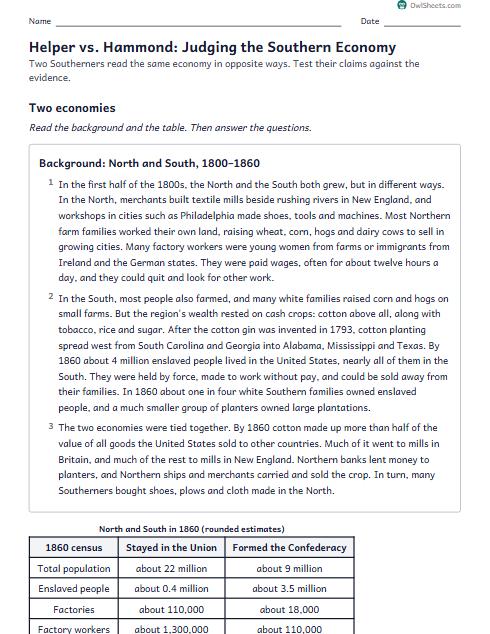
Helper vs. Hammond: Judging the Southern Economy
Grade 8 · ECO.8.2
14 questionsPremium
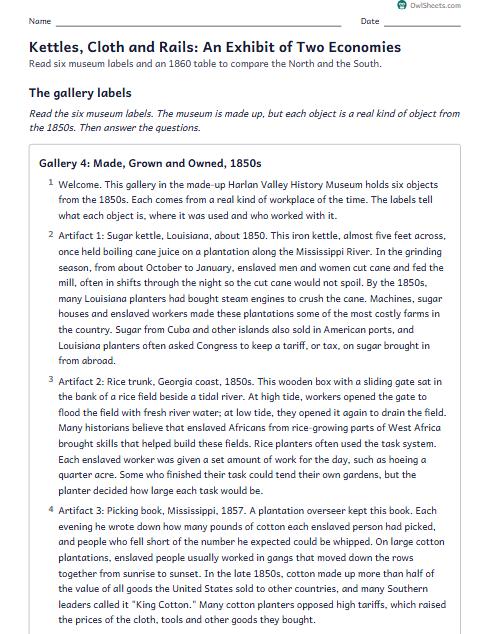
Kettles, Cloth and Rails: An Exhibit of Two Economies
Grade 8 · ECO.8.2
13 questionsPremium
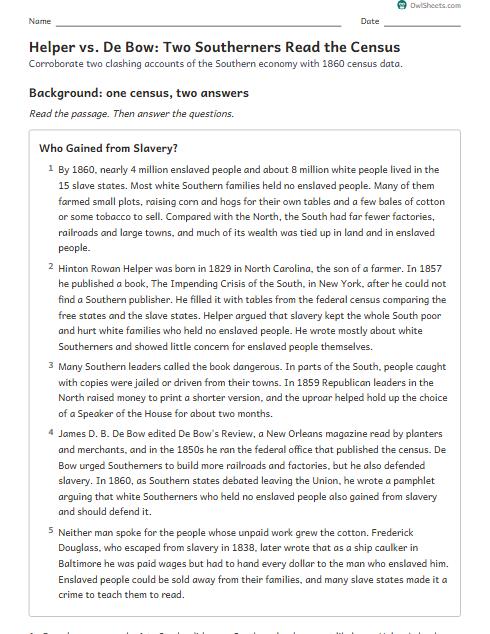
Helper vs. De Bow: Two Southerners Read the Census
Grade 8 · ECO.8.2
11 questionsPremium
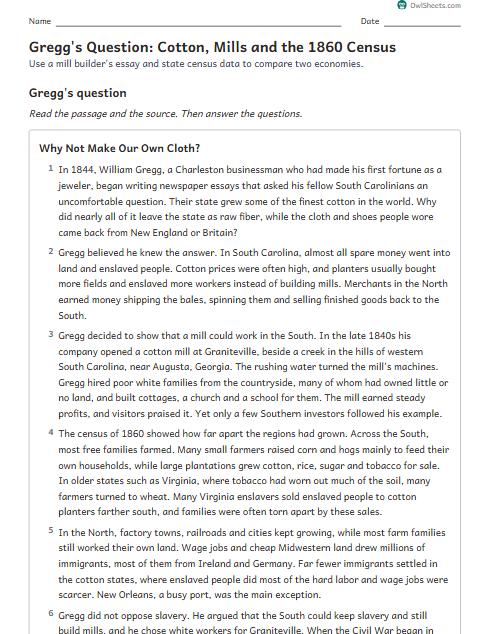
Gregg's Question: Cotton, Mills and the 1860 Census
Grade 8 · ECO.8.2
11 questionsPremium