Grade 8 · Social StudiesECO.8.2Premium
Helper vs. Hammond: Judging the Southern Economy
Grade 8: compare North and South economies before the Civil War by testing adapted writings of Hinton Helper and James Hammond against 1860 data.
Preview
OwlSheets.com
Helper vs. Hammond: Judging the Southern Economy
Two Southerners read the same economy in opposite ways. Test their claims against the evidence.
Two economies
Read the background and the table. Then answer the questions.
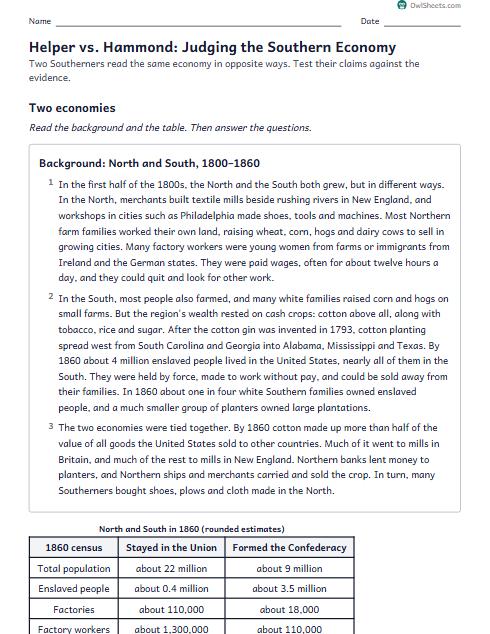
Background: North and South, 1800–1860
1In the first half of the 1800s, the North and the South both grew, but in different ways. In the North, merchants built textile mills beside rushing rivers in New England, and workshops in cities such as Philadelphia made shoes, tools and machines. Most Northern farm families worked their own land, raising wheat, corn, hogs and dairy cows to sell in growing cities. Many factory workers were young women from farms or immigrants from Ireland and the German states. They were paid wages, often for about twelve hours a day, and they could quit and look for other work.
2In the South, most people also farmed, and many white families raised corn and hogs on small farms. But the region's wealth rested on cash crops: cotton above all, along with tobacco, rice and sugar. After the cotton gin was invented in 1793, cotton planting spread west from South Carolina and Georgia into Alabama, Mississippi and Texas. By 1860 about 4 million enslaved people lived in the United States, nearly all of them in the South. They were held by force, made to work without pay, and could be sold away from their families. In 1860 about one in four white Southern families owned enslaved people, and a much smaller group of planters owned large plantations.
3The two economies were tied together. By 1860 cotton made up more than half of the value of all goods the United States sold to other countries. Much of it went to mills in Britain, and much of the rest to mills in New England. Northern banks lent money to planters, and Northern ships and merchants carried and sold the crop. In turn, many Southerners bought shoes, plows and cloth made in the North.
| 1860 census | Stayed in the Union | Formed the Confederacy |
|---|---|---|
| Total population | about 22 million | about 9 million |
| Enslaved people | about 0.4 million | about 3.5 million |
| Factories | about 110,000 | about 18,000 |
| Factory workers | about 1,300,000 | about 110,000 |
| Miles of railroad | about 22,000 | about 9,000 |
The preview shows the first questions. Unlock the worksheet to see all of it.
Related worksheets
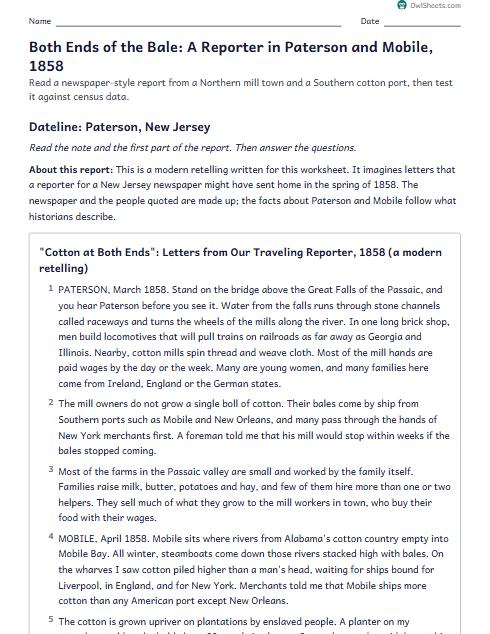
Both Ends of the Bale: A Reporter in Paterson and Mobile, 1858
Grade 8 · ECO.8.2
15 questionsPremium
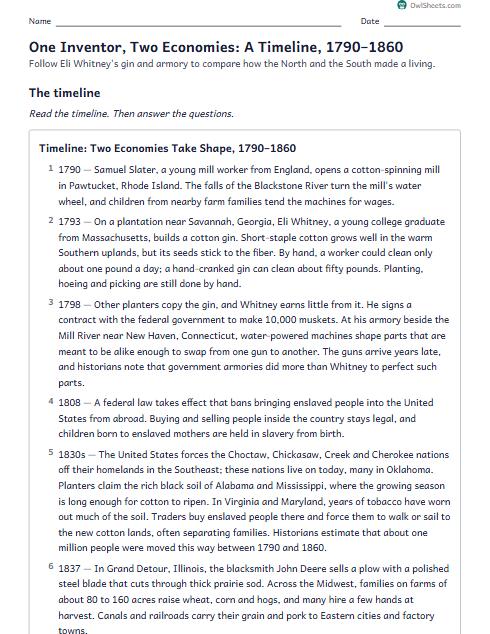
One Inventor, Two Economies: A Timeline, 1790–1860
Grade 8 · ECO.8.2
13 questionsPremium
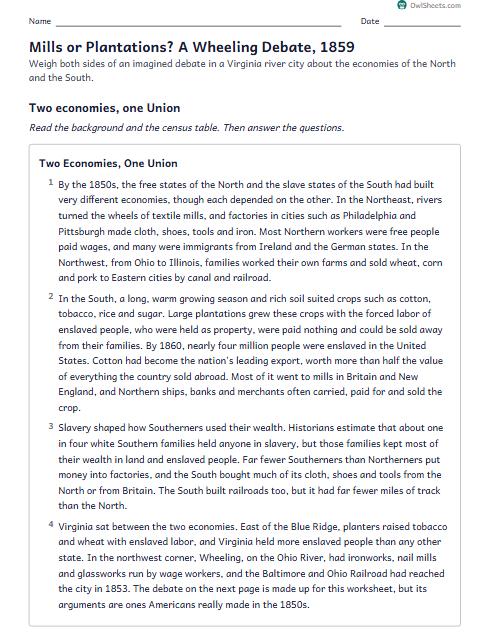
Mills or Plantations? A Wheeling Debate, 1859
Grade 8 · ECO.8.2
14 questionsPremium
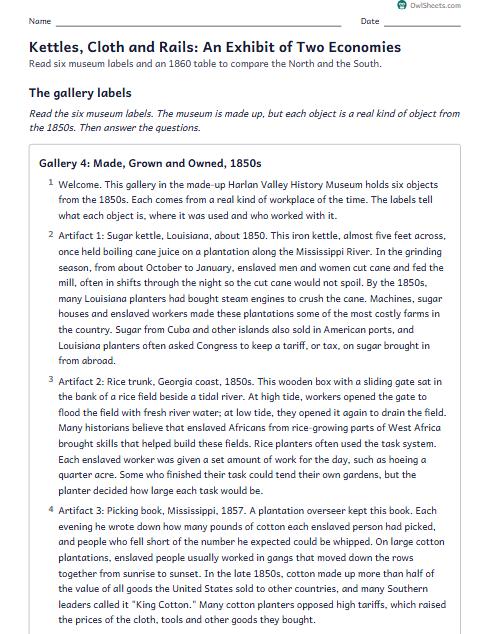
Kettles, Cloth and Rails: An Exhibit of Two Economies
Grade 8 · ECO.8.2
13 questionsPremium
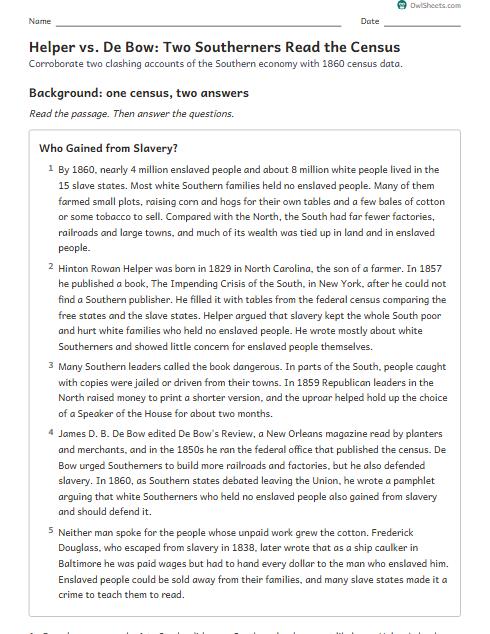
Helper vs. De Bow: Two Southerners Read the Census
Grade 8 · ECO.8.2
11 questionsPremium
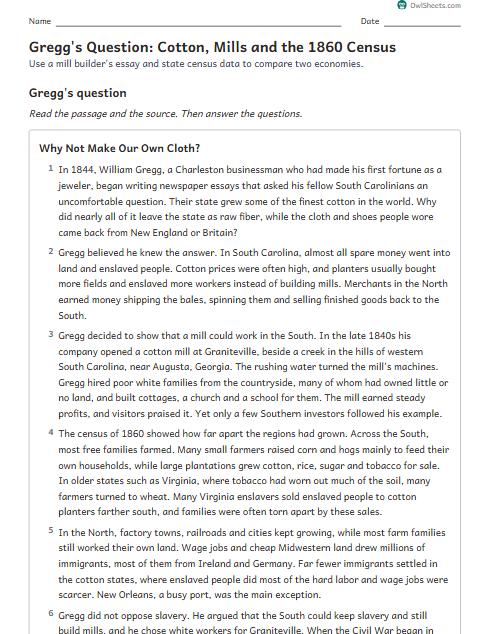
Gregg's Question: Cotton, Mills and the 1860 Census
Grade 8 · ECO.8.2
11 questionsPremium