Grade 8 · Social StudiesECO.8.2Premium
Mills or Plantations? A Wheeling Debate, 1859
Grade 8 economics: an imagined 1859 Wheeling debate and 1860 census data compare Northern and Southern economies: factories, farms, cotton and slavery.
Preview
OwlSheets.com
Mills or Plantations? A Wheeling Debate, 1859
Weigh both sides of an imagined debate in a Virginia river city about the economies of the North and the South.
Two economies, one Union
Read the background and the census table. Then answer the questions.
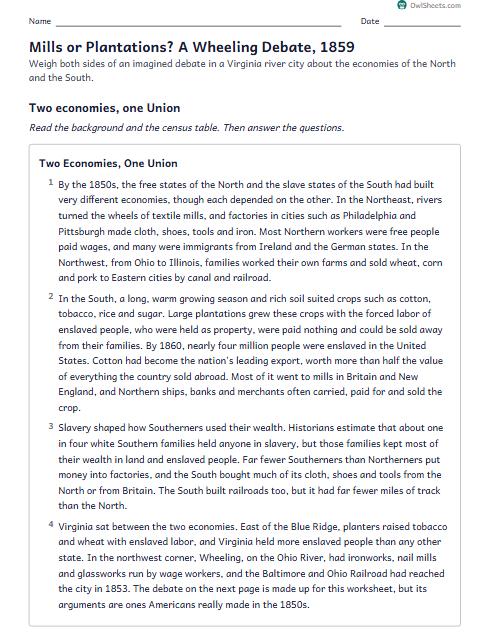
Two Economies, One Union
1By the 1850s, the free states of the North and the slave states of the South had built very different economies, though each depended on the other. In the Northeast, rivers turned the wheels of textile mills, and factories in cities such as Philadelphia and Pittsburgh made cloth, shoes, tools and iron. Most Northern workers were free people paid wages, and many were immigrants from Ireland and the German states. In the Northwest, from Ohio to Illinois, families worked their own farms and sold wheat, corn and pork to Eastern cities by canal and railroad.
2In the South, a long, warm growing season and rich soil suited crops such as cotton, tobacco, rice and sugar. Large plantations grew these crops with the forced labor of enslaved people, who were held as property, were paid nothing and could be sold away from their families. By 1860, nearly four million people were enslaved in the United States. Cotton had become the nation's leading export, worth more than half the value of everything the country sold abroad. Most of it went to mills in Britain and New England, and Northern ships, banks and merchants often carried, paid for and sold the crop.
3Slavery shaped how Southerners used their wealth. Historians estimate that about one in four white Southern families held anyone in slavery, but those families kept most of their wealth in land and enslaved people. Far fewer Southerners than Northerners put money into factories, and the South bought much of its cloth, shoes and tools from the North or from Britain. The South built railroads too, but it had far fewer miles of track than the North.
4Virginia sat between the two economies. East of the Blue Ridge, planters raised tobacco and wheat with enslaved labor, and Virginia held more enslaved people than any other state. In the northwest corner, Wheeling, on the Ohio River, had ironworks, nail mills and glassworks run by wage workers, and the Baltimore and Ohio Railroad had reached the city in 1853. The debate on the next page is made up for this worksheet, but its arguments are ones Americans really made in the 1850s.
| State | All people | Enslaved people | Born abroad |
|---|---|---|---|
| Massachusetts | 1,231,000 | 0 | 260,000 |
| Pennsylvania | 2,906,000 | 0 | 430,000 |
| Virginia | 1,596,000 | 491,000 | 35,000 |
| Mississippi | 791,000 | 437,000 | 9,000 |
- A. The family most likely grew cotton for export; the planter most likely grew corn for Eastern cities.
- B. The family most likely worked its own land; the planter most likely relied on enslaved workers.
- C. The family most likely shipped its crop to Britain; the planter most likely sold his crop in his own county.
- D. The family most likely rented land from a planter; the planter most likely paid wages to his workers.
The preview shows the first questions. Unlock the worksheet to see all of it.
Related worksheets
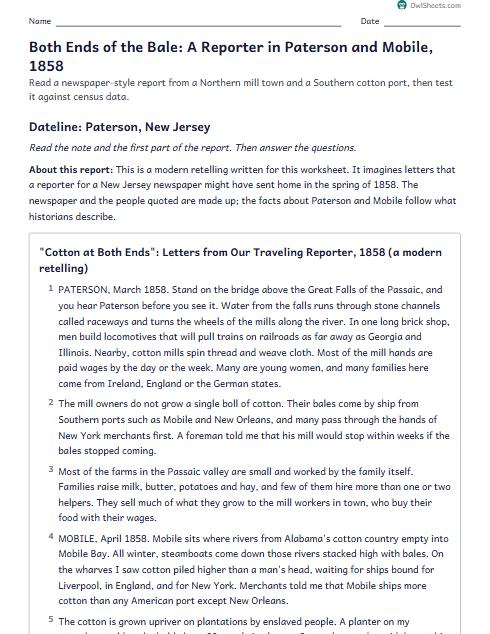
Both Ends of the Bale: A Reporter in Paterson and Mobile, 1858
Grade 8 · ECO.8.2
15 questionsPremium
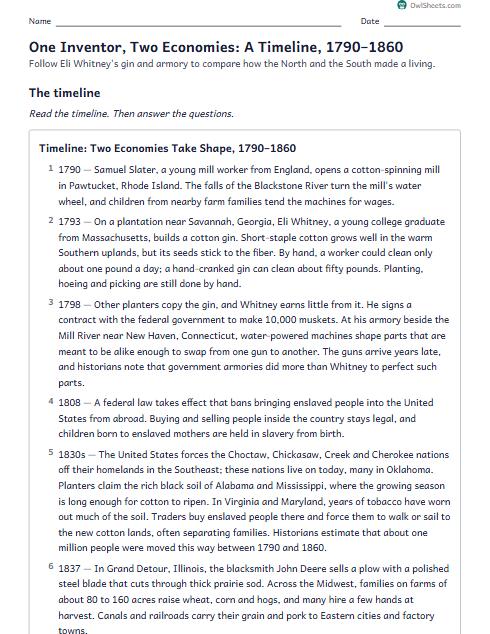
One Inventor, Two Economies: A Timeline, 1790–1860
Grade 8 · ECO.8.2
13 questionsPremium
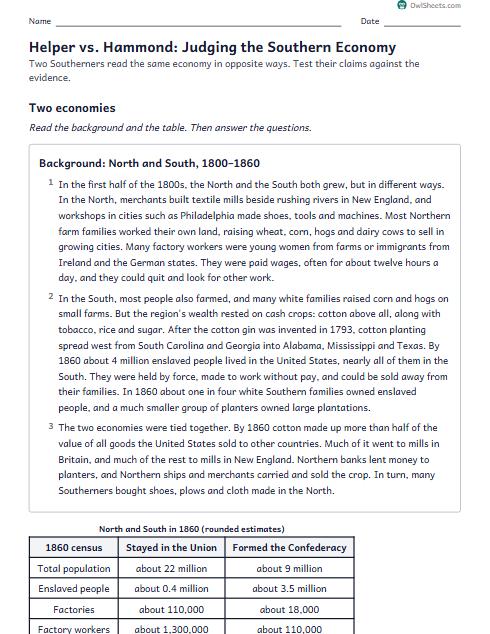
Helper vs. Hammond: Judging the Southern Economy
Grade 8 · ECO.8.2
14 questionsPremium
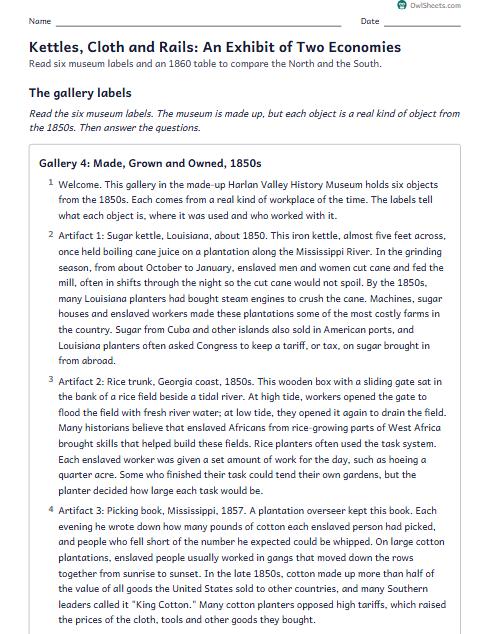
Kettles, Cloth and Rails: An Exhibit of Two Economies
Grade 8 · ECO.8.2
13 questionsPremium
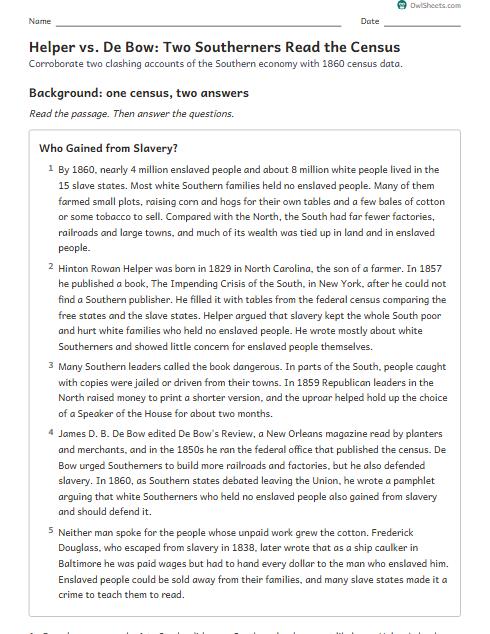
Helper vs. De Bow: Two Southerners Read the Census
Grade 8 · ECO.8.2
11 questionsPremium
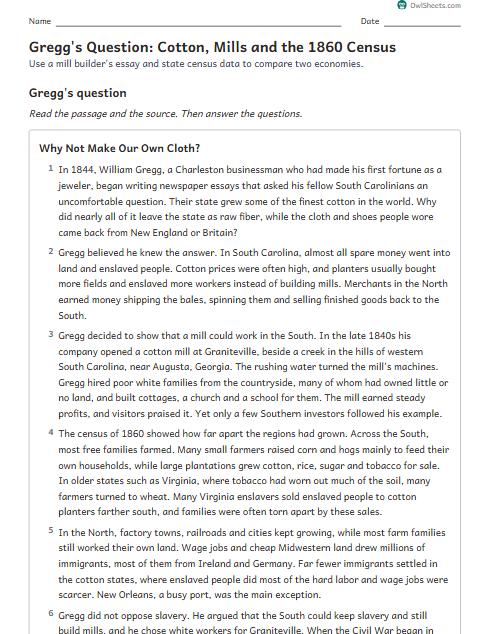
Gregg's Question: Cotton, Mills and the 1860 Census
Grade 8 · ECO.8.2
11 questionsPremium