Grade 8 · Social StudiesECO.8.2Premium
Both Ends of the Bale: A Reporter in Paterson and Mobile, 1858
Grade 8 economics: a newspaper-style report from Paterson and Mobile in 1858 and 1860 census data compare Northern and Southern economies.
Preview
OwlSheets.com
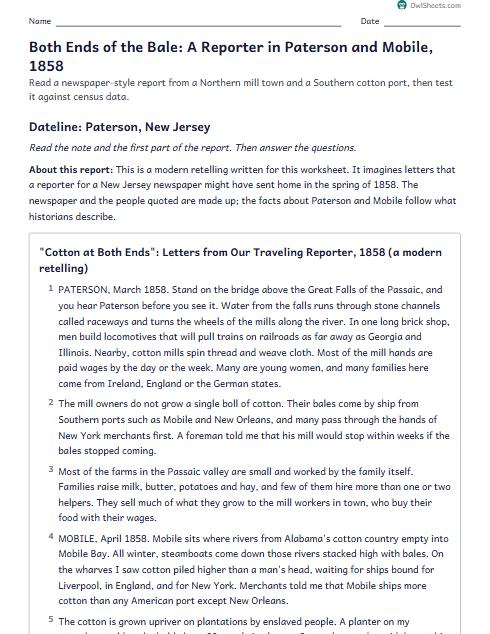
Both Ends of the Bale: A Reporter in Paterson and Mobile, 1858
Read a newspaper-style report from a Northern mill town and a Southern cotton port, then test it against census data.
Dateline: Paterson, New Jersey
Read the note and the first part of the report. Then answer the questions.
"Cotton at Both Ends": Letters from Our Traveling Reporter, 1858 (a modern retelling)
1PATERSON, March 1858. Stand on the bridge above the Great Falls of the Passaic, and you hear Paterson before you see it. Water from the falls runs through stone channels called raceways and turns the wheels of the mills along the river. In one long brick shop, men build locomotives that will pull trains on railroads as far away as Georgia and Illinois. Nearby, cotton mills spin thread and weave cloth. Most of the mill hands are paid wages by the day or the week. Many are young women, and many families here came from Ireland, England or the German states.
2The mill owners do not grow a single boll of cotton. Their bales come by ship from Southern ports such as Mobile and New Orleans, and many pass through the hands of New York merchants first. A foreman told me that his mill would stop within weeks if the bales stopped coming.
3Most of the farms in the Passaic valley are small and worked by the family itself. Families raise milk, butter, potatoes and hay, and few of them hire more than one or two helpers. They sell much of what they grow to the mill workers in town, who buy their food with their wages.
4MOBILE, April 1858. Mobile sits where rivers from Alabama's cotton country empty into Mobile Bay. All winter, steamboats come down those rivers stacked high with bales. On the wharves I saw cotton piled higher than a man's head, waiting for ships bound for Liverpool, in England, and for New York. Merchants told me that Mobile ships more cotton than any American port except New Orleans.
5The cotton is grown upriver on plantations by enslaved people. A planter on my steamboat told me he held about 90 people in slavery. In good years, he said, he put his profits into more land and more enslaved workers. Enslaved men, women and children worked in the fields from first light to dark under overseers and were paid nothing. They could be sold away from their families at any time. At an auction house in Mobile, I saw a notice that listed people for sale by name and age, next to notices for mules and land.
6Not every white farmer in Alabama is a planter. In the hill counties of the north, most white families hold no one in slavery. They grow corn, raise hogs and plant a few acres of cotton when prices are high. Roads there are poor and railroads few, so getting a crop to market is slow and costly.
7Mobile has few factories of its own. In its shops I found shoes made in Massachusetts, cloth woven in New England and plows made in the North. When I told a shopkeeper where I came from, he laughed. "Your mills spin our cotton," he said, "and then you sell it back to us as shirts."
- A. Falling water from the Great Falls could turn the mill wheels.
- B. Mill hands from Ireland and England had settled by the water.
- C. The river valley's farms grew the cotton the mills needed.
- D. Ships from Southern ports could unload bales beside each mill.
The preview shows the first questions. Unlock the worksheet to see all of it.
Related worksheets
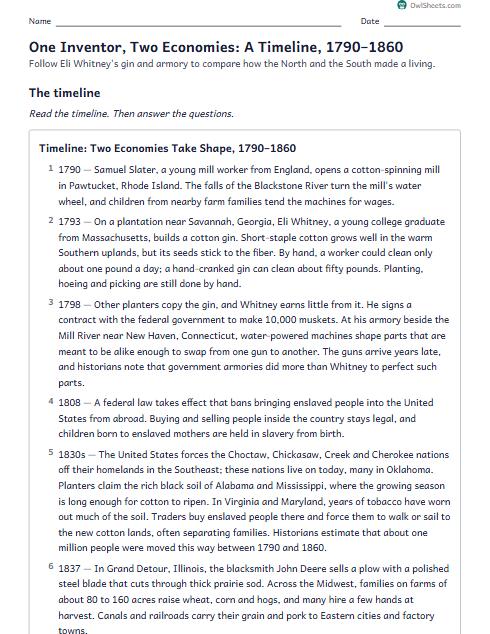
One Inventor, Two Economies: A Timeline, 1790–1860
Grade 8 · ECO.8.2
13 questionsPremium
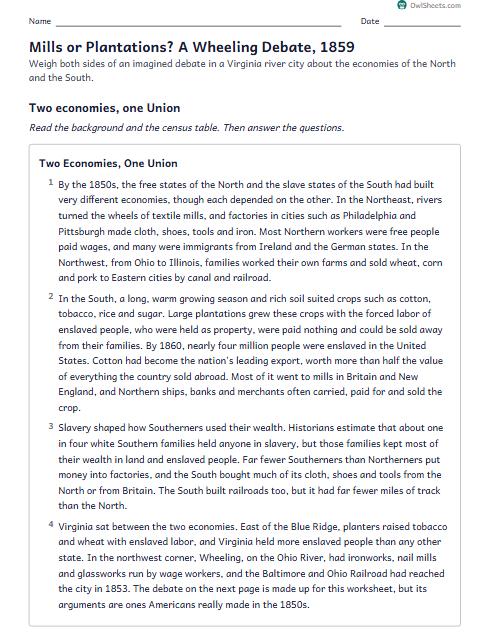
Mills or Plantations? A Wheeling Debate, 1859
Grade 8 · ECO.8.2
14 questionsPremium
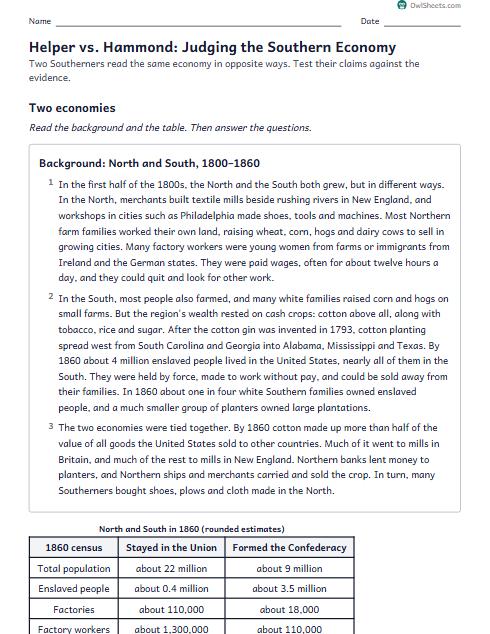
Helper vs. Hammond: Judging the Southern Economy
Grade 8 · ECO.8.2
14 questionsPremium
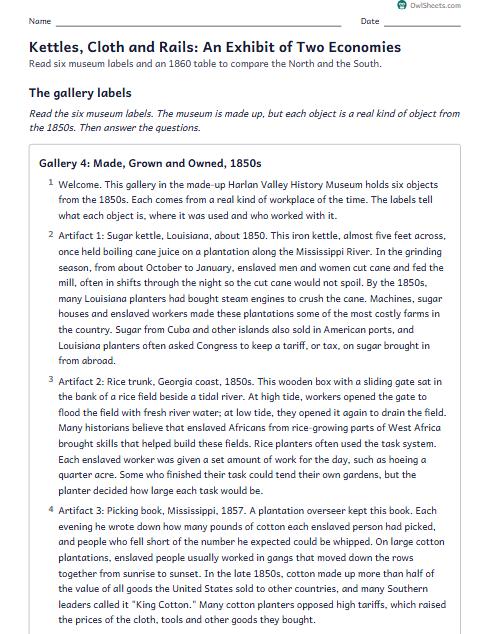
Kettles, Cloth and Rails: An Exhibit of Two Economies
Grade 8 · ECO.8.2
13 questionsPremium
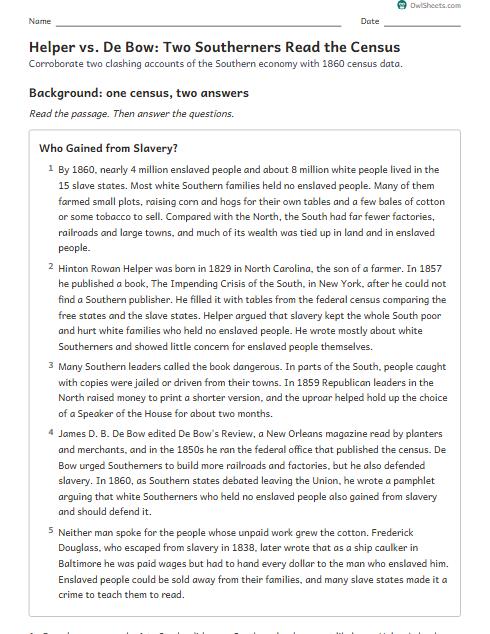
Helper vs. De Bow: Two Southerners Read the Census
Grade 8 · ECO.8.2
11 questionsPremium
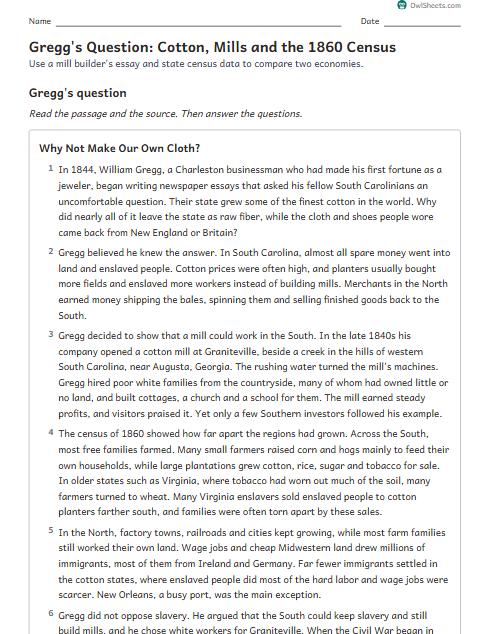
Gregg's Question: Cotton, Mills and the 1860 Census
Grade 8 · ECO.8.2
11 questionsPremium