Grade 8 · Social StudiesECO.8.2Premium
Kettles, Cloth and Rails: An Exhibit of Two Economies
Grade 8 economics: museum labels on six 1850s objects and an 1860 table compare Northern and Southern economies, from factories to cotton and slavery.
Preview
OwlSheets.com
Kettles, Cloth and Rails: An Exhibit of Two Economies
Read six museum labels and an 1860 table to compare the North and the South.
The gallery labels
Read the six museum labels. The museum is made up, but each object is a real kind of object from the 1850s. Then answer the questions.
Gallery 4: Made, Grown and Owned, 1850s
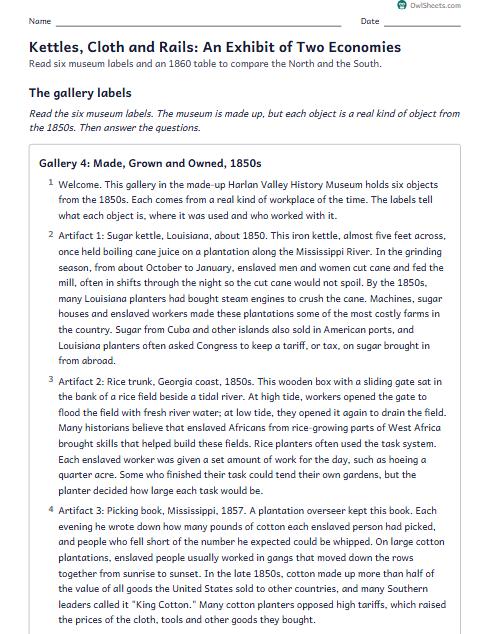
1Welcome. This gallery in the made-up Harlan Valley History Museum holds six objects from the 1850s. Each comes from a real kind of workplace of the time. The labels tell what each object is, where it was used and who worked with it.
2Artifact 1: Sugar kettle, Louisiana, about 1850. This iron kettle, almost five feet across, once held boiling cane juice on a plantation along the Mississippi River. In the grinding season, from about October to January, enslaved men and women cut cane and fed the mill, often in shifts through the night so the cut cane would not spoil. By the 1850s, many Louisiana planters had bought steam engines to crush the cane. Machines, sugar houses and enslaved workers made these plantations some of the most costly farms in the country. Sugar from Cuba and other islands also sold in American ports, and Louisiana planters often asked Congress to keep a tariff, or tax, on sugar brought in from abroad.
3Artifact 2: Rice trunk, Georgia coast, 1850s. This wooden box with a sliding gate sat in the bank of a rice field beside a tidal river. At high tide, workers opened the gate to flood the field with fresh river water; at low tide, they opened it again to drain the field. Many historians believe that enslaved Africans from rice-growing parts of West Africa brought skills that helped build these fields. Rice planters often used the task system. Each enslaved worker was given a set amount of work for the day, such as hoeing a quarter acre. Some who finished their task could tend their own gardens, but the planter decided how large each task would be.
4Artifact 3: Picking book, Mississippi, 1857. A plantation overseer kept this book. Each evening he wrote down how many pounds of cotton each enslaved person had picked, and people who fell short of the number he expected could be whipped. On large cotton plantations, enslaved people usually worked in gangs that moved down the rows together from sunrise to sunset. In the late 1850s, cotton made up more than half of the value of all goods the United States sold to other countries, and many Southern leaders called it "King Cotton." Many cotton planters opposed high tariffs, which raised the prices of the cloth, tools and other goods they bought.
5Artifact 4: Bolt of coarse cloth, Rhode Island, 1850s. Mill workers who were paid wages wove this rough cloth of wool and cotton. Rhode Island mill owners sold large amounts of cloth like it to Southern planters, who used it to make clothing for the people they enslaved. Northern merchants also shipped Southern cotton to Europe, and Northern banks lent planters money against their next crop.
6Artifact 5: Pay book, Ohio, 1855. An Irish-born laborer kept this pay book while he laid railroad track for about $1 a day. When the work stopped for the winter, he was free to look for another job, and in the spring of 1856 he left for a lumberyard in Chicago. Most of the millions of people who came from Ireland and the German states in the 1840s and 1850s settled in the North, where growing cities, farms and railroads needed workers.
7Artifact 6: Builder's plate, Paterson, New Jersey, 1857. This brass plate was fixed to a railroad engine built in Paterson, one of the country's leading centers for building locomotives. Paterson's shops sold engines to railroads in many states, including some in the South.
- A. His workers could leave the plantation for paid jobs.
- B. Northern mills would stop buying cotton from Louisiana.
- C. His steam engines would be taxed at a higher rate.
- D. Cheaper sugar from Cuba could lower the price of his crop.
This wooden box with a sliding gate sat in the bank of a rice field beside a tidal river.At high tide, workers opened the gate to flood the field with fresh river water; at low tide, they opened it again to drain the field.Many historians believe that enslaved Africans from rice-growing parts of West Africa brought skills that helped build these fields.Rice planters often used the task system.Some who finished their task could tend their own gardens, but the planter decided how large each task would be.
The preview shows the first questions. Unlock the worksheet to see all of it.
Related worksheets
Both Ends of the Bale: A Reporter in Paterson and Mobile, 1858
Grade 8 · ECO.8.2
15 questionsPremium
One Inventor, Two Economies: A Timeline, 1790–1860
Grade 8 · ECO.8.2
13 questionsPremium
Mills or Plantations? A Wheeling Debate, 1859
Grade 8 · ECO.8.2
14 questionsPremium
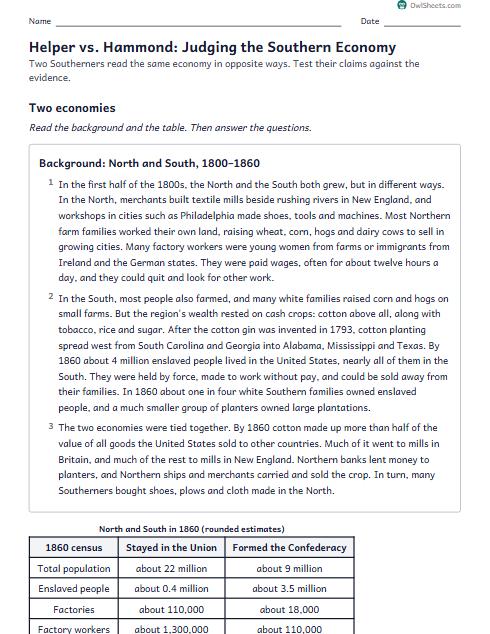
Helper vs. Hammond: Judging the Southern Economy
Grade 8 · ECO.8.2
14 questionsPremium
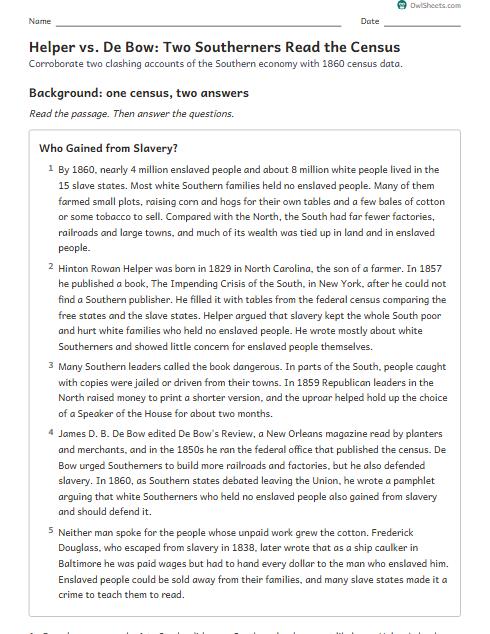
Helper vs. De Bow: Two Southerners Read the Census
Grade 8 · ECO.8.2
11 questionsPremium
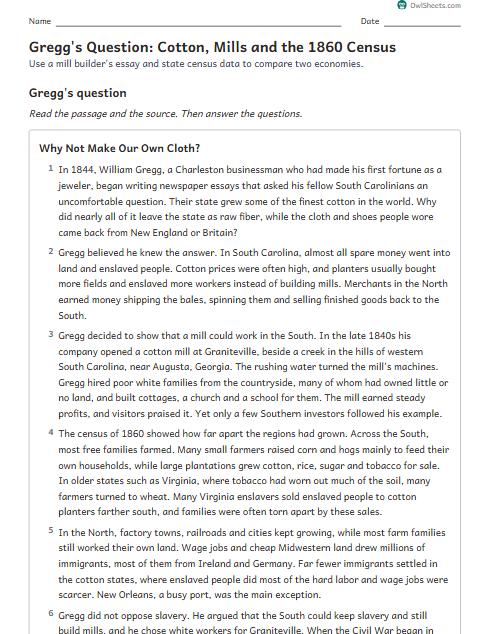
Gregg's Question: Cotton, Mills and the 1860 Census
Grade 8 · ECO.8.2
11 questionsPremium