Grade 8 · Social StudiesHIS.8.1Premium
News from Philadelphia: A Savannah Report on the New Plan, 1787
Grade 8 history: a newspaper-style Savannah report from 1787 and a table of convention votes explain the Articles' weaknesses and the 1787 compromises.
Preview
OwlSheets.com
News from Philadelphia: A Savannah Report on the New Plan, 1787
Read a newspaper-style report from Georgia and a table of convention votes to explain the Articles' weaknesses and the compromises of 1787.
A weak union
Read the note and the report. Then answer the questions.
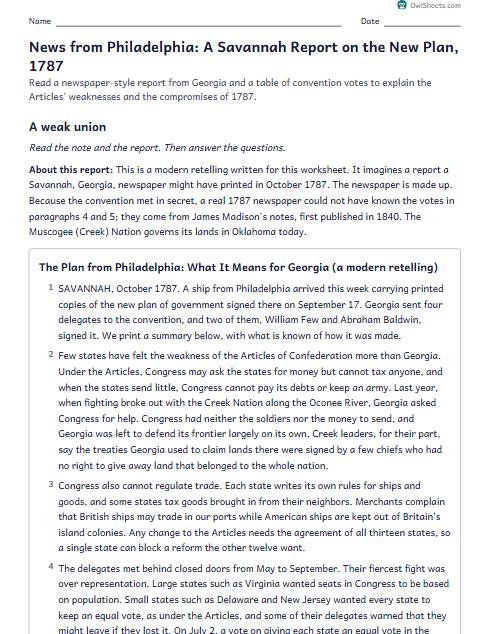
The Plan from Philadelphia: What It Means for Georgia (a modern retelling)
1SAVANNAH, October 1787. A ship from Philadelphia arrived this week carrying printed copies of the new plan of government signed there on September 17. Georgia sent four delegates to the convention, and two of them, William Few and Abraham Baldwin, signed it. We print a summary below, with what is known of how it was made.
2Few states have felt the weakness of the Articles of Confederation more than Georgia. Under the Articles, Congress may ask the states for money but cannot tax anyone, and when the states send little, Congress cannot pay its debts or keep an army. Last year, when fighting broke out with the Creek Nation along the Oconee River, Georgia asked Congress for help. Congress had neither the soldiers nor the money to send, and Georgia was left to defend its frontier largely on its own. Creek leaders, for their part, say the treaties Georgia used to claim lands there were signed by a few chiefs who had no right to give away land that belonged to the whole nation.
3Congress also cannot regulate trade. Each state writes its own rules for ships and goods, and some states tax goods brought in from their neighbors. Merchants complain that British ships may trade in our ports while American ships are kept out of Britain's island colonies. Any change to the Articles needs the agreement of all thirteen states, so a single state can block a reform the other twelve want.
4The delegates met behind closed doors from May to September. Their fiercest fight was over representation. Large states such as Virginia wanted seats in Congress to be based on population. Small states such as Delaware and New Jersey wanted every state to keep an equal vote, as under the Articles, and some of their delegates warned that they might leave if they lost it. On July 2, a vote on giving each state an equal vote in the Senate ended in a tie, because Georgia's two delegates present split. William Houstoun voted no, but Abraham Baldwin, who had grown up in Connecticut, voted yes.
5A committee then worked out a bargain, and on July 16 the convention accepted it (see the table). Seats in the House of Representatives will be based on population, and each state will have two members in the Senate. In counting population for the House, three of every five enslaved people will be counted, a rule Southern delegates pressed for. Later, in August, delegates from Georgia and South Carolina won a promise that Congress may not ban the bringing in of enslaved Africans before 1808. In return, Congress may pass laws to regulate trade by a simple majority, a power many Northern merchants wanted.
6To choose the president, the delegates turned down both a choice by Congress and a direct vote of the people. Some feared that a president chosen by Congress would owe his office to it. Others doubted that voters spread across so large a country could know the candidates. Instead, each state will choose electors equal to its number of senators and representatives.
7Many here expect Georgia to approve the plan quickly. A national government that can tax and raise an army, they say, could at last help defend our frontier.
- A. Congress could not make rules for trade between the states.
- B. Congress had too little money to keep an army or send one.
- C. Congress could not tax; it could only ask the states for money.
- D. Any change to the Articles needed all thirteen states to agree.
The preview shows the first questions. Unlock the worksheet to see all of it.
Related worksheets
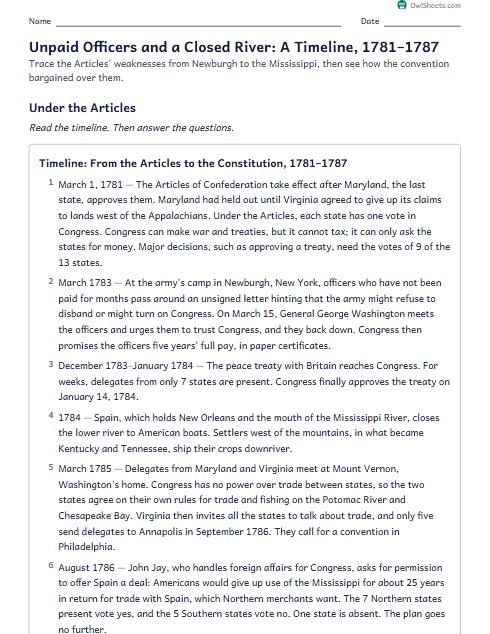
Unpaid Officers and a Closed River: A Timeline, 1781–1787
Grade 8 · HIS.8.1
14 questionsPremium
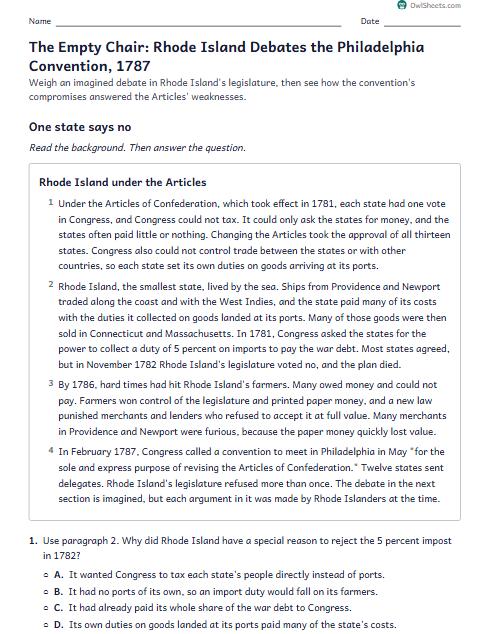
The Empty Chair: Rhode Island Debates the Philadelphia Convention, 1787
Grade 8 · HIS.8.1
14 questionsPremium
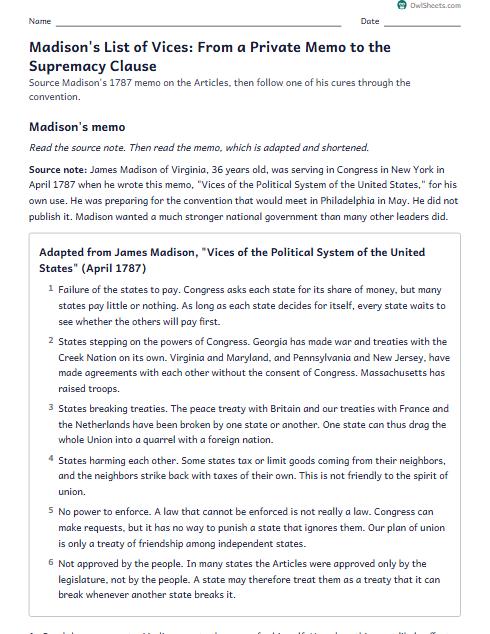
Madison's List of Vices: From a Private Memo to the Supremacy Clause
Grade 8 · HIS.8.1
14 questionsPremium
Sign or Refuse? Franklin and Mason Judge the Constitution
Grade 8 · HIS.8.1
13 questionsPremium
One State, One Vote? The Numbers Behind the Great Compromise
Grade 8 · HIS.8.1
12 questionsPremium
Five Stops, One Weak Government: A Historian's Field Notes, 1781–1787
Grade 8 · HIS.8.1
11 questionsFree