Grade 8 · Social StudiesHIS.8.1Premium
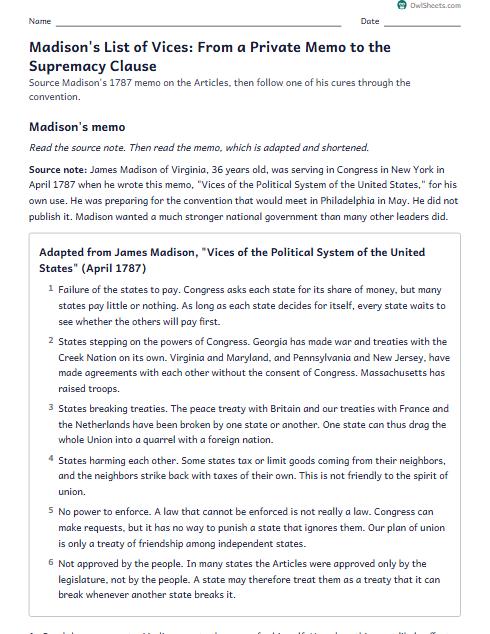
Madison's List of Vices: From a Private Memo to the Supremacy Clause
Grade 8: source Madison's 1787 memo on the weaknesses of the Articles, then trace the convention debate that traded his veto for the Supremacy Clause.
Preview
OwlSheets.com
Madison's List of Vices: From a Private Memo to the Supremacy Clause
Source Madison's 1787 memo on the Articles, then follow one of his cures through the convention.
Madison's memo
Read the source note. Then read the memo, which is adapted and shortened.
Adapted from James Madison, "Vices of the Political System of the United States" (April 1787)
1Failure of the states to pay. Congress asks each state for its share of money, but many states pay little or nothing. As long as each state decides for itself, every state waits to see whether the others will pay first.
2States stepping on the powers of Congress. Georgia has made war and treaties with the Creek Nation on its own. Virginia and Maryland, and Pennsylvania and New Jersey, have made agreements with each other without the consent of Congress. Massachusetts has raised troops.
3States breaking treaties. The peace treaty with Britain and our treaties with France and the Netherlands have been broken by one state or another. One state can thus drag the whole Union into a quarrel with a foreign nation.
4States harming each other. Some states tax or limit goods coming from their neighbors, and the neighbors strike back with taxes of their own. This is not friendly to the spirit of union.
5No power to enforce. A law that cannot be enforced is not really a law. Congress can make requests, but it has no way to punish a state that ignores them. Our plan of union is only a treaty of friendship among independent states.
6Not approved by the people. In many states the Articles were approved only by the legislature, not by the people. A state may therefore treat them as a treaty that it can break whenever another state breaks it.
- A. It shows his own private views, but not what most Americans believed.
- B. It is of little use, since a private memo cannot show real views.
- C. It shows exactly what Congress as a whole agreed on in April 1787.
- D. It shows the final Constitution, since he wrote it at the convention.
The preview shows the first questions. Unlock the worksheet to see all of it.
Related worksheets
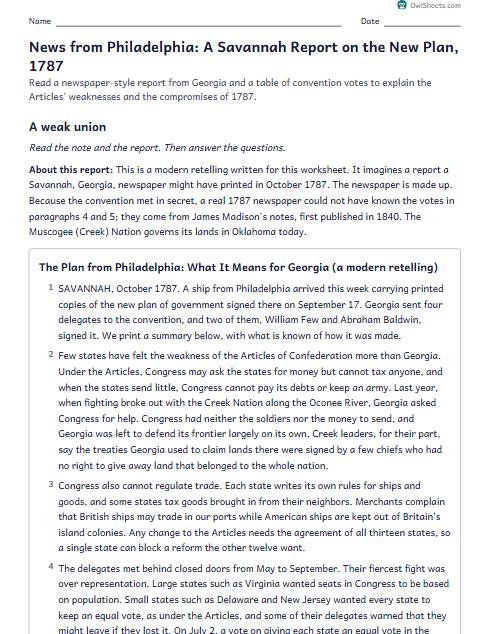
News from Philadelphia: A Savannah Report on the New Plan, 1787
Grade 8 · HIS.8.1
14 questionsPremium
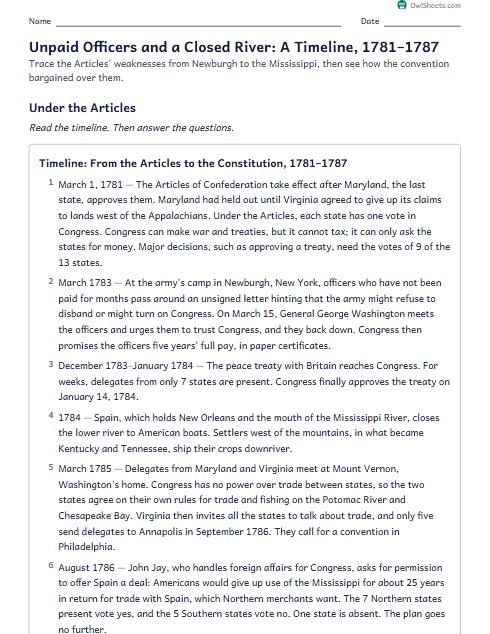
Unpaid Officers and a Closed River: A Timeline, 1781–1787
Grade 8 · HIS.8.1
14 questionsPremium
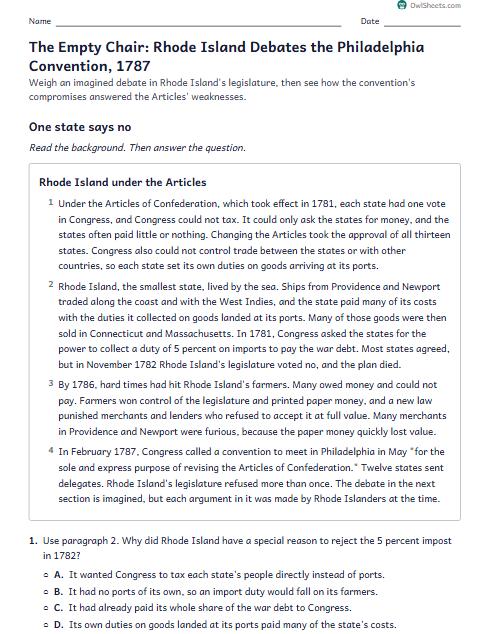
The Empty Chair: Rhode Island Debates the Philadelphia Convention, 1787
Grade 8 · HIS.8.1
14 questionsPremium
Sign or Refuse? Franklin and Mason Judge the Constitution
Grade 8 · HIS.8.1
13 questionsPremium
One State, One Vote? The Numbers Behind the Great Compromise
Grade 8 · HIS.8.1
12 questionsPremium
Five Stops, One Weak Government: A Historian's Field Notes, 1781–1787
Grade 8 · HIS.8.1
11 questionsFree