Grade 8 · Social StudiesHIS.8.1Premium
The Empty Chair: Rhode Island Debates the Philadelphia Convention, 1787
Grade 8 history: an imagined 1787 Rhode Island debate and a timeline show the Articles' weaknesses and how the convention's compromises answered them.
Preview
OwlSheets.com
The Empty Chair: Rhode Island Debates the Philadelphia Convention, 1787
Weigh an imagined debate in Rhode Island's legislature, then see how the convention's compromises answered the Articles' weaknesses.
One state says no
Read the background. Then answer the question.
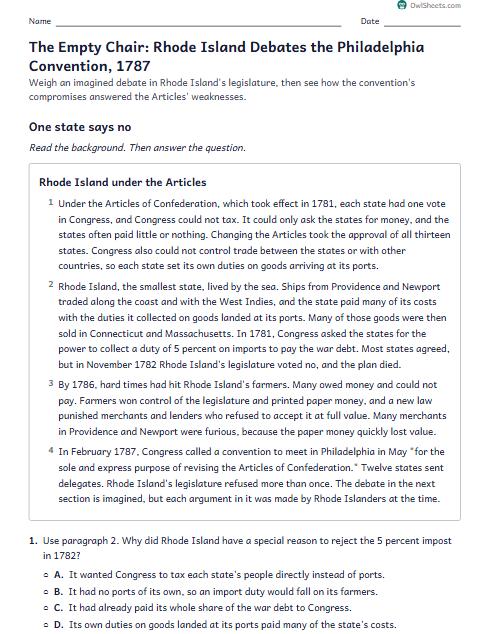
Rhode Island under the Articles
1Under the Articles of Confederation, which took effect in 1781, each state had one vote in Congress, and Congress could not tax. It could only ask the states for money, and the states often paid little or nothing. Changing the Articles took the approval of all thirteen states. Congress also could not control trade between the states or with other countries, so each state set its own duties on goods arriving at its ports.
2Rhode Island, the smallest state, lived by the sea. Ships from Providence and Newport traded along the coast and with the West Indies, and the state paid many of its costs with the duties it collected on goods landed at its ports. Many of those goods were then sold in Connecticut and Massachusetts. In 1781, Congress asked the states for the power to collect a duty of 5 percent on imports to pay the war debt. Most states agreed, but in November 1782 Rhode Island's legislature voted no, and the plan died.
3By 1786, hard times had hit Rhode Island's farmers. Many owed money and could not pay. Farmers won control of the legislature and printed paper money, and a new law punished merchants and lenders who refused to accept it at full value. Many merchants in Providence and Newport were furious, because the paper money quickly lost value.
4In February 1787, Congress called a convention to meet in Philadelphia in May "for the sole and express purpose of revising the Articles of Confederation." Twelve states sent delegates. Rhode Island's legislature refused more than once. The debate in the next section is imagined, but each argument in it was made by Rhode Islanders at the time.
- A. It wanted Congress to tax each state's people directly instead of ports.
- B. It had no ports of its own, so an import duty would fall on its farmers.
- C. It had already paid its whole share of the war debt to Congress.
- D. Its own duties on goods landed at its ports paid many of the state's costs.
The preview shows the first questions. Unlock the worksheet to see all of it.
Related worksheets
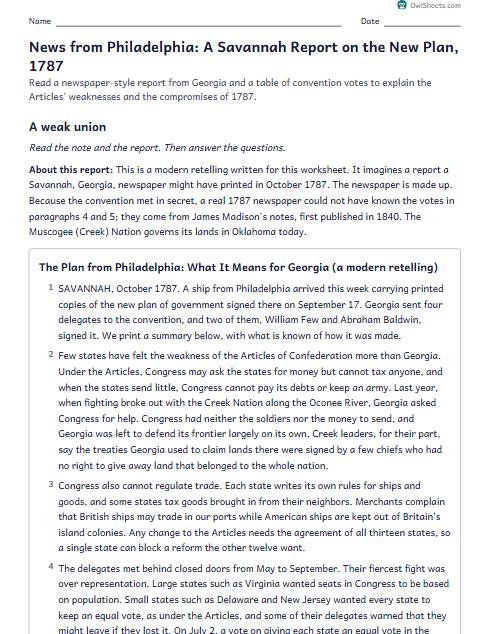
News from Philadelphia: A Savannah Report on the New Plan, 1787
Grade 8 · HIS.8.1
14 questionsPremium
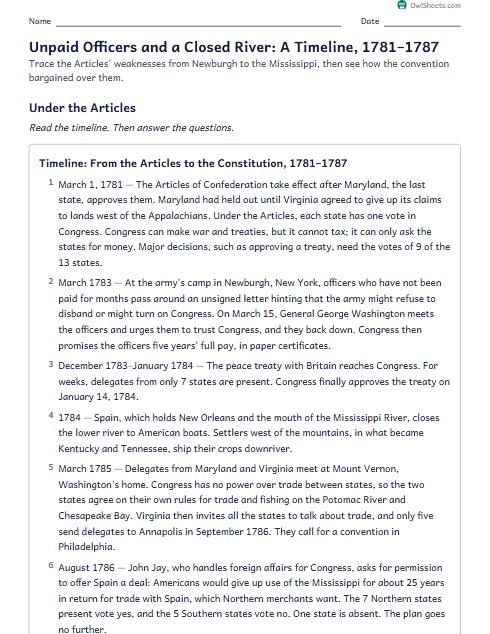
Unpaid Officers and a Closed River: A Timeline, 1781–1787
Grade 8 · HIS.8.1
14 questionsPremium
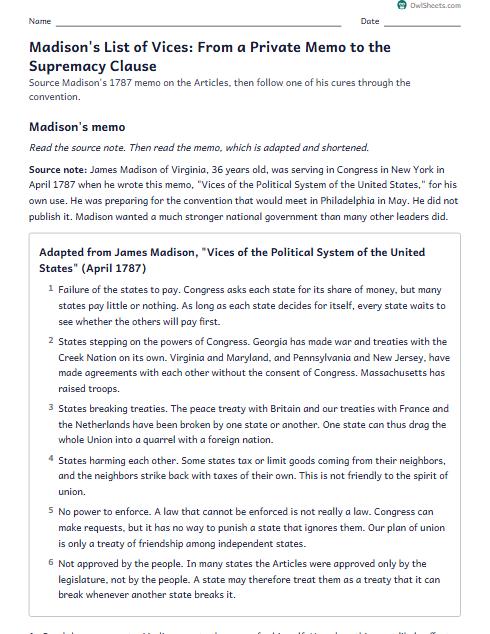
Madison's List of Vices: From a Private Memo to the Supremacy Clause
Grade 8 · HIS.8.1
14 questionsPremium
Sign or Refuse? Franklin and Mason Judge the Constitution
Grade 8 · HIS.8.1
13 questionsPremium
One State, One Vote? The Numbers Behind the Great Compromise
Grade 8 · HIS.8.1
12 questionsPremium
Five Stops, One Weak Government: A Historian's Field Notes, 1781–1787
Grade 8 · HIS.8.1
11 questionsFree