Grade 8 · Social StudiesHIS.8.1Premium
Unpaid Officers and a Closed River: A Timeline, 1781–1787
Grade 8 history: a dated timeline from Newburgh to the Jay–Gardoqui vote shows the Articles' weaknesses and the 1787 bargains over trade and treaties.
Preview
OwlSheets.com
Unpaid Officers and a Closed River: A Timeline, 1781–1787
Trace the Articles' weaknesses from Newburgh to the Mississippi, then see how the convention bargained over them.
Under the Articles
Read the timeline. Then answer the questions.
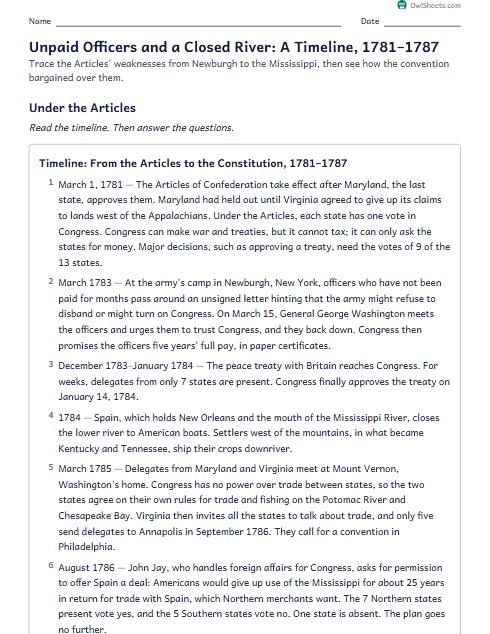
Timeline: From the Articles to the Constitution, 1781–1787
1March 1, 1781 — The Articles of Confederation take effect after Maryland, the last state, approves them. Maryland had held out until Virginia agreed to give up its claims to lands west of the Appalachians. Under the Articles, each state has one vote in Congress. Congress can make war and treaties, but it cannot tax; it can only ask the states for money. Major decisions, such as approving a treaty, need the votes of 9 of the 13 states.
2March 1783 — At the army's camp in Newburgh, New York, officers who have not been paid for months pass around an unsigned letter hinting that the army might refuse to disband or might turn on Congress. On March 15, General George Washington meets the officers and urges them to trust Congress, and they back down. Congress then promises the officers five years' full pay, in paper certificates.
3December 1783–January 1784 — The peace treaty with Britain reaches Congress. For weeks, delegates from only 7 states are present. Congress finally approves the treaty on January 14, 1784.
41784 — Spain, which holds New Orleans and the mouth of the Mississippi River, closes the lower river to American boats. Settlers west of the mountains, in what became Kentucky and Tennessee, ship their crops downriver.
5March 1785 — Delegates from Maryland and Virginia meet at Mount Vernon, Washington's home. Congress has no power over trade between states, so the two states agree on their own rules for trade and fishing on the Potomac River and Chesapeake Bay. Virginia then invites all the states to talk about trade, and only five send delegates to Annapolis in September 1786. They call for a convention in Philadelphia.
6August 1786 — John Jay, who handles foreign affairs for Congress, asks for permission to offer Spain a deal: Americans would give up use of the Mississippi for about 25 years in return for trade with Spain, which Northern merchants want. The 7 Northern states present vote yes, and the 5 Southern states vote no. One state is absent. The plan goes no further.
7May–June 1787 — In Philadelphia, Edmund Randolph presents the Virginia Plan: a Congress of two houses, with seats in both based on population. William Paterson answers with the New Jersey Plan: keep one vote per state, but let Congress tax imports and regulate trade.
8July 16, 1787 — By 5 states to 4, with Massachusetts split, the delegates approve the Great Compromise: seats in the House based on population, and two senators for every state.
9August–September 1787 — Southern delegates fear that a Northern majority will pass trade laws that hurt the crops they ship abroad. The delegates agree that Congress may tax imports but never exports and that trade laws need only a simple majority. At the demand of delegates from South Carolina and Georgia, they also agree that Congress may not ban the bringing in of enslaved people before 1808. Remembering Jay's plan, Southern delegates press for a high bar on treaties: two-thirds of the senators present must approve one.
10September 17, 1787 — Thirty-nine delegates sign the Constitution. Three delegates who are present refuse.
- A. Congress could not make war, so the army answered to the states alone.
- B. Congress gave each state one vote, so large states paid smaller shares.
- C. Congress could ask the states for money but could not collect taxes itself.
- D. Congress could not make treaties, so the war with Britain dragged on.
- A. It raised the danger of Spain closing New York's harbor to trade.
- B. It showed that soldiers wanted Congress to raise taxes on their families.
- C. It raised the danger of an army forcing its will on elected leaders.
- D. It showed that the officers wanted Britain to take back the states.
The preview shows the first questions. Unlock the worksheet to see all of it.
Related worksheets
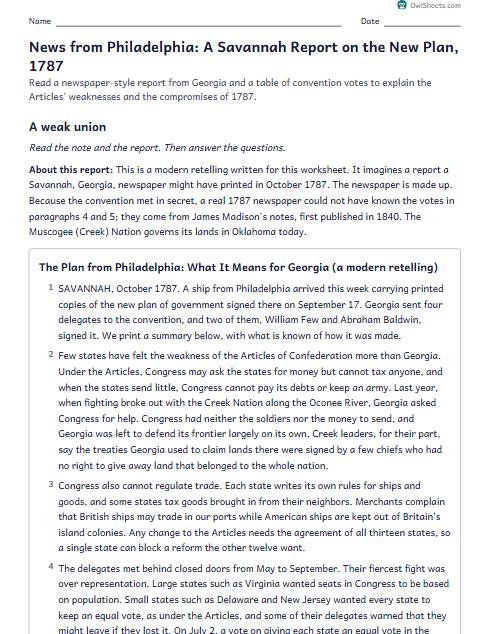
News from Philadelphia: A Savannah Report on the New Plan, 1787
Grade 8 · HIS.8.1
14 questionsPremium
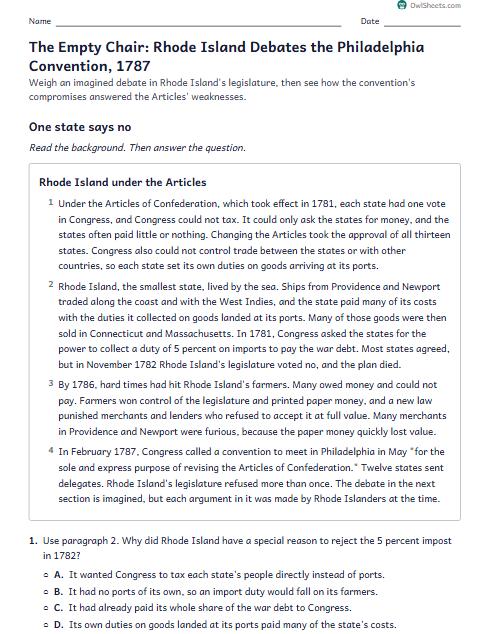
The Empty Chair: Rhode Island Debates the Philadelphia Convention, 1787
Grade 8 · HIS.8.1
14 questionsPremium
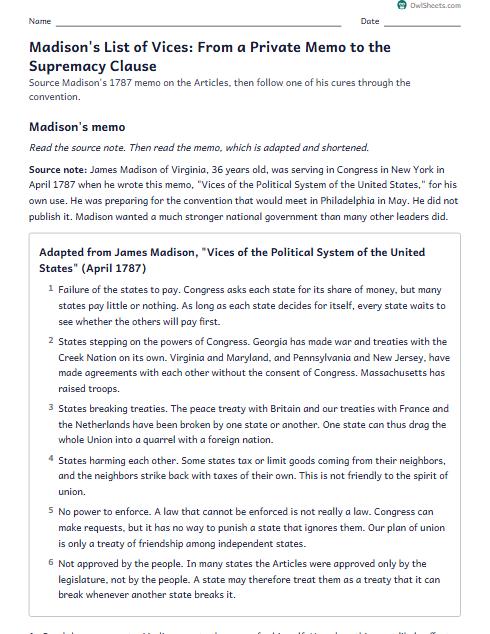
Madison's List of Vices: From a Private Memo to the Supremacy Clause
Grade 8 · HIS.8.1
14 questionsPremium
Sign or Refuse? Franklin and Mason Judge the Constitution
Grade 8 · HIS.8.1
13 questionsPremium
One State, One Vote? The Numbers Behind the Great Compromise
Grade 8 · HIS.8.1
12 questionsPremium
Five Stops, One Weak Government: A Historian's Field Notes, 1781–1787
Grade 8 · HIS.8.1
11 questionsFree