Grade 8 · Social StudiesHIS.8.1Premium
Sign or Refuse? Franklin and Mason Judge the Constitution
Grade 8 history: compare Benjamin Franklin's signing-day speech with George Mason's objections to explain the Articles' weaknesses and the 1787 compromises.
Preview
OwlSheets.com
Sign or Refuse? Franklin and Mason Judge the Constitution
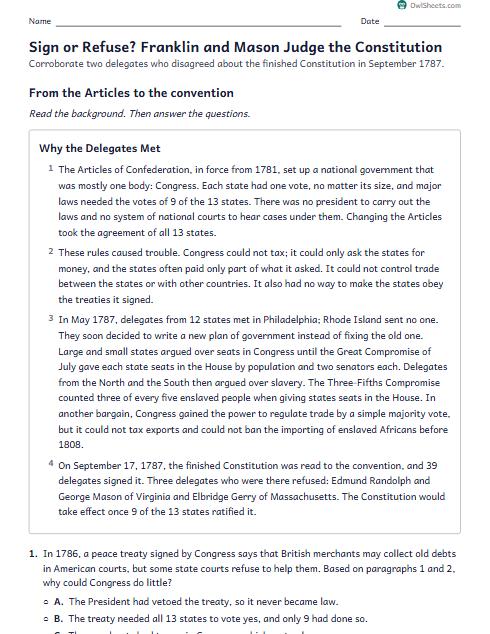
Corroborate two delegates who disagreed about the finished Constitution in September 1787.
From the Articles to the convention
Read the background. Then answer the questions.
Why the Delegates Met
1The Articles of Confederation, in force from 1781, set up a national government that was mostly one body: Congress. Each state had one vote, no matter its size, and major laws needed the votes of 9 of the 13 states. There was no president to carry out the laws and no system of national courts to hear cases under them. Changing the Articles took the agreement of all 13 states.
2These rules caused trouble. Congress could not tax; it could only ask the states for money, and the states often paid only part of what it asked. It could not control trade between the states or with other countries. It also had no way to make the states obey the treaties it signed.
3In May 1787, delegates from 12 states met in Philadelphia; Rhode Island sent no one. They soon decided to write a new plan of government instead of fixing the old one. Large and small states argued over seats in Congress until the Great Compromise of July gave each state seats in the House by population and two senators each. Delegates from the North and the South then argued over slavery. The Three-Fifths Compromise counted three of every five enslaved people when giving states seats in the House. In another bargain, Congress gained the power to regulate trade by a simple majority vote, but it could not tax exports and could not ban the importing of enslaved Africans before 1808.
4On September 17, 1787, the finished Constitution was read to the convention, and 39 delegates signed it. Three delegates who were there refused: Edmund Randolph and George Mason of Virginia and Elbridge Gerry of Massachusetts. The Constitution would take effect once 9 of the 13 states ratified it.
- A. The President had vetoed the treaty, so it never became law.
- B. The treaty needed all 13 states to vote yes, and only 9 had done so.
- C. The merchants had to sue in Congress, which met only once a year.
- D. It had no national courts and no way to make states obey treaties.
Changing the Articles needed the agreement of states, but the Constitution would take effect once states ratified it.
The preview shows the first questions. Unlock the worksheet to see all of it.
Related worksheets
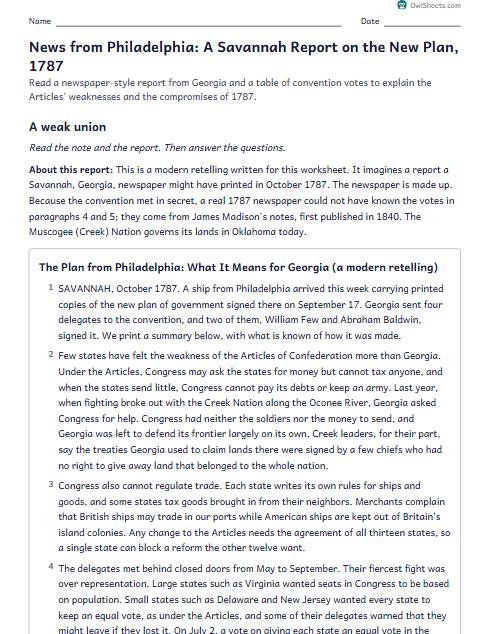
News from Philadelphia: A Savannah Report on the New Plan, 1787
Grade 8 · HIS.8.1
14 questionsPremium
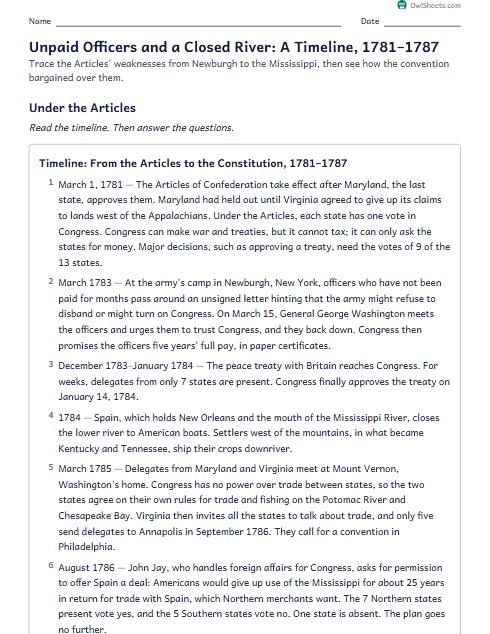
Unpaid Officers and a Closed River: A Timeline, 1781–1787
Grade 8 · HIS.8.1
14 questionsPremium
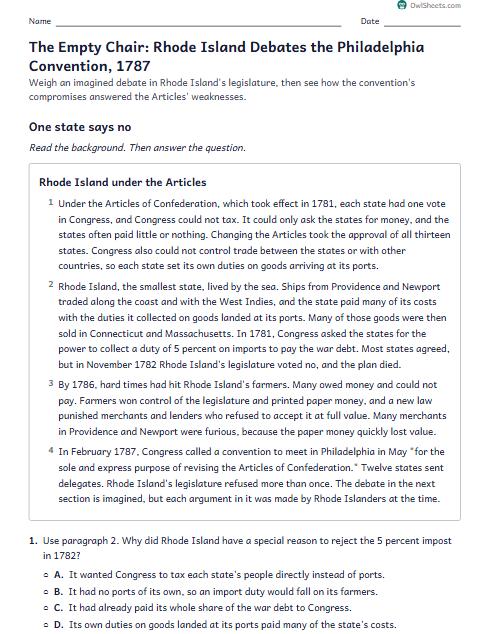
The Empty Chair: Rhode Island Debates the Philadelphia Convention, 1787
Grade 8 · HIS.8.1
14 questionsPremium
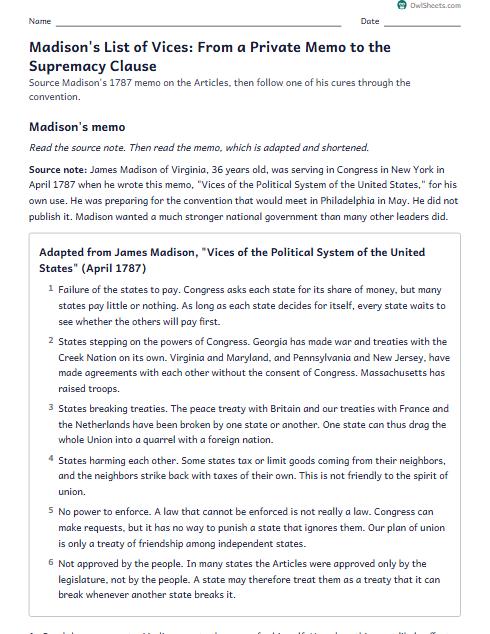
Madison's List of Vices: From a Private Memo to the Supremacy Clause
Grade 8 · HIS.8.1
14 questionsPremium
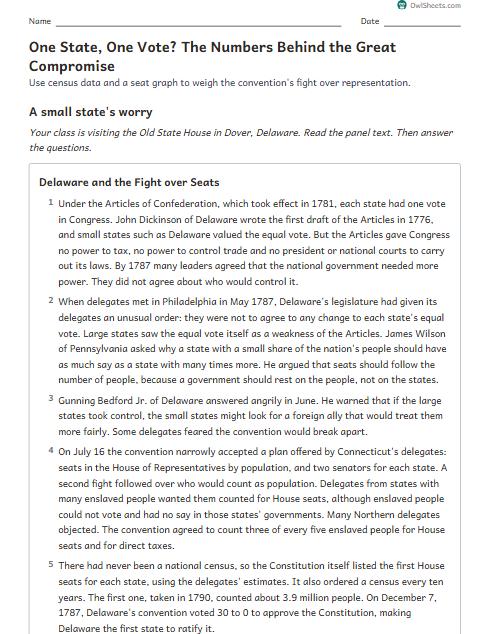
One State, One Vote? The Numbers Behind the Great Compromise
Grade 8 · HIS.8.1
12 questionsPremium
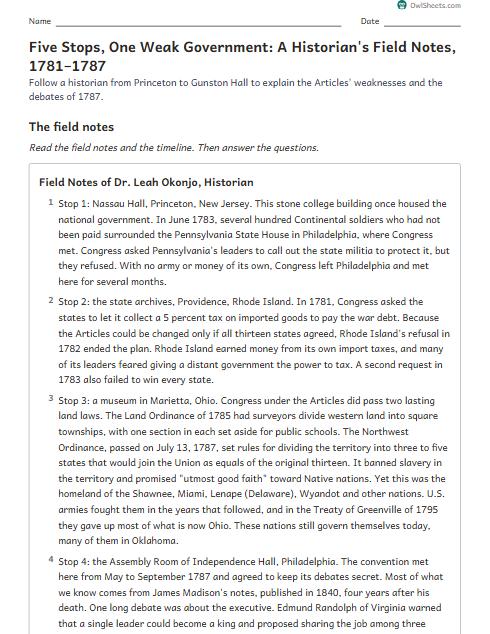
Five Stops, One Weak Government: A Historian's Field Notes, 1781–1787
Grade 8 · HIS.8.1
11 questionsFree