Grade 8 · Social StudiesHIS.8.4Premium
Men May Listen, Not Speak: A Salem, Ohio, Newspaper Reports, 1850
Grade 8 reform movements: a retold 1850 newspaper report on the Salem, Ohio, women's convention links women's rights, abolition and free public schools.
Preview
OwlSheets.com
Men May Listen, Not Speak: A Salem, Ohio, Newspaper Reports, 1850
Read a retold 1850 report on the Salem women's convention and track women's rights, abolition and school reform in Ohio.
The April 1850 report
Read the newspaper report. It is a modern retelling written as if at the time. Then answer the questions.
The Columbiana County Advocate, Salem, Ohio, April 27, 1850 (a modern retelling)
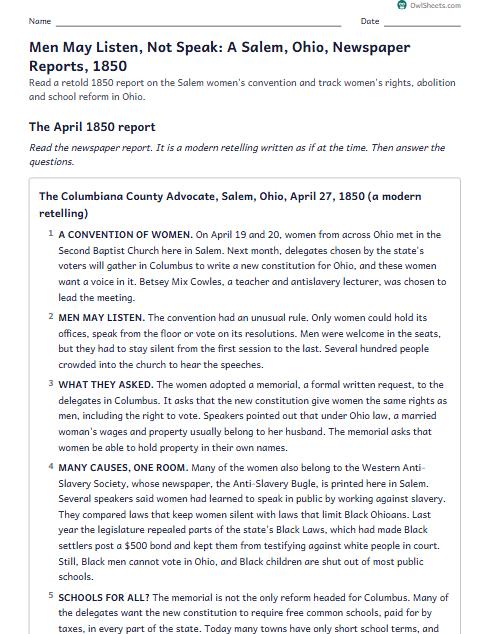
1A CONVENTION OF WOMEN. On April 19 and 20, women from across Ohio met in the Second Baptist Church here in Salem. Next month, delegates chosen by the state's voters will gather in Columbus to write a new constitution for Ohio, and these women want a voice in it. Betsey Mix Cowles, a teacher and antislavery lecturer, was chosen to lead the meeting.
2MEN MAY LISTEN. The convention had an unusual rule. Only women could hold its offices, speak from the floor or vote on its resolutions. Men were welcome in the seats, but they had to stay silent from the first session to the last. Several hundred people crowded into the church to hear the speeches.
3WHAT THEY ASKED. The women adopted a memorial, a formal written request, to the delegates in Columbus. It asks that the new constitution give women the same rights as men, including the right to vote. Speakers pointed out that under Ohio law, a married woman's wages and property usually belong to her husband. The memorial asks that women be able to hold property in their own names.
4MANY CAUSES, ONE ROOM. Many of the women also belong to the Western Anti-Slavery Society, whose newspaper, the Anti-Slavery Bugle, is printed here in Salem. Several speakers said women had learned to speak in public by working against slavery. They compared laws that keep women silent with laws that limit Black Ohioans. Last year the legislature repealed parts of the state's Black Laws, which had made Black settlers post a $500 bond and kept them from testifying against white people in court. Still, Black men cannot vote in Ohio, and Black children are shut out of most public schools.
5SCHOOLS FOR ALL? The memorial is not the only reform headed for Columbus. Many of the delegates want the new constitution to require free common schools, paid for by taxes, in every part of the state. Today many towns have only short school terms, and families who can pay send their children to private academies.
6WHAT NEXT. The memorial will be carried to Columbus when the delegates meet. As news of the convention spread through town this week, our reporter heard both cheers and laughter.
- A. Congress had told Ohio to rewrite its voting laws by the end of the year.
- B. Ohio's voters had just chosen the first women to serve in the legislature.
- C. A new state constitution was about to be written, and they hoped to shape it.
- D. The Anti-Slavery Society had ordered every county to hold a meeting that spring.
- A. To show that women could lead and run a public meeting by themselves
- B. To keep the meeting short so the memorial would reach Columbus in time
- C. To make room for the women, since the church had too few seats for everyone
- D. To follow an Ohio law that kept men out of meetings held by women
The preview shows the first questions. Unlock the worksheet to see all of it.
Related worksheets
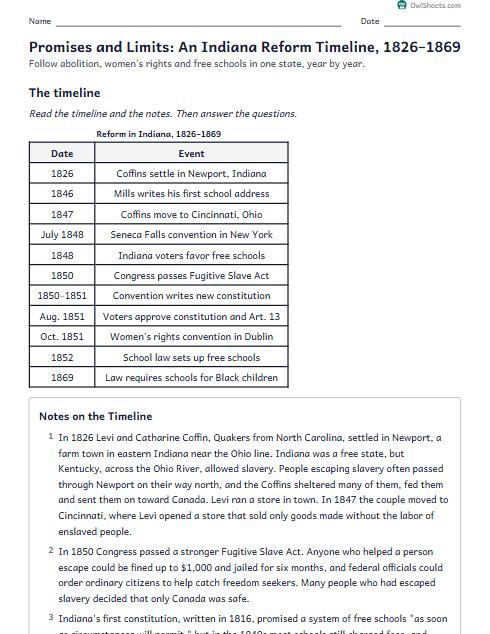
Promises and Limits: An Indiana Reform Timeline, 1826–1869
Grade 8 · HIS.8.4
14 questionsPremium
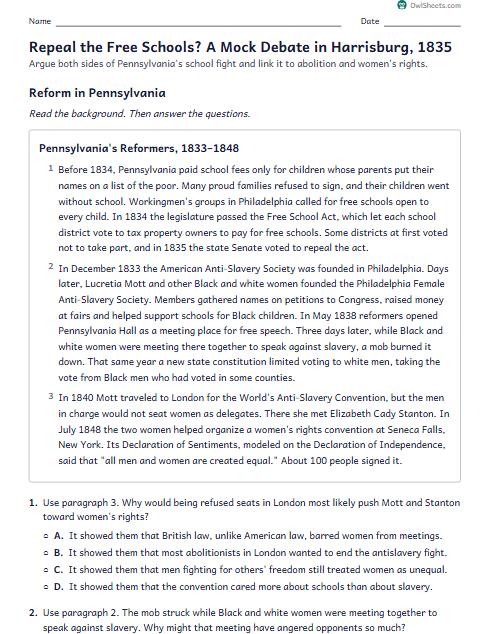
Repeal the Free Schools? A Mock Debate in Harrisburg, 1835
Grade 8 · HIS.8.4
14 questionsPremium
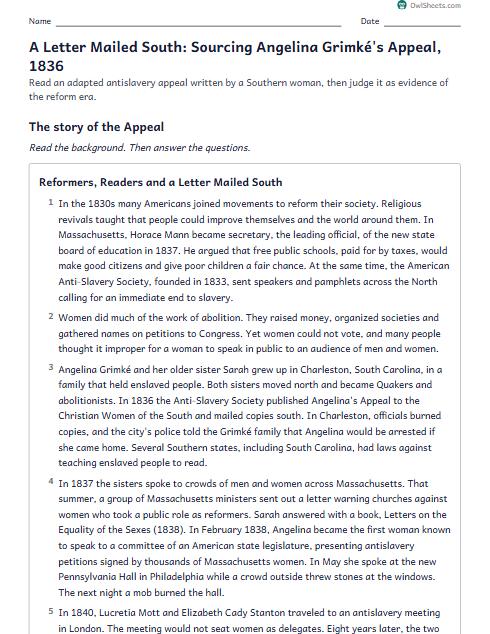
A Letter Mailed South: Sourcing Angelina Grimké's Appeal, 1836
Grade 8 · HIS.8.4
13 questionsPremium
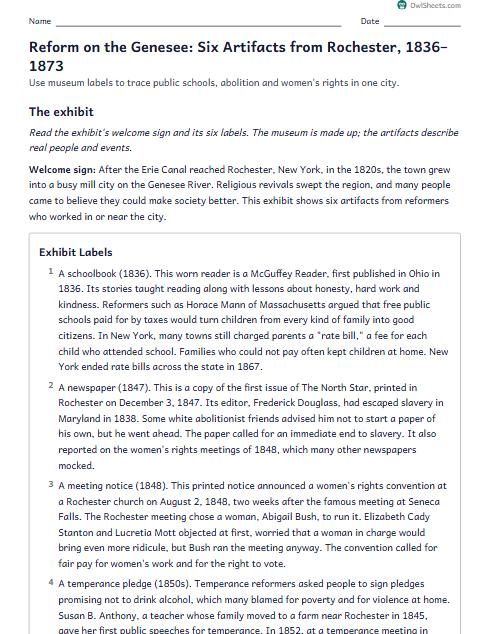
Reform on the Genesee: Six Artifacts from Rochester, 1836–1873
Grade 8 · HIS.8.4
13 questionsPremium
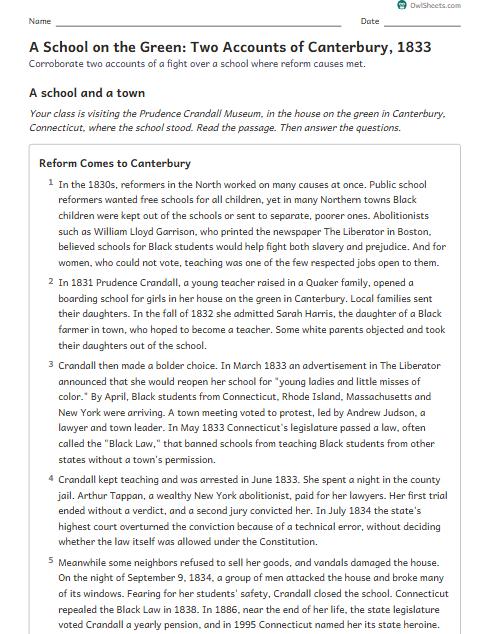
A School on the Green: Two Accounts of Canterbury, 1833
Grade 8 · HIS.8.4
11 questionsPremium
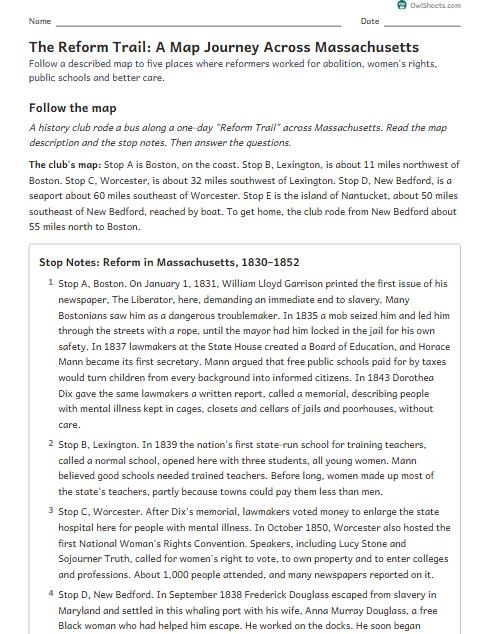
The Reform Trail: A Map Journey Across Massachusetts
Grade 8 · HIS.8.4
11 questionsPremium