Grade 8 · Social StudiesHIS.8.4Premium
Promises and Limits: An Indiana Reform Timeline, 1826–1869
Grade 8 reform movements: an Indiana timeline traces the Coffins' Underground Railroad work, Caleb Mills's school campaign and women's rights.
Preview
OwlSheets.com
Promises and Limits: An Indiana Reform Timeline, 1826–1869
Follow abolition, women's rights and free schools in one state, year by year.
The timeline
Read the timeline and the notes. Then answer the questions.
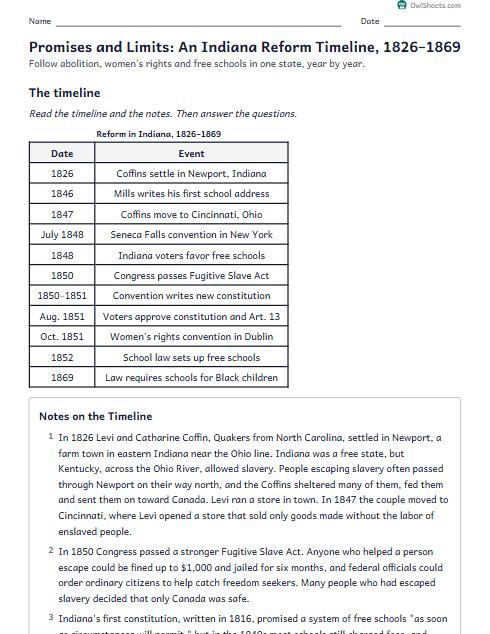
| Date | Event |
|---|---|
| 1826 | Coffins settle in Newport, Indiana |
| 1846 | Mills writes his first school address |
| 1847 | Coffins move to Cincinnati, Ohio |
| July 1848 | Seneca Falls convention in New York |
| 1848 | Indiana voters favor free schools |
| 1850 | Congress passes Fugitive Slave Act |
| 1850–1851 | Convention writes new constitution |
| Aug. 1851 | Voters approve constitution and Art. 13 |
| Oct. 1851 | Women's rights convention in Dublin |
| 1852 | School law sets up free schools |
| 1869 | Law requires schools for Black children |
Notes on the Timeline
1In 1826 Levi and Catharine Coffin, Quakers from North Carolina, settled in Newport, a farm town in eastern Indiana near the Ohio line. Indiana was a free state, but Kentucky, across the Ohio River, allowed slavery. People escaping slavery often passed through Newport on their way north, and the Coffins sheltered many of them, fed them and sent them on toward Canada. Levi ran a store in town. In 1847 the couple moved to Cincinnati, where Levi opened a store that sold only goods made without the labor of enslaved people.
2In 1850 Congress passed a stronger Fugitive Slave Act. Anyone who helped a person escape could be fined up to $1,000 and jailed for six months, and federal officials could order ordinary citizens to help catch freedom seekers. Many people who had escaped slavery decided that only Canada was safe.
3Indiana's first constitution, written in 1816, promised a system of free schools "as soon as circumstances will permit," but in the 1840s most schools still charged fees, and many children did not attend. Caleb Mills, a minister born in New Hampshire who taught at Wabash College, wrote a long address to the state's lawmakers in most years from 1846 to 1852 and signed it "One of the People." In 1848 a majority of voters in a statewide vote said they wanted free schools paid for by taxes.
4In 1850 and 1851, delegates met in Indianapolis to write a new constitution. It promised common schools "wherein tuition shall be without charge." Delegate Robert Dale Owen argued that a married woman should keep control of her own property. Under Indiana law at the time, the property a woman brought into a marriage, and often the wages she earned, came under her husband's control. The delegates narrowly rejected his plan, but in 1851 a group of Indiana women gave Owen a silver pitcher to thank him. The convention also wrote Article 13, which banned Black people from moving into the state. In August 1851 voters approved the constitution and, in a separate vote, approved Article 13 by a wide margin.
5That October, women and men met in Dublin, Indiana, for the state's first women's rights convention. Amanda Way, a Quaker reformer from Winchester who also worked against slavery, helped call the meeting. In 1852 the legislature passed a school law that set up free schools paid for by a state tax, but Black children were left out of them. Not until 1869 did a new law require schools for Black children, and those schools were kept separate.
The Coffins lived in Newport for about years. Black children in Indiana waited years after the 1852 school law for a law requiring schools for them.
The preview shows the first questions. Unlock the worksheet to see all of it.
Related worksheets
Men May Listen, Not Speak: A Salem, Ohio, Newspaper Reports, 1850
Grade 8 · HIS.8.4
14 questionsPremium
Repeal the Free Schools? A Mock Debate in Harrisburg, 1835
Grade 8 · HIS.8.4
14 questionsPremium
A Letter Mailed South: Sourcing Angelina Grimké's Appeal, 1836
Grade 8 · HIS.8.4
13 questionsPremium
Reform on the Genesee: Six Artifacts from Rochester, 1836–1873
Grade 8 · HIS.8.4
13 questionsPremium
A School on the Green: Two Accounts of Canterbury, 1833
Grade 8 · HIS.8.4
11 questionsPremium
The Reform Trail: A Map Journey Across Massachusetts
Grade 8 · HIS.8.4
11 questionsPremium