Grade 8 · Social StudiesHIS.8.4Premium
Reform on the Genesee: Six Artifacts from Rochester, 1836–1873
Grade 8 reform movements: six museum artifacts from Rochester, New York, on public schools, abolition, the Underground Railroad, temperance and women's rights.
Preview
OwlSheets.com
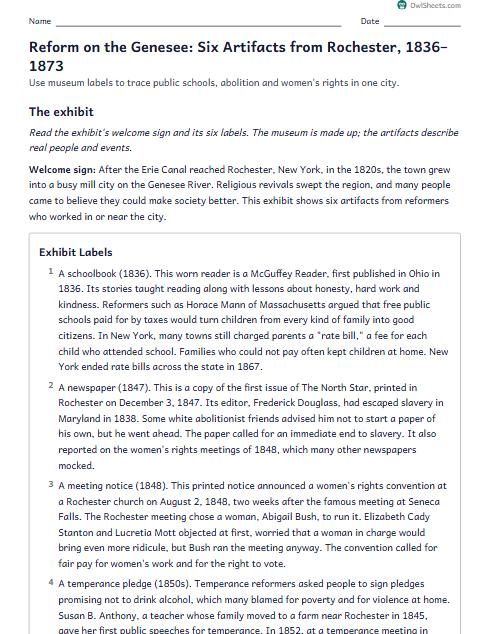
Reform on the Genesee: Six Artifacts from Rochester, 1836–1873
Use museum labels to trace public schools, abolition and women's rights in one city.
The exhibit
Read the exhibit's welcome sign and its six labels. The museum is made up; the artifacts describe real people and events.
Exhibit Labels
1A schoolbook (1836). This worn reader is a McGuffey Reader, first published in Ohio in 1836. Its stories taught reading along with lessons about honesty, hard work and kindness. Reformers such as Horace Mann of Massachusetts argued that free public schools paid for by taxes would turn children from every kind of family into good citizens. In New York, many towns still charged parents a "rate bill," a fee for each child who attended school. Families who could not pay often kept children at home. New York ended rate bills across the state in 1867.
2A newspaper (1847). This is a copy of the first issue of The North Star, printed in Rochester on December 3, 1847. Its editor, Frederick Douglass, had escaped slavery in Maryland in 1838. Some white abolitionist friends advised him not to start a paper of his own, but he went ahead. The paper called for an immediate end to slavery. It also reported on the women's rights meetings of 1848, which many other newspapers mocked.
3A meeting notice (1848). This printed notice announced a women's rights convention at a Rochester church on August 2, 1848, two weeks after the famous meeting at Seneca Falls. The Rochester meeting chose a woman, Abigail Bush, to run it. Elizabeth Cady Stanton and Lucretia Mott objected at first, worried that a woman in charge would bring even more ridicule, but Bush ran the meeting anyway. The convention called for fair pay for women's work and for the right to vote.
4A temperance pledge (1850s). Temperance reformers asked people to sign pledges promising not to drink alcohol, which many blamed for poverty and for violence at home. Susan B. Anthony, a teacher whose family moved to a farm near Rochester in 1845, gave her first public speeches for temperance. In 1852, at a temperance meeting in Albany, she rose to speak and was told that the women were there to listen and learn, not to speak. She walked out and soon helped found a women's temperance society.
5A lantern (1850s). This lantern stands for the Underground Railroad, the secret network that helped people escape slavery. From Rochester's port on Lake Ontario, freedom seekers could take a boat to Canada. After Congress passed the Fugitive Slave Act in 1850, people who had escaped could be seized even in free states, and anyone who helped them could be fined or jailed. Douglass hid freedom seekers in his Rochester home. Harriet Tubman, who had escaped slavery in Maryland, guided groups north toward Canada.
6A court record (1873). In November 1872, Anthony and fourteen other women voted in a Rochester election. She argued that the Fourteenth Amendment made women citizens and that citizens had the right to vote. She was arrested, and in 1873 a judge found her guilty of voting illegally and fined her $100. She never paid the fine. Women in New York did not win the right to vote until 1917.
- A. They would learn at home, since New York towns had no schools of their own.
- B. Some might stay home, since she would owe a fee for each child in school.
- C. They would go to school free, since Mann's plan was already law in New York.
- D. They would go to a church school, since town schools did not teach reading.
The preview shows the first questions. Unlock the worksheet to see all of it.
Related worksheets
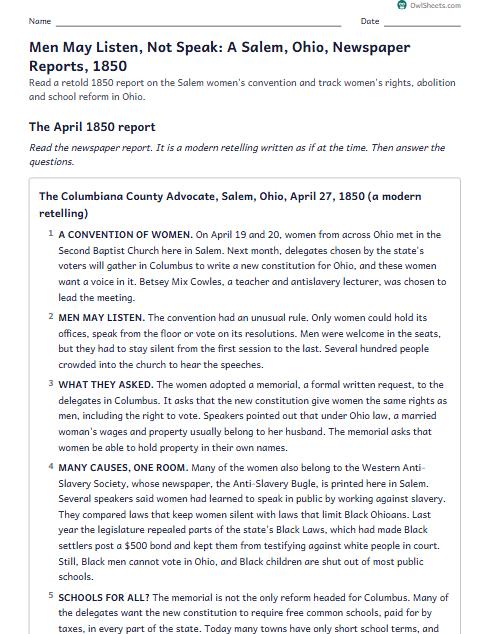
Men May Listen, Not Speak: A Salem, Ohio, Newspaper Reports, 1850
Grade 8 · HIS.8.4
14 questionsPremium
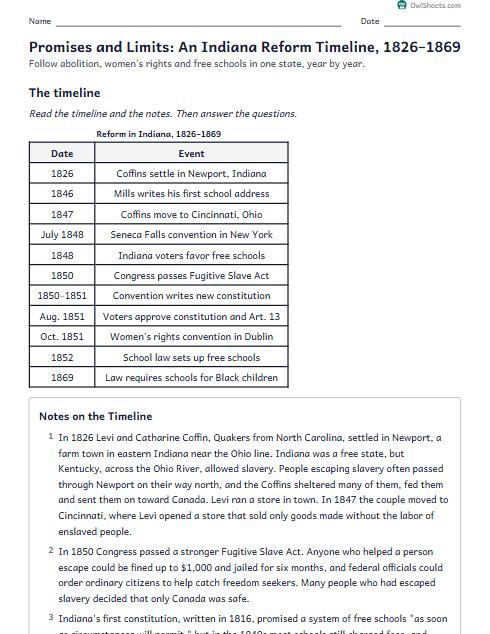
Promises and Limits: An Indiana Reform Timeline, 1826–1869
Grade 8 · HIS.8.4
14 questionsPremium
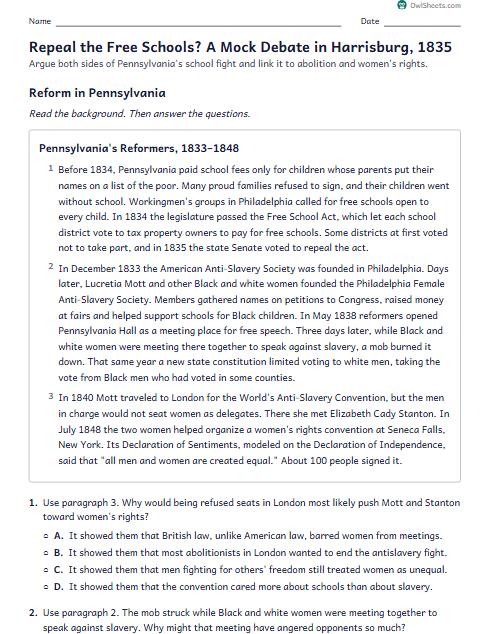
Repeal the Free Schools? A Mock Debate in Harrisburg, 1835
Grade 8 · HIS.8.4
14 questionsPremium
A Letter Mailed South: Sourcing Angelina Grimké's Appeal, 1836
Grade 8 · HIS.8.4
13 questionsPremium
A School on the Green: Two Accounts of Canterbury, 1833
Grade 8 · HIS.8.4
11 questionsPremium
The Reform Trail: A Map Journey Across Massachusetts
Grade 8 · HIS.8.4
11 questionsPremium