Grade 8 · Social StudiesHIS.8.4Premium
Repeal the Free Schools? A Mock Debate in Harrisburg, 1835
Grade 8 reform era: a mock 1835 Pennsylvania House debate on free public schools, plus Philadelphia abolitionists and the road to Seneca Falls.
Preview
OwlSheets.com
Repeal the Free Schools? A Mock Debate in Harrisburg, 1835
Argue both sides of Pennsylvania's school fight and link it to abolition and women's rights.
Reform in Pennsylvania
Read the background. Then answer the questions.
Pennsylvania's Reformers, 1833–1848
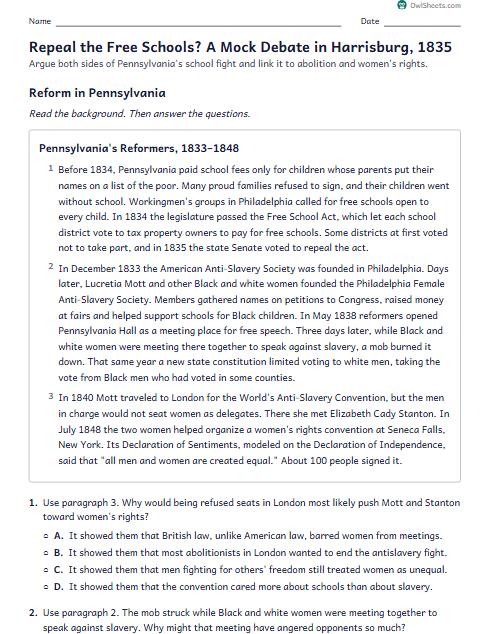
1Before 1834, Pennsylvania paid school fees only for children whose parents put their names on a list of the poor. Many proud families refused to sign, and their children went without school. Workingmen's groups in Philadelphia called for free schools open to every child. In 1834 the legislature passed the Free School Act, which let each school district vote to tax property owners to pay for free schools. Some districts at first voted not to take part, and in 1835 the state Senate voted to repeal the act.
2In December 1833 the American Anti-Slavery Society was founded in Philadelphia. Days later, Lucretia Mott and other Black and white women founded the Philadelphia Female Anti-Slavery Society. Members gathered names on petitions to Congress, raised money at fairs and helped support schools for Black children. In May 1838 reformers opened Pennsylvania Hall as a meeting place for free speech. Three days later, while Black and white women were meeting there together to speak against slavery, a mob burned it down. That same year a new state constitution limited voting to white men, taking the vote from Black men who had voted in some counties.
3In 1840 Mott traveled to London for the World's Anti-Slavery Convention, but the men in charge would not seat women as delegates. There she met Elizabeth Cady Stanton. In July 1848 the two women helped organize a women's rights convention at Seneca Falls, New York. Its Declaration of Sentiments, modeled on the Declaration of Independence, said that "all men and women are created equal." About 100 people signed it.
- A. It showed them that British law, unlike American law, barred women from meetings.
- B. It showed them that most abolitionists in London wanted to end the antislavery fight.
- C. It showed them that men fighting for others' freedom still treated women as unequal.
- D. It showed them that the convention cared more about schools than about slavery.
- A. Many thought the hall had been built with money taken from the state.
- B. Many thought the meeting had been planned to raise taxes for free schools.
- C. Many thought the women had broken a state law against petitions to Congress.
- D. Many thought women of both races speaking out in public broke the social order.
The preview shows the first questions. Unlock the worksheet to see all of it.
Related worksheets
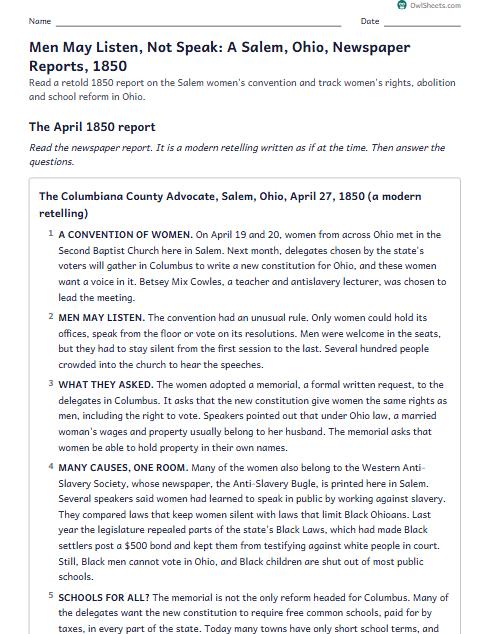
Men May Listen, Not Speak: A Salem, Ohio, Newspaper Reports, 1850
Grade 8 · HIS.8.4
14 questionsPremium
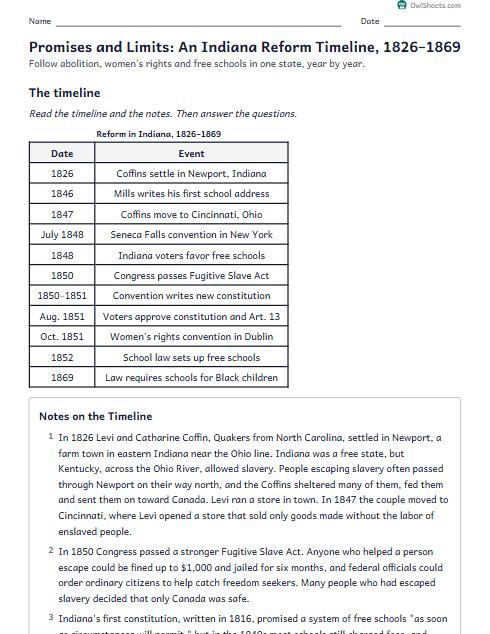
Promises and Limits: An Indiana Reform Timeline, 1826–1869
Grade 8 · HIS.8.4
14 questionsPremium
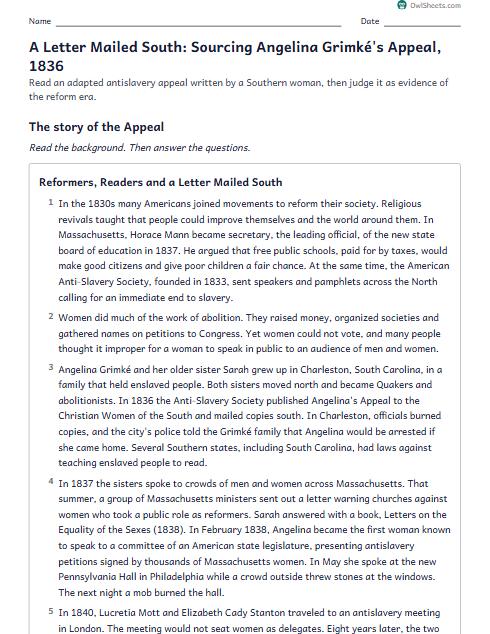
A Letter Mailed South: Sourcing Angelina Grimké's Appeal, 1836
Grade 8 · HIS.8.4
13 questionsPremium
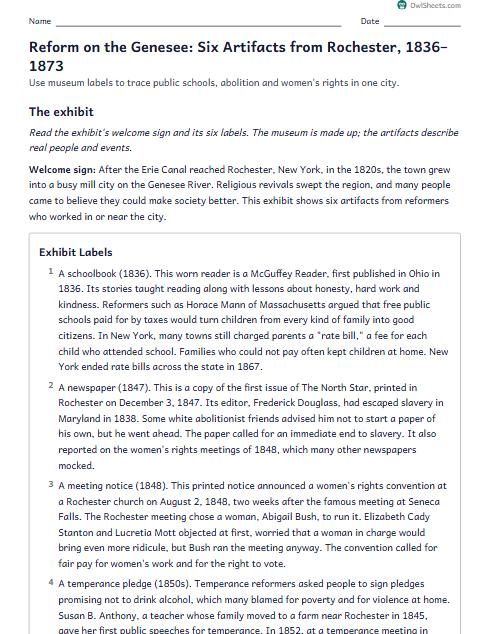
Reform on the Genesee: Six Artifacts from Rochester, 1836–1873
Grade 8 · HIS.8.4
13 questionsPremium
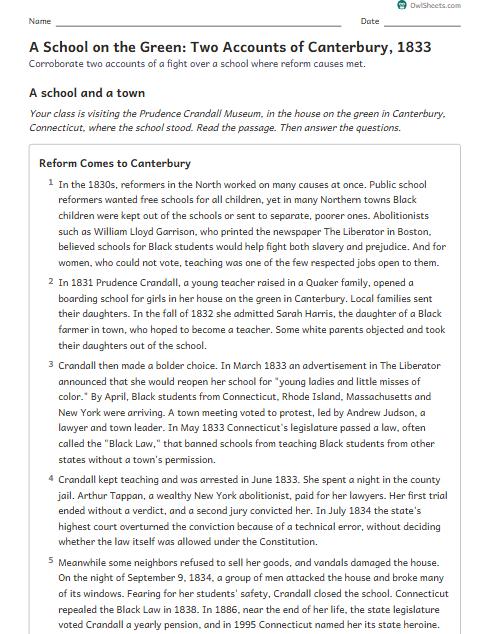
A School on the Green: Two Accounts of Canterbury, 1833
Grade 8 · HIS.8.4
11 questionsPremium
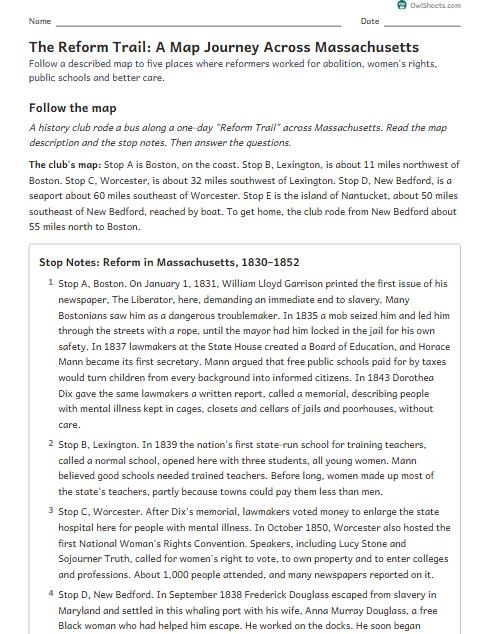
The Reform Trail: A Map Journey Across Massachusetts
Grade 8 · HIS.8.4
11 questionsPremium