Grade 7 · Social StudiesHIS.7.7Premium
Venice to Rome: A Route Guide to New Ideas
Grade 7 history: a route guide from Venice to Rome links Aldine printing, perspective in art and Galileo's telescope observations.
Preview
OwlSheets.com
Venice to Rome: A Route Guide to New Ideas
Follow a described map through five Italian cities to see how printing, art and Galileo's telescope changed ideas.
Follow the route
Read the route guide. Then answer the questions.
A Route Guide: Five Cities of New Ideas, 1420–1611
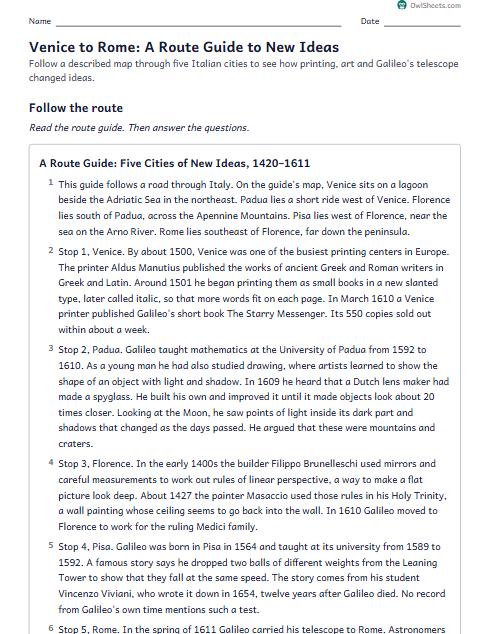
1This guide follows a road through Italy. On the guide's map, Venice sits on a lagoon beside the Adriatic Sea in the northeast. Padua lies a short ride west of Venice. Florence lies south of Padua, across the Apennine Mountains. Pisa lies west of Florence, near the sea on the Arno River. Rome lies southeast of Florence, far down the peninsula.
2Stop 1, Venice. By about 1500, Venice was one of the busiest printing centers in Europe. The printer Aldus Manutius published the works of ancient Greek and Roman writers in Greek and Latin. Around 1501 he began printing them as small books in a new slanted type, later called italic, so that more words fit on each page. In March 1610 a Venice printer published Galileo's short book The Starry Messenger. Its 550 copies sold out within about a week.
3Stop 2, Padua. Galileo taught mathematics at the University of Padua from 1592 to 1610. As a young man he had also studied drawing, where artists learned to show the shape of an object with light and shadow. In 1609 he heard that a Dutch lens maker had made a spyglass. He built his own and improved it until it made objects look about 20 times closer. Looking at the Moon, he saw points of light inside its dark part and shadows that changed as the days passed. He argued that these were mountains and craters.
4Stop 3, Florence. In the early 1400s the builder Filippo Brunelleschi used mirrors and careful measurements to work out rules of linear perspective, a way to make a flat picture look deep. About 1427 the painter Masaccio used those rules in his Holy Trinity, a wall painting whose ceiling seems to go back into the wall. In 1610 Galileo moved to Florence to work for the ruling Medici family.
5Stop 4, Pisa. Galileo was born in Pisa in 1564 and taught at its university from 1589 to 1592. A famous story says he dropped two balls of different weights from the Leaning Tower to show that they fall at the same speed. The story comes from his student Vincenzo Viviani, who wrote it down in 1654, twelve years after Galileo died. No record from Galileo's own time mentions such a test.
6Stop 5, Rome. In the spring of 1611 Galileo carried his telescope to Rome. Astronomers at the Collegio Romano, a Jesuit college, looked for themselves and agreed that the four moons of Jupiter were real. Most of them still did not accept that Earth moves around the Sun. Visitors to Rome could also see Raphael's School of Athens, painted from 1509 to 1511, which shows ancient Greek thinkers such as Plato and Aristotle in a grand hall drawn in perspective.
- A. West, then southeast
- B. West, then south
- C. East, then northeast
- D. East, then southeast
- A. More students could own and carry copies of ancient texts.
- B. Painters could copy the books' pictures onto church walls.
- C. Readers no longer had to know Greek or Latin to use them.
- D. Scholars could stop studying ancient writers at university.
The preview shows the first questions. Unlock the worksheet to see all of it.
Related worksheets
Saturn in Three Parts: A News Sheet of the New Learning
Grade 7 · HIS.7.7
15 questionsPremium
Chapels, Presses and a Telescope: Padua's Timeline, 1305–1633
Grade 7 · HIS.7.7
14 questionsPremium
Harriot or Galileo? A Council Chooses a Moon for the Mural
Grade 7 · HIS.7.7
13 questionsPremium
Printed in Nuremberg: Woodcuts, a Rhinoceros and New Skies
Grade 7 · HIS.7.7
14 questionsPremium
Senses, Reason and the Heavens: Galileo's Letter to a Grand Duchess
Grade 7 · HIS.7.7
11 questionsFree
Spots on the Sun: Galileo and Scheiner Disagree
Grade 7 · HIS.7.7
11 questionsPremium