Grade 7 · Social StudiesHIS.7.7Premium
Saturn in Three Parts: A News Sheet of the New Learning
Grade 7 history: a modern news-sheet retelling covers Caxton's press, Raphael's perspective and Galileo's puzzling Saturn observations of 1610 to 1612.
Preview
OwlSheets.com
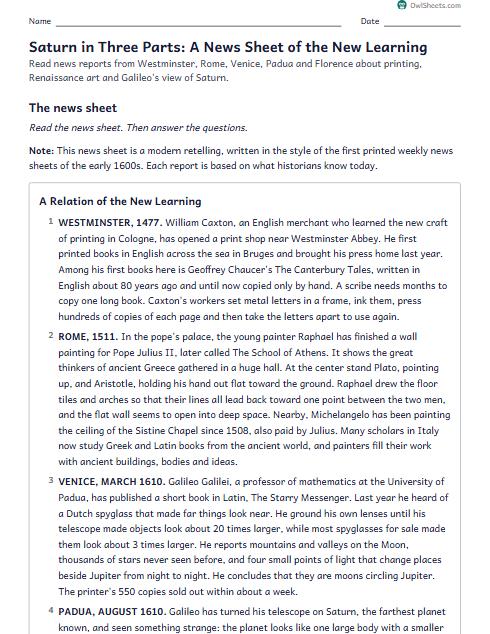
Saturn in Three Parts: A News Sheet of the New Learning
Read news reports from Westminster, Rome, Venice, Padua and Florence about printing, Renaissance art and Galileo's view of Saturn.
The news sheet
Read the news sheet. Then answer the questions.
A Relation of the New Learning
1WESTMINSTER, 1477. William Caxton, an English merchant who learned the new craft of printing in Cologne, has opened a print shop near Westminster Abbey. He first printed books in English across the sea in Bruges and brought his press home last year. Among his first books here is Geoffrey Chaucer's The Canterbury Tales, written in English about 80 years ago and until now copied only by hand. A scribe needs months to copy one long book. Caxton's workers set metal letters in a frame, ink them, press hundreds of copies of each page and then take the letters apart to use again.
2ROME, 1511. In the pope's palace, the young painter Raphael has finished a wall painting for Pope Julius II, later called The School of Athens. It shows the great thinkers of ancient Greece gathered in a huge hall. At the center stand Plato, pointing up, and Aristotle, holding his hand out flat toward the ground. Raphael drew the floor tiles and arches so that their lines all lead back toward one point between the two men, and the flat wall seems to open into deep space. Nearby, Michelangelo has been painting the ceiling of the Sistine Chapel since 1508, also paid by Julius. Many scholars in Italy now study Greek and Latin books from the ancient world, and painters fill their work with ancient buildings, bodies and ideas.
3VENICE, MARCH 1610. Galileo Galilei, a professor of mathematics at the University of Padua, has published a short book in Latin, The Starry Messenger. Last year he heard of a Dutch spyglass that made far things look near. He ground his own lenses until his telescope made objects look about 20 times larger, while most spyglasses for sale made them look about 3 times larger. He reports mountains and valleys on the Moon, thousands of stars never seen before, and four small points of light that change places beside Jupiter from night to night. He concludes that they are moons circling Jupiter. The printer's 550 copies sold out within about a week.
4PADUA, AUGUST 1610. Galileo has turned his telescope on Saturn, the farthest planet known, and seen something strange: the planet looks like one large body with a smaller one pressed close on each side. Instead of announcing it, he has sent a scrambled message of 37 letters to Prague, where Johannes Kepler, the emperor's mathematician, is trying to solve it. Only Galileo knows the sentence hidden inside. (Editor's note: in November 1610 Galileo revealed it: "I have observed the highest planet threefold." Kepler had guessed wrong, reading the letters as a message about Mars.)
5FLORENCE, DECEMBER 1612. Galileo, now mathematician to the Grand Duke of Tuscany, reports that Saturn's two side bodies have disappeared. He has looked again and again and sees only a single round planet. He admits he does not know what has happened, but he predicts that the side bodies will come back into view within a few years. (Editor's note: they did. In 1659 the Dutch scientist Christiaan Huygens, using a stronger telescope, explained that Saturn is circled by a thin, flat ring. When the ring is seen edge-on from Earth, it almost disappears.)
- A. Readers could finally see a work that scribes had refused to copy.
- B. Readers no longer had to learn English to enjoy Chaucer's stories.
- C. Readers could buy the first book ever written in the English language.
- D. Readers who knew little Latin could now buy copies of a long work.
The preview shows the first questions. Unlock the worksheet to see all of it.
Related worksheets
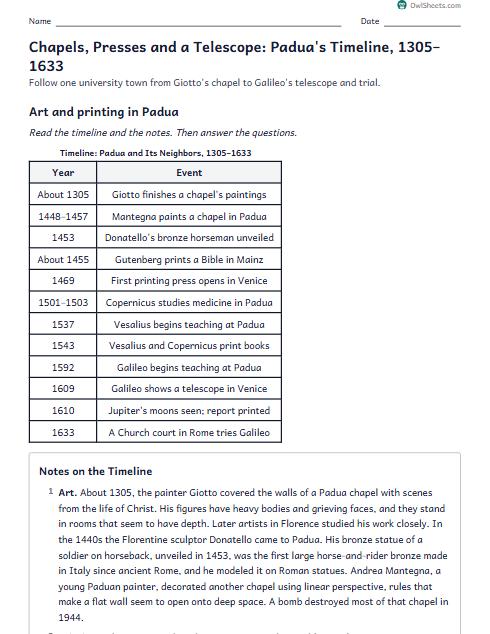
Chapels, Presses and a Telescope: Padua's Timeline, 1305–1633
Grade 7 · HIS.7.7
14 questionsPremium
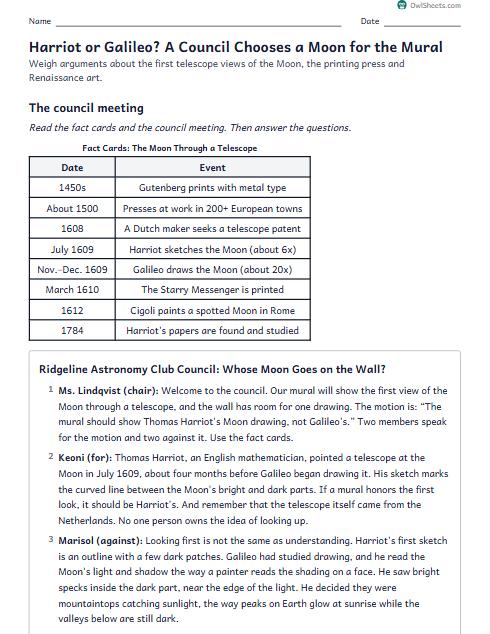
Harriot or Galileo? A Council Chooses a Moon for the Mural
Grade 7 · HIS.7.7
13 questionsPremium
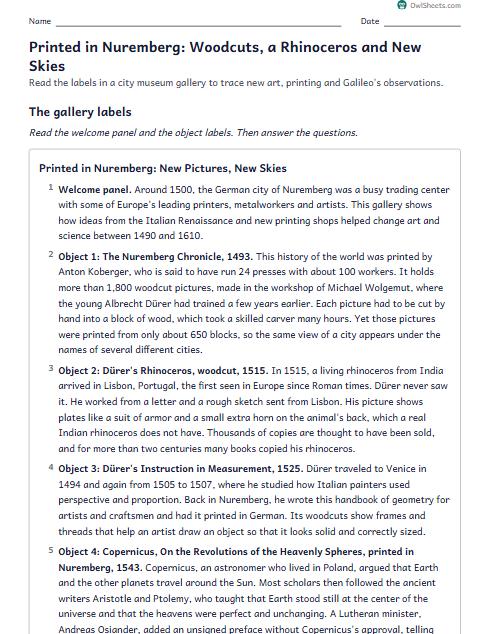
Printed in Nuremberg: Woodcuts, a Rhinoceros and New Skies
Grade 7 · HIS.7.7
14 questionsPremium
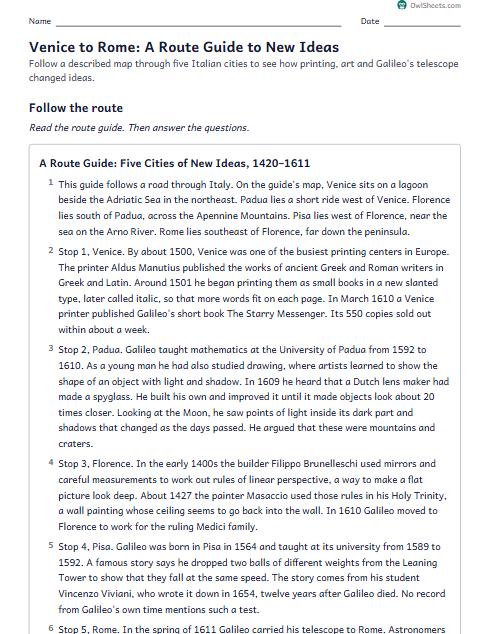
Venice to Rome: A Route Guide to New Ideas
Grade 7 · HIS.7.7
13 questionsPremium
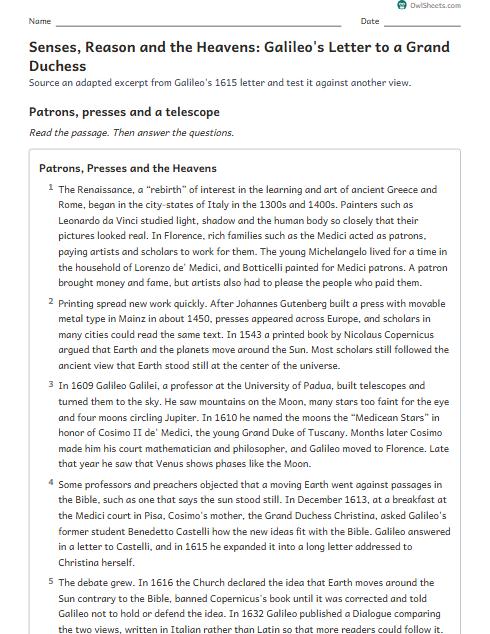
Senses, Reason and the Heavens: Galileo's Letter to a Grand Duchess
Grade 7 · HIS.7.7
11 questionsFree
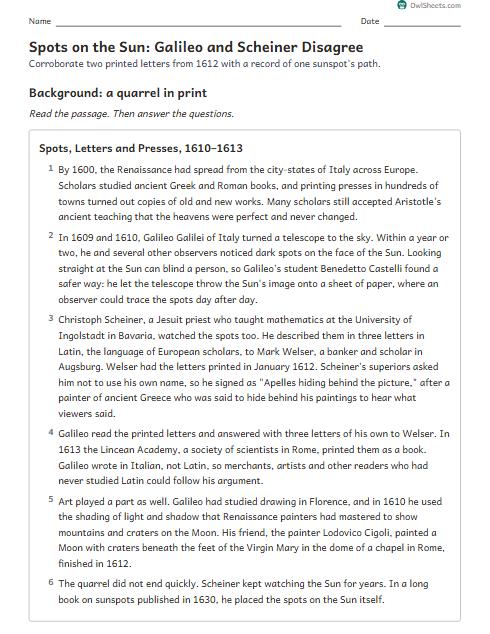
Spots on the Sun: Galileo and Scheiner Disagree
Grade 7 · HIS.7.7
11 questionsPremium