Grade 7 · Social StudiesHIS.7.7Premium
Harriot or Galileo? A Council Chooses a Moon for the Mural
Grade 7 history: a student council debates Harriot's and Galileo's 1609 Moon drawings to show how printing, Renaissance art and observation changed science.
Preview
OwlSheets.com
Harriot or Galileo? A Council Chooses a Moon for the Mural
Weigh arguments about the first telescope views of the Moon, the printing press and Renaissance art.
The council meeting
Read the fact cards and the council meeting. Then answer the questions.
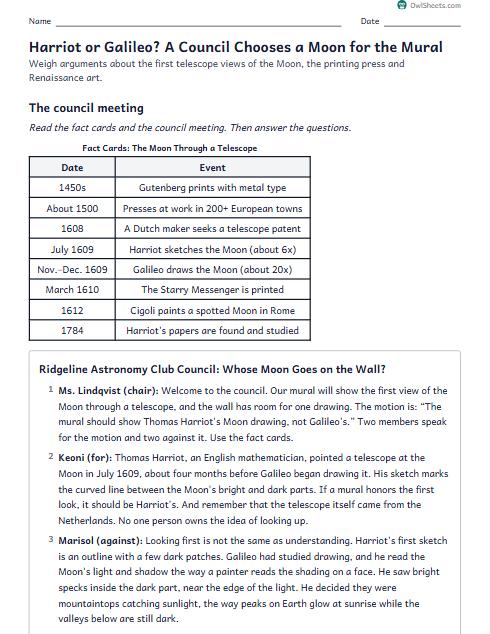
| Date | Event |
|---|---|
| 1450s | Gutenberg prints with metal type |
| About 1500 | Presses at work in 200+ European towns |
| 1608 | A Dutch maker seeks a telescope patent |
| July 1609 | Harriot sketches the Moon (about 6x) |
| Nov.–Dec. 1609 | Galileo draws the Moon (about 20x) |
| March 1610 | The Starry Messenger is printed |
| 1612 | Cigoli paints a spotted Moon in Rome |
| 1784 | Harriot's papers are found and studied |
Ridgeline Astronomy Club Council: Whose Moon Goes on the Wall?
1Ms. Lindqvist (chair): Welcome to the council. Our mural will show the first view of the Moon through a telescope, and the wall has room for one drawing. The motion is: “The mural should show Thomas Harriot's Moon drawing, not Galileo's.” Two members speak for the motion and two against it. Use the fact cards.
2Keoni (for): Thomas Harriot, an English mathematician, pointed a telescope at the Moon in July 1609, about four months before Galileo began drawing it. His sketch marks the curved line between the Moon's bright and dark parts. If a mural honors the first look, it should be Harriot's. And remember that the telescope itself came from the Netherlands. No one person owns the idea of looking up.
3Marisol (against): Looking first is not the same as understanding. Harriot's first sketch is an outline with a few dark patches. Galileo had studied drawing, and he read the Moon's light and shadow the way a painter reads the shading on a face. He saw bright specks inside the dark part, near the edge of the light. He decided they were mountaintops catching sunlight, the way peaks on Earth glow at sunrise while the valleys below are still dark.
4Farida (for): Galileo's telescope magnified about 20 times, and Harriot's first one about 6, so of course Galileo saw more. After Harriot read Galileo's book in 1610, he made a full map of the Moon that some historians praise for placing its features carefully. Harriot was no stranger to printing, either: he had published a book about Virginia in 1588. He simply chose not to rush his Moon work into print.
5Desmond (against): Choosing not to print is the problem. Galileo's book, The Starry Messenger, was printed in Venice in March 1610, about 550 copies, and it sold out quickly. It also reported that the Milky Way is made of countless stars and that four moons circle Jupiter. Readers across Europe could point their own telescopes and check him. Harriot's notes stayed in a private house until 1784. A drawing nobody saw could not change anyone's mind. Galileo's Moon even reached art: in 1612, his friend the painter Ludovico Cigoli showed an uneven, spotted Moon in a chapel dome in Rome.
6Ms. Lindqvist: Thank you. Before you vote, decide what a first view of the Moon should mean on our wall: the first person to look, or the first view that changed what people knew.
- A. 1608: A Dutch maker seeks a telescope patent
- B. 1450s: Gutenberg prints with metal type
- C. 1784: Harriot's papers are found and studied
- D. March 1610: The Starry Messenger is printed
The preview shows the first questions. Unlock the worksheet to see all of it.
Related worksheets
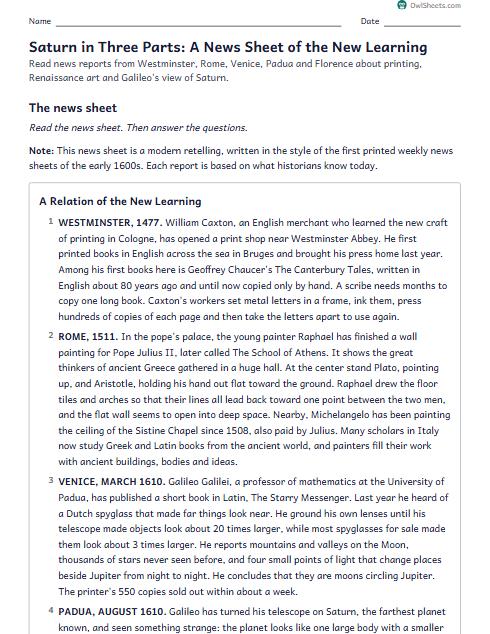
Saturn in Three Parts: A News Sheet of the New Learning
Grade 7 · HIS.7.7
15 questionsPremium
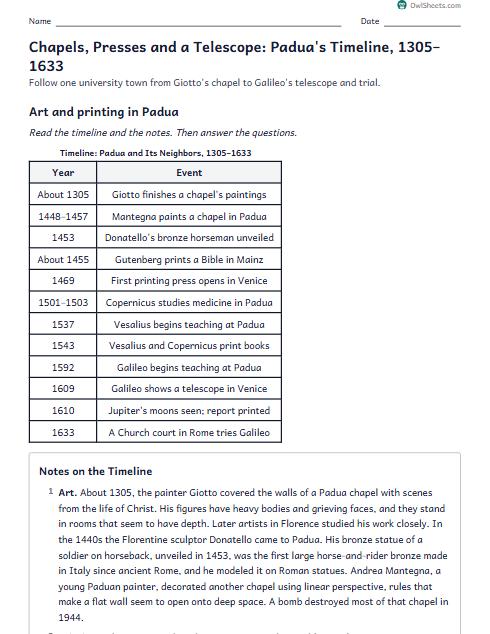
Chapels, Presses and a Telescope: Padua's Timeline, 1305–1633
Grade 7 · HIS.7.7
14 questionsPremium
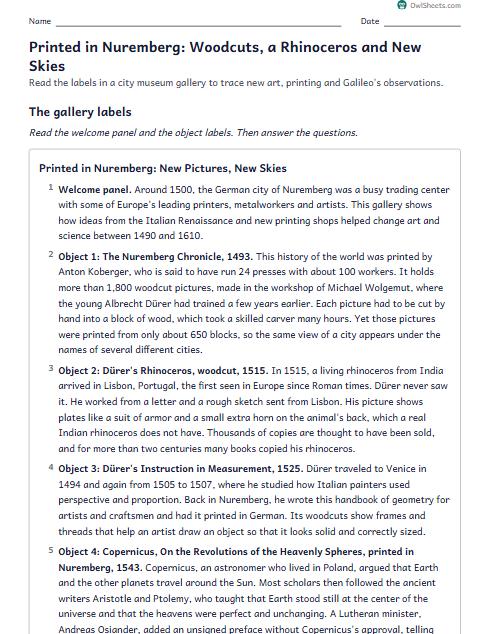
Printed in Nuremberg: Woodcuts, a Rhinoceros and New Skies
Grade 7 · HIS.7.7
14 questionsPremium
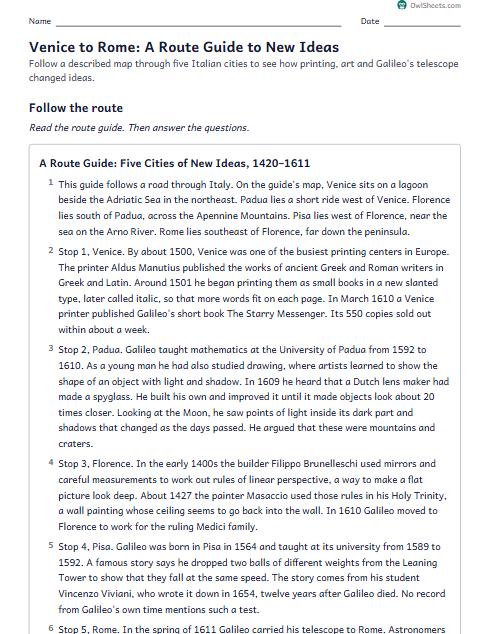
Venice to Rome: A Route Guide to New Ideas
Grade 7 · HIS.7.7
13 questionsPremium
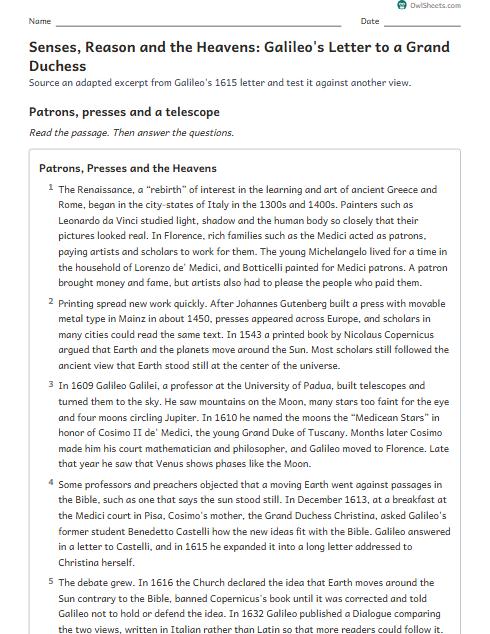
Senses, Reason and the Heavens: Galileo's Letter to a Grand Duchess
Grade 7 · HIS.7.7
11 questionsFree
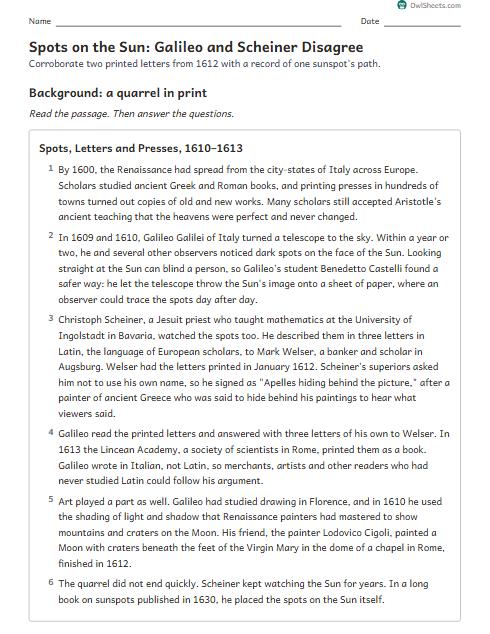
Spots on the Sun: Galileo and Scheiner Disagree
Grade 7 · HIS.7.7
11 questionsPremium