Grade 7 · Social StudiesHIS.7.7Premium
Printed in Nuremberg: Woodcuts, a Rhinoceros and New Skies
Grade 7 history: museum labels on the Nuremberg Chronicle, Dürer's rhinoceros, Copernicus and Galileo's Starry Messenger, with a print-run table.
Preview
OwlSheets.com
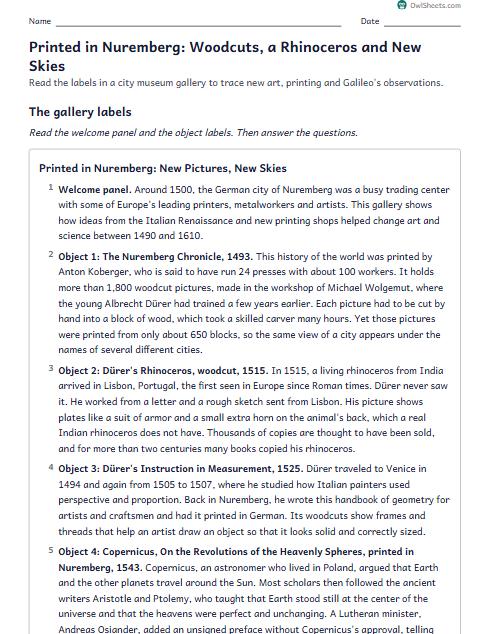
Printed in Nuremberg: Woodcuts, a Rhinoceros and New Skies
Read the labels in a city museum gallery to trace new art, printing and Galileo's observations.
The gallery labels
Read the welcome panel and the object labels. Then answer the questions.
Printed in Nuremberg: New Pictures, New Skies
1Welcome panel. Around 1500, the German city of Nuremberg was a busy trading center with some of Europe's leading printers, metalworkers and artists. This gallery shows how ideas from the Italian Renaissance and new printing shops helped change art and science between 1490 and 1610.
2Object 1: The Nuremberg Chronicle, 1493. This history of the world was printed by Anton Koberger, who is said to have run 24 presses with about 100 workers. It holds more than 1,800 woodcut pictures, made in the workshop of Michael Wolgemut, where the young Albrecht Dürer had trained a few years earlier. Each picture had to be cut by hand into a block of wood, which took a skilled carver many hours. Yet those pictures were printed from only about 650 blocks, so the same view of a city appears under the names of several different cities.
3Object 2: Dürer's Rhinoceros, woodcut, 1515. In 1515, a living rhinoceros from India arrived in Lisbon, Portugal, the first seen in Europe since Roman times. Dürer never saw it. He worked from a letter and a rough sketch sent from Lisbon. His picture shows plates like a suit of armor and a small extra horn on the animal's back, which a real Indian rhinoceros does not have. Thousands of copies are thought to have been sold, and for more than two centuries many books copied his rhinoceros.
4Object 3: Dürer's Instruction in Measurement, 1525. Dürer traveled to Venice in 1494 and again from 1505 to 1507, where he studied how Italian painters used perspective and proportion. Back in Nuremberg, he wrote this handbook of geometry for artists and craftsmen and had it printed in German. Its woodcuts show frames and threads that help an artist draw an object so that it looks solid and correctly sized.
5Object 4: Copernicus, On the Revolutions of the Heavenly Spheres, printed in Nuremberg, 1543. Copernicus, an astronomer who lived in Poland, argued that Earth and the other planets travel around the Sun. Most scholars then followed the ancient writers Aristotle and Ptolemy, who taught that Earth stood still at the center of the universe and that the heavens were perfect and unchanging. A Lutheran minister, Andreas Osiander, added an unsigned preface without Copernicus's approval, telling readers the idea was a tool for calculating, not a claim about what was true. Copernicus died in 1543, the year the book came out.
6Object 5: Galileo, The Starry Messenger, printed in Venice, 1610. Galileo, a professor at Padua, built a telescope that made objects look about 20 times larger. In ink drawings he showed the Moon's surface as rough, with mountains and valleys like those on Earth. He reported that the Milky Way was a crowd of stars too faint to see one by one, and he described four moons circling Jupiter. The first 550 copies were soon sold out.
7Object 6: Kepler, Conversation with the Starry Messenger, printed in Prague, 1610. Johannes Kepler, the emperor's astronomer in Prague, quickly printed this letter supporting Galileo, although he did not yet have a good telescope. Later in 1610, he borrowed a telescope made by Galileo and watched Jupiter for several nights. In 1611 he printed a short report saying that he had seen the moons too.
- A. The pictures were painted in by hand after the pages were printed.
- B. The same woodcut was printed for several different cities.
- C. The pictures were drawn by Dürer, who had never left Nuremberg.
- D. The city views were copied from ancient Roman maps of Europe.
- A. Reusing blocks saved the many hours it took to carve new ones.
- B. The law in Nuremberg limited how many blocks a printer could own.
- C. Readers wanted to see each city drawn exactly the same way.
- D. Wood was too scarce in Germany to carve more than a few blocks.
The preview shows the first questions. Unlock the worksheet to see all of it.
Related worksheets
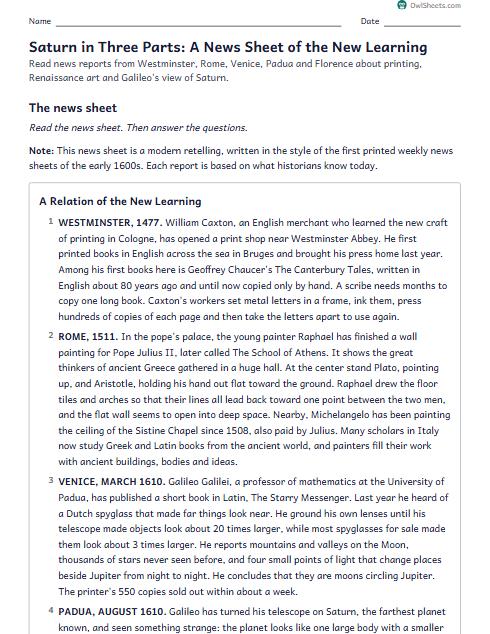
Saturn in Three Parts: A News Sheet of the New Learning
Grade 7 · HIS.7.7
15 questionsPremium
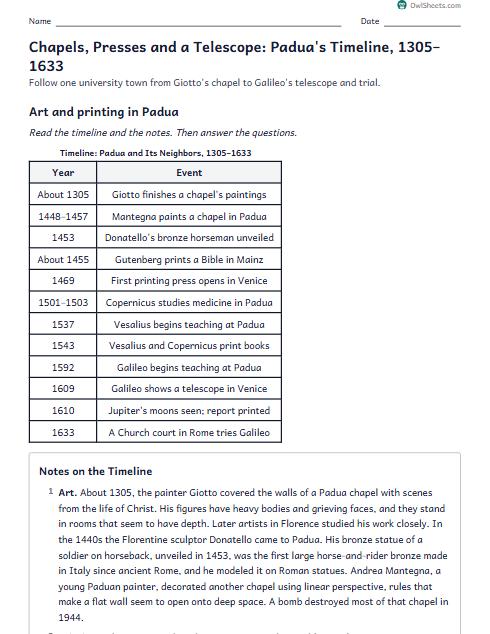
Chapels, Presses and a Telescope: Padua's Timeline, 1305–1633
Grade 7 · HIS.7.7
14 questionsPremium
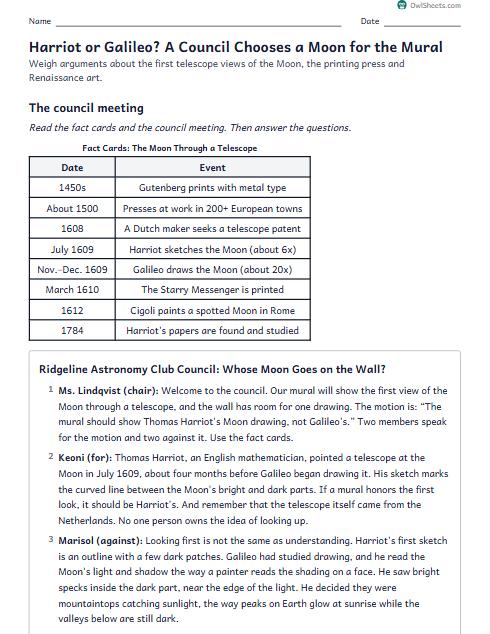
Harriot or Galileo? A Council Chooses a Moon for the Mural
Grade 7 · HIS.7.7
13 questionsPremium
Venice to Rome: A Route Guide to New Ideas
Grade 7 · HIS.7.7
13 questionsPremium
Senses, Reason and the Heavens: Galileo's Letter to a Grand Duchess
Grade 7 · HIS.7.7
11 questionsFree
Spots on the Sun: Galileo and Scheiner Disagree
Grade 7 · HIS.7.7
11 questionsPremium