Grade 7 · Social StudiesHIS.7.7Premium
Chapels, Presses and a Telescope: Padua's Timeline, 1305–1633
Grade 7 history: a timeline of Padua from Giotto to Galileo links Renaissance art, the printing press, Vesalius and Galileo's 1610 observations.
Preview
OwlSheets.com
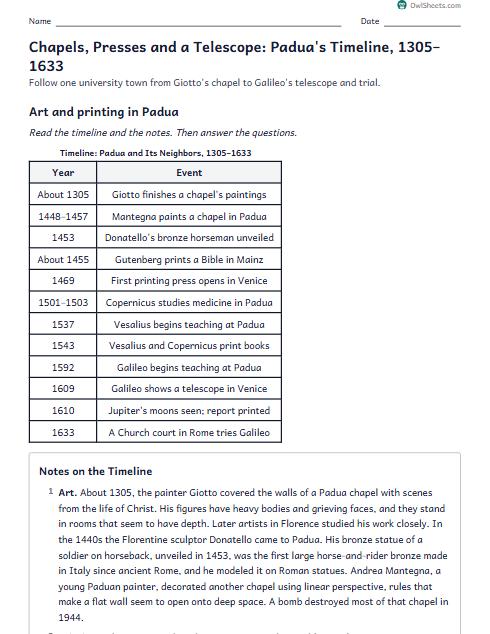
Chapels, Presses and a Telescope: Padua's Timeline, 1305–1633
Follow one university town from Giotto's chapel to Galileo's telescope and trial.
Art and printing in Padua
Read the timeline and the notes. Then answer the questions.
| Year | Event |
|---|---|
| About 1305 | Giotto finishes a chapel's paintings |
| 1448–1457 | Mantegna paints a chapel in Padua |
| 1453 | Donatello's bronze horseman unveiled |
| About 1455 | Gutenberg prints a Bible in Mainz |
| 1469 | First printing press opens in Venice |
| 1501–1503 | Copernicus studies medicine in Padua |
| 1537 | Vesalius begins teaching at Padua |
| 1543 | Vesalius and Copernicus print books |
| 1592 | Galileo begins teaching at Padua |
| 1609 | Galileo shows a telescope in Venice |
| 1610 | Jupiter's moons seen; report printed |
| 1633 | A Church court in Rome tries Galileo |
Notes on the Timeline
1Art. About 1305, the painter Giotto covered the walls of a Padua chapel with scenes from the life of Christ. His figures have heavy bodies and grieving faces, and they stand in rooms that seem to have depth. Later artists in Florence studied his work closely. In the 1440s the Florentine sculptor Donatello came to Padua. His bronze statue of a soldier on horseback, unveiled in 1453, was the first large horse-and-rider bronze made in Italy since ancient Rome, and he modeled it on Roman statues. Andrea Mantegna, a young Paduan painter, decorated another chapel using linear perspective, rules that make a flat wall seem to open onto deep space. A bomb destroyed most of that chapel in 1944.
2Printing. Johannes Gutenberg began printing with movable metal type in Mainz, Germany, in the 1450s. In 1469 the first press opened in Venice, about 25 miles east of Padua, and by 1500 Venice was one of the busiest printing centers in Europe. Students in Padua could now buy printed copies of the books they studied. Pictures could also be cut into wood blocks and printed again and again.
3The body. For centuries, medical professors read aloud from Galen, a Greek doctor of the 100s CE, while a helper cut open a body. Andreas Vesalius, who began teaching at Padua in 1537, did the cutting himself in front of his students. He found that some of Galen's descriptions fit apes and other animals better than humans. In 1543 his book On the Fabric of the Human Body, with large woodcut pictures, was printed in Basel. The same year, a book by Nicolaus Copernicus was printed in Nuremberg. It argued that Earth moves around the Sun, but most scholars still held the ancient view that Earth stood still at the center of the universe, with everything in the heavens circling it.
4The sky. Galileo Galilei taught mathematics at Padua from 1592. In 1609 he heard of a Dutch spyglass and built his own. In August he showed one to Venice's leaders from a bell tower near the city's harbor, and they raised his pay. That winter he turned a stronger telescope to the sky. Many scholars believed the Moon was a perfect, smooth sphere, but Galileo saw mountains and craters on it. In January 1610 he saw four points of light near Jupiter. Night after night they changed places but stayed with the planet, so he concluded that they circled it. In March 1610 a Venice printer published his report, The Starry Messenger, and reports say its 550 copies sold out within a week. Galileo named the moons after the Medici, the ruling family of Florence, and that September he left Padua to become their court mathematician.
5Afterward. Galileo kept arguing that Copernicus was right. In 1633 a Church court in Rome condemned him, banned his newest book and ordered him to stay in his house near Florence for the rest of his life. By then, printed copies of his earlier work were in libraries across Europe.
Galileo taught at Padua for years, from 1592 until he left in 1610.
Donatello's horseman was unveiled about years after Giotto finished his chapel.
The Starry Messenger was printed years after the first press opened in Venice.
The preview shows the first questions. Unlock the worksheet to see all of it.
Related worksheets
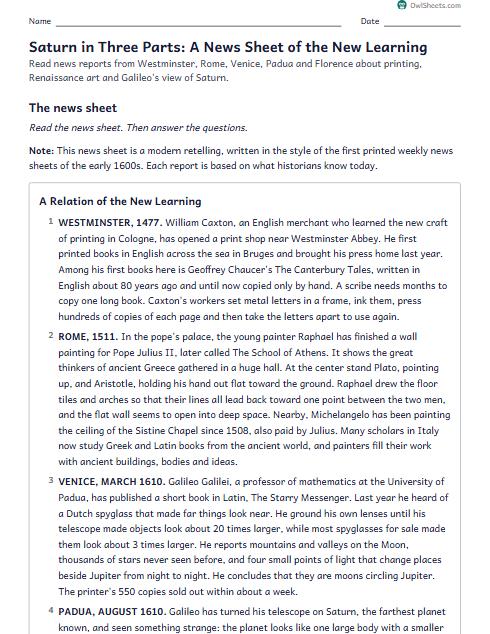
Saturn in Three Parts: A News Sheet of the New Learning
Grade 7 · HIS.7.7
15 questionsPremium
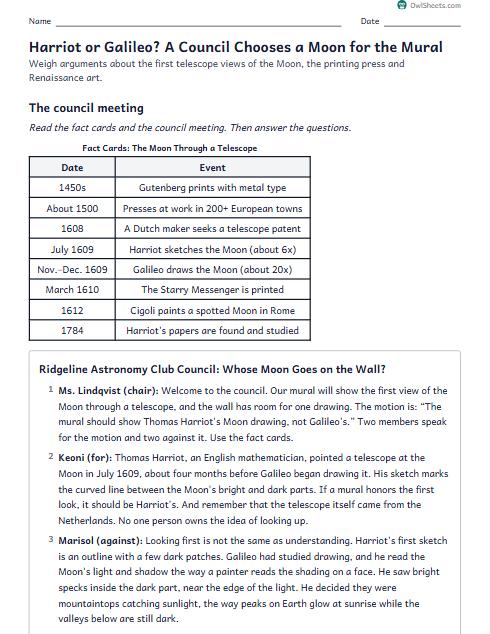
Harriot or Galileo? A Council Chooses a Moon for the Mural
Grade 7 · HIS.7.7
13 questionsPremium
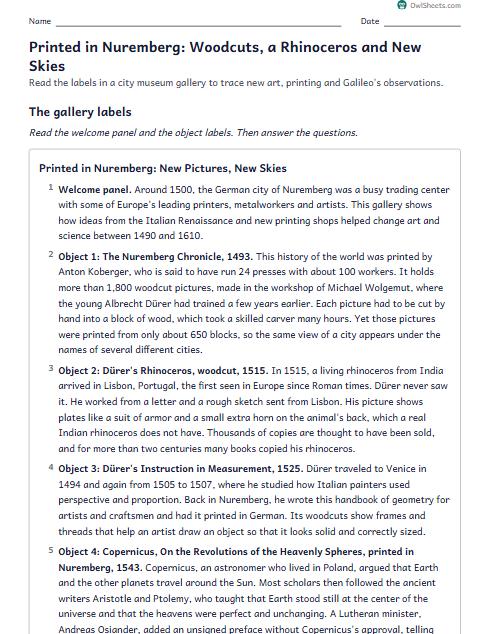
Printed in Nuremberg: Woodcuts, a Rhinoceros and New Skies
Grade 7 · HIS.7.7
14 questionsPremium
Venice to Rome: A Route Guide to New Ideas
Grade 7 · HIS.7.7
13 questionsPremium
Senses, Reason and the Heavens: Galileo's Letter to a Grand Duchess
Grade 7 · HIS.7.7
11 questionsFree
Spots on the Sun: Galileo and Scheiner Disagree
Grade 7 · HIS.7.7
11 questionsPremium