Grade 7 · Social StudiesECO.7.3Premium
Bulbs, Contracts and a Crash: A Historian's Notes on the Tulip Trade
Grade 7 economics: a historian's field notes from Leiden, Haarlem and Alkmaar explain the tulip price boom and crash of 1637 with supply and demand.
Preview
OwlSheets.com
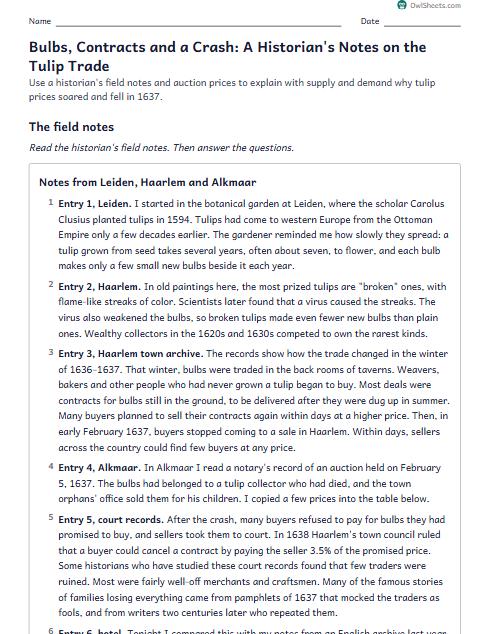
Bulbs, Contracts and a Crash: A Historian's Notes on the Tulip Trade
Use a historian's field notes and auction prices to explain with supply and demand why tulip prices soared and fell in 1637.
The field notes
Read the historian's field notes. Then answer the questions.
Notes from Leiden, Haarlem and Alkmaar
1Entry 1, Leiden. I started in the botanical garden at Leiden, where the scholar Carolus Clusius planted tulips in 1594. Tulips had come to western Europe from the Ottoman Empire only a few decades earlier. The gardener reminded me how slowly they spread: a tulip grown from seed takes several years, often about seven, to flower, and each bulb makes only a few small new bulbs beside it each year.
2Entry 2, Haarlem. In old paintings here, the most prized tulips are "broken" ones, with flame-like streaks of color. Scientists later found that a virus caused the streaks. The virus also weakened the bulbs, so broken tulips made even fewer new bulbs than plain ones. Wealthy collectors in the 1620s and 1630s competed to own the rarest kinds.
3Entry 3, Haarlem town archive. The records show how the trade changed in the winter of 1636–1637. That winter, bulbs were traded in the back rooms of taverns. Weavers, bakers and other people who had never grown a tulip began to buy. Most deals were contracts for bulbs still in the ground, to be delivered after they were dug up in summer. Many buyers planned to sell their contracts again within days at a higher price. Then, in early February 1637, buyers stopped coming to a sale in Haarlem. Within days, sellers across the country could find few buyers at any price.
4Entry 4, Alkmaar. In Alkmaar I read a notary's record of an auction held on February 5, 1637. The bulbs had belonged to a tulip collector who had died, and the town orphans' office sold them for his children. I copied a few prices into the table below.
5Entry 5, court records. After the crash, many buyers refused to pay for bulbs they had promised to buy, and sellers took them to court. In 1638 Haarlem's town council ruled that a buyer could cancel a contract by paying the seller 3.5% of the promised price. Some historians who have studied these court records found that few traders were ruined. Most were fairly well-off merchants and craftsmen. Many of the famous stories of families losing everything came from pamphlets of 1637 that mocked the traders as fools, and from writers two centuries later who repeated them.
6Entry 6, hotel. Tonight I compared this with my notes from an English archive last year. After the Black Death of 1348–1349 killed perhaps a third or more of England's people, landowners had far fewer workers to hire at harvest time. The daily pay of farm workers rose, even though the king ordered that wages stay at the old level.
- A. New bulbs took years to grow, and each bulb made only a few more.
- B. Gardeners were not allowed to plant tulips from seed.
- C. The Ottoman Empire stopped selling bulbs to western Europe.
- D. Clusius kept every bulb in the Leiden garden for himself.
- A. The virus made the bulbs larger, so they cost more to ship.
- B. Collectors wanted them most, yet they multiplied the slowest.
- C. Plain tulips were not sold anywhere, so their price was low.
- D. Painters paid growers to grow streaked tulips for their art.
The preview shows the first questions. Unlock the worksheet to see all of it.
Related worksheets
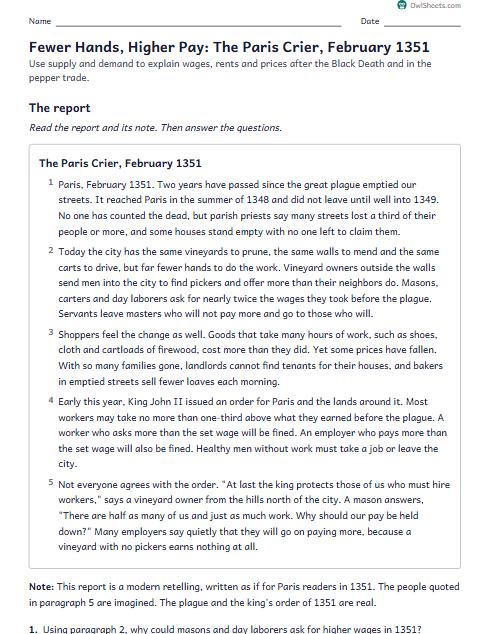
Fewer Hands, Higher Pay: The Paris Crier, February 1351
Grade 7 · ECO.7.3
14 questionsPremium
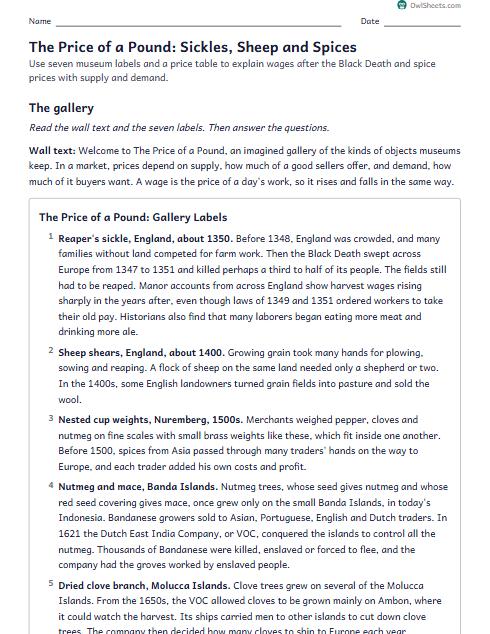
The Price of a Pound: Sickles, Sheep and Spices
Grade 7 · ECO.7.3
14 questionsPremium
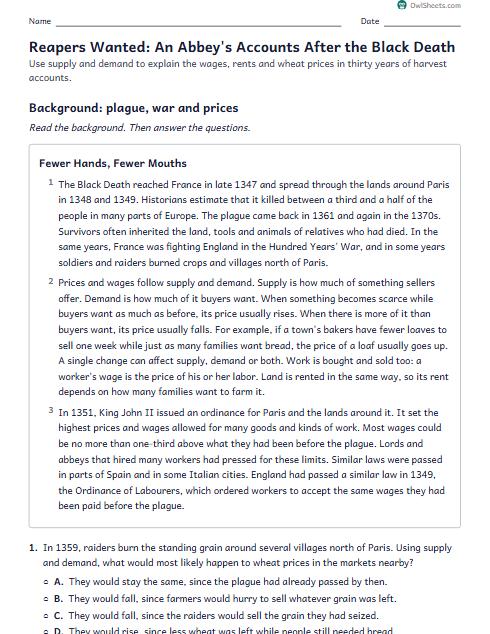
Reapers Wanted: An Abbey's Accounts After the Black Death
Grade 7 · ECO.7.3
14 questionsPremium
Grain for Tuscany: A Ship's Voyage from Danzig to Livorno, 1591
Grade 7 · ECO.7.3
13 questionsPremium
Pepper by a New Route: Venice's Merchants Debate, 1502
Grade 7 · ECO.7.3
12 questionsPremium
A Price on Bread? A Town Council in the Great Famine
Grade 7 · ECO.7.3
12 questionsPremium