Grade 7 · Social StudiesECO.7.3Premium
Fewer Hands, Higher Pay: The Paris Crier, February 1351
Grade 7 economics: a retold Paris news report of 1351 on wages, rents and a royal wage order after the Black Death, plus a note on pepper prices.
Preview
OwlSheets.com
Fewer Hands, Higher Pay: The Paris Crier, February 1351
Use supply and demand to explain wages, rents and prices after the Black Death and in the pepper trade.
The report
Read the report and its note. Then answer the questions.
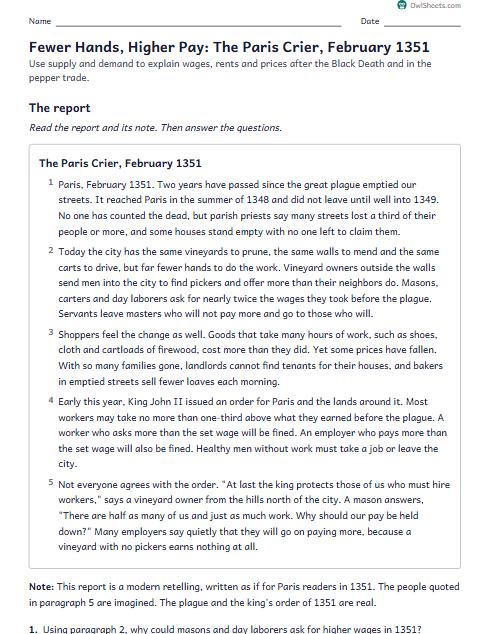
The Paris Crier, February 1351
1Paris, February 1351. Two years have passed since the great plague emptied our streets. It reached Paris in the summer of 1348 and did not leave until well into 1349. No one has counted the dead, but parish priests say many streets lost a third of their people or more, and some houses stand empty with no one left to claim them.
2Today the city has the same vineyards to prune, the same walls to mend and the same carts to drive, but far fewer hands to do the work. Vineyard owners outside the walls send men into the city to find pickers and offer more than their neighbors do. Masons, carters and day laborers ask for nearly twice the wages they took before the plague. Servants leave masters who will not pay more and go to those who will.
3Shoppers feel the change as well. Goods that take many hours of work, such as shoes, cloth and cartloads of firewood, cost more than they did. Yet some prices have fallen. With so many families gone, landlords cannot find tenants for their houses, and bakers in emptied streets sell fewer loaves each morning.
4Early this year, King John II issued an order for Paris and the lands around it. Most workers may take no more than one-third above what they earned before the plague. A worker who asks more than the set wage will be fined. An employer who pays more than the set wage will also be fined. Healthy men without work must take a job or leave the city.
5Not everyone agrees with the order. "At last the king protects those of us who must hire workers," says a vineyard owner from the hills north of the city. A mason answers, "There are half as many of us and just as much work. Why should our pay be held down?" Many employers say quietly that they will go on paying more, because a vineyard with no pickers earns nothing at all.
- A. Employers had more workers than they could keep busy.
- B. Fewer workers were left for the same fields and walls.
- C. The vineyards needed fewer pickers than before the plague.
- D. The king had ordered every wage raised after the plague.
The preview shows the first questions. Unlock the worksheet to see all of it.
Related worksheets
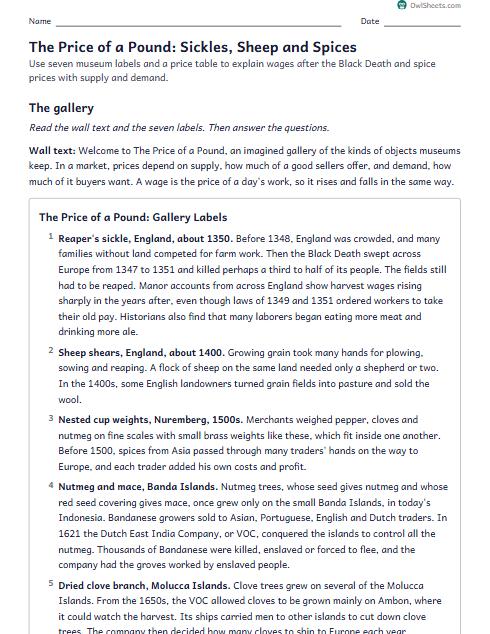
The Price of a Pound: Sickles, Sheep and Spices
Grade 7 · ECO.7.3
14 questionsPremium
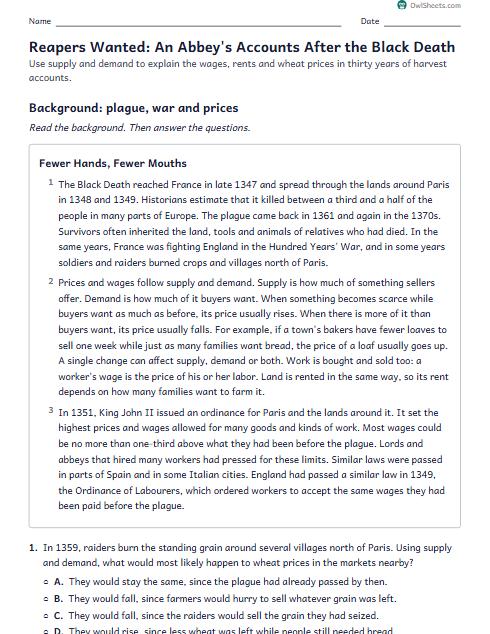
Reapers Wanted: An Abbey's Accounts After the Black Death
Grade 7 · ECO.7.3
14 questionsPremium
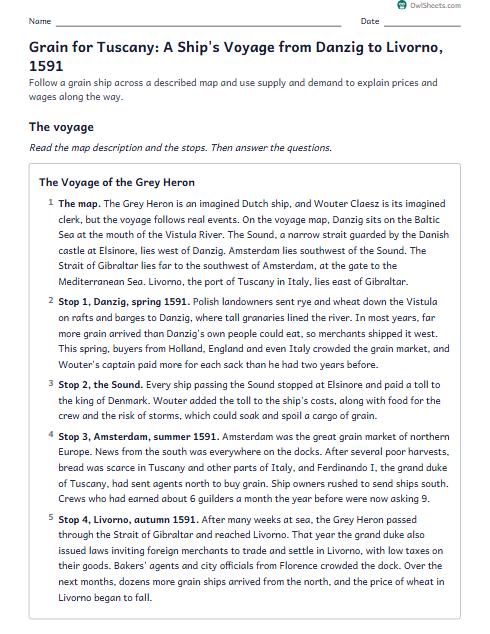
Grain for Tuscany: A Ship's Voyage from Danzig to Livorno, 1591
Grade 7 · ECO.7.3
13 questionsPremium
Bulbs, Contracts and a Crash: A Historian's Notes on the Tulip Trade
Grade 7 · ECO.7.3
13 questionsPremium
Pepper by a New Route: Venice's Merchants Debate, 1502
Grade 7 · ECO.7.3
12 questionsPremium
A Price on Bread? A Town Council in the Great Famine
Grade 7 · ECO.7.3
12 questionsPremium