Grade 7 · Social StudiesECO.7.3Premium
Grain for Tuscany: A Ship's Voyage from Danzig to Livorno, 1591
Grade 7 economics: follow a grain ship from Danzig to famine-struck Tuscany in 1591 and use supply and demand to explain prices and sailors' wages.
Preview
OwlSheets.com
Grain for Tuscany: A Ship's Voyage from Danzig to Livorno, 1591
Follow a grain ship across a described map and use supply and demand to explain prices and wages along the way.
The voyage
Read the map description and the stops. Then answer the questions.
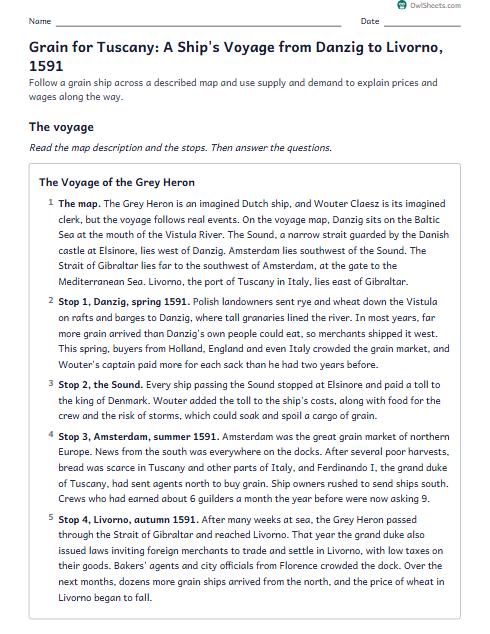
The Voyage of the Grey Heron
1The map. The Grey Heron is an imagined Dutch ship, and Wouter Claesz is its imagined clerk, but the voyage follows real events. On the voyage map, Danzig sits on the Baltic Sea at the mouth of the Vistula River. The Sound, a narrow strait guarded by the Danish castle at Elsinore, lies west of Danzig. Amsterdam lies southwest of the Sound. The Strait of Gibraltar lies far to the southwest of Amsterdam, at the gate to the Mediterranean Sea. Livorno, the port of Tuscany in Italy, lies east of Gibraltar.
2Stop 1, Danzig, spring 1591. Polish landowners sent rye and wheat down the Vistula on rafts and barges to Danzig, where tall granaries lined the river. In most years, far more grain arrived than Danzig's own people could eat, so merchants shipped it west. This spring, buyers from Holland, England and even Italy crowded the grain market, and Wouter's captain paid more for each sack than he had two years before.
3Stop 2, the Sound. Every ship passing the Sound stopped at Elsinore and paid a toll to the king of Denmark. Wouter added the toll to the ship's costs, along with food for the crew and the risk of storms, which could soak and spoil a cargo of grain.
4Stop 3, Amsterdam, summer 1591. Amsterdam was the great grain market of northern Europe. News from the south was everywhere on the docks. After several poor harvests, bread was scarce in Tuscany and other parts of Italy, and Ferdinando I, the grand duke of Tuscany, had sent agents north to buy grain. Ship owners rushed to send ships south. Crews who had earned about 6 guilders a month the year before were now asking 9.
5Stop 4, Livorno, autumn 1591. After many weeks at sea, the Grey Heron passed through the Strait of Gibraltar and reached Livorno. That year the grand duke also issued laws inviting foreign merchants to trade and settle in Livorno, with low taxes on their goods. Bakers' agents and city officials from Florence crowded the dock. Over the next months, dozens more grain ships arrived from the north, and the price of wheat in Livorno began to fall.
- A. West, then south
- B. Northeast, then west
- C. Southwest, then east
- D. Southeast, then north
- A. Danzig's own bakers bought nearly all the grain each year.
- B. The king of Denmark set a low price for grain sold there.
- C. Far more grain arrived each year than its people could eat.
- D. Polish grain was poorer in quality than Italian grain.
The preview shows the first questions. Unlock the worksheet to see all of it.
Related worksheets
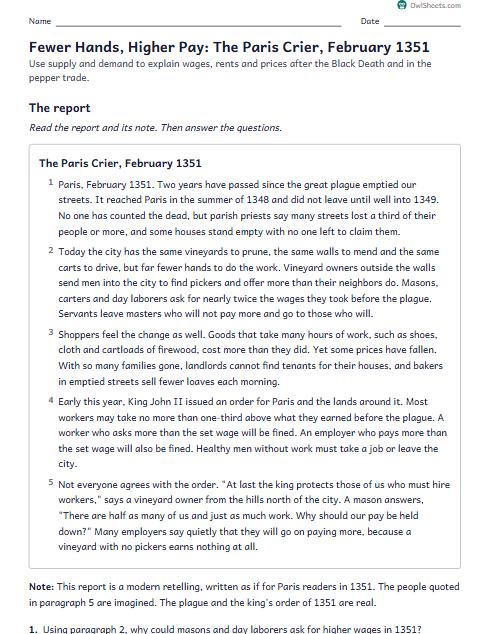
Fewer Hands, Higher Pay: The Paris Crier, February 1351
Grade 7 · ECO.7.3
14 questionsPremium
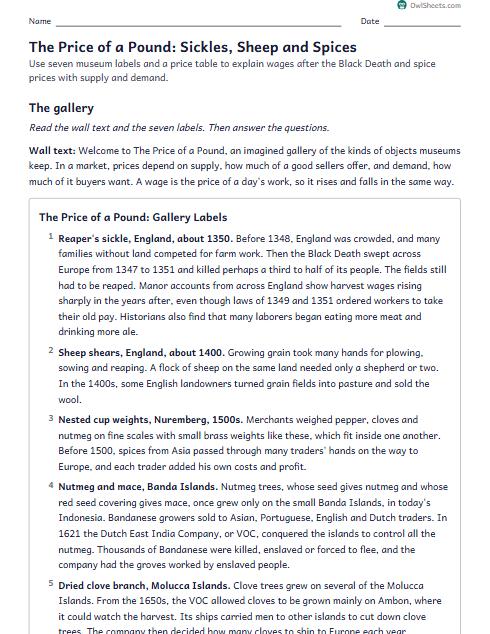
The Price of a Pound: Sickles, Sheep and Spices
Grade 7 · ECO.7.3
14 questionsPremium
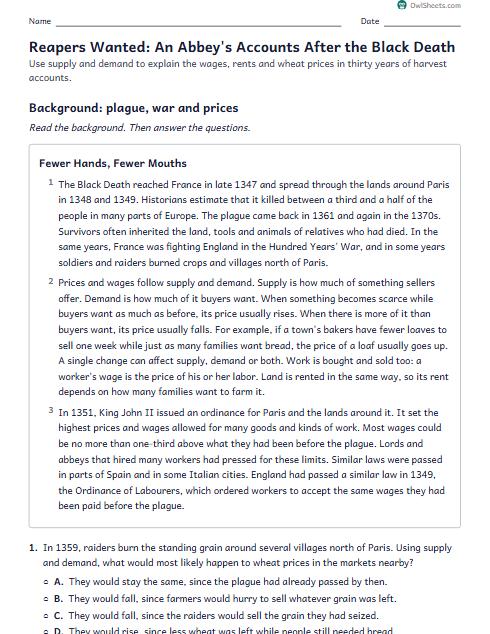
Reapers Wanted: An Abbey's Accounts After the Black Death
Grade 7 · ECO.7.3
14 questionsPremium
Bulbs, Contracts and a Crash: A Historian's Notes on the Tulip Trade
Grade 7 · ECO.7.3
13 questionsPremium
Pepper by a New Route: Venice's Merchants Debate, 1502
Grade 7 · ECO.7.3
12 questionsPremium
A Price on Bread? A Town Council in the Great Famine
Grade 7 · ECO.7.3
12 questionsPremium