Grade 7 · Social StudiesECO.7.3Premium
The Price of a Pound: Sickles, Sheep and Spices
Grade 7 economics: museum labels on a sickle, sheep shears, spice weights, nutmeg, cloves and pepper explain wages and prices with supply and demand.
Preview
OwlSheets.com
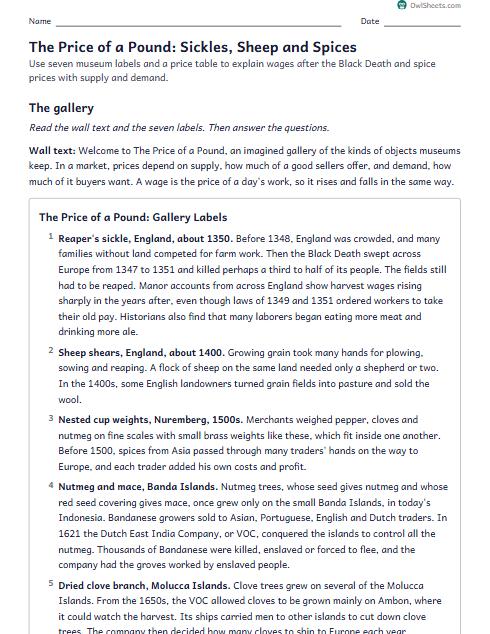
The Price of a Pound: Sickles, Sheep and Spices
Use seven museum labels and a price table to explain wages after the Black Death and spice prices with supply and demand.
The gallery
Read the wall text and the seven labels. Then answer the questions.
The Price of a Pound: Gallery Labels
1Reaper's sickle, England, about 1350. Before 1348, England was crowded, and many families without land competed for farm work. Then the Black Death swept across Europe from 1347 to 1351 and killed perhaps a third to half of its people. The fields still had to be reaped. Manor accounts from across England show harvest wages rising sharply in the years after, even though laws of 1349 and 1351 ordered workers to take their old pay. Historians also find that many laborers began eating more meat and drinking more ale.
2Sheep shears, England, about 1400. Growing grain took many hands for plowing, sowing and reaping. A flock of sheep on the same land needed only a shepherd or two. In the 1400s, some English landowners turned grain fields into pasture and sold the wool.
3Nested cup weights, Nuremberg, 1500s. Merchants weighed pepper, cloves and nutmeg on fine scales with small brass weights like these, which fit inside one another. Before 1500, spices from Asia passed through many traders' hands on the way to Europe, and each trader added his own costs and profit.
4Nutmeg and mace, Banda Islands. Nutmeg trees, whose seed gives nutmeg and whose red seed covering gives mace, once grew only on the small Banda Islands, in today's Indonesia. Bandanese growers sold to Asian, Portuguese, English and Dutch traders. In 1621 the Dutch East India Company, or VOC, conquered the islands to control all the nutmeg. Thousands of Bandanese were killed, enslaved or forced to flee, and the company had the groves worked by enslaved people.
5Dried clove branch, Molucca Islands. Clove trees grew on several of the Molucca Islands. From the 1650s, the VOC allowed cloves to be grown mainly on Ambon, where it could watch the harvest. Its ships carried men to other islands to cut down clove trees. The company then decided how many cloves to ship to Europe each year.
6Book open to a page about spices, London, 1776. In The Wealth of Nations, the Scottish thinker Adam Smith wrote that in years of plenty the Dutch company was said to burn part of its spices, so that it could keep up the price in Europe.
7Pepper sack, about 1650. Unlike nutmeg, pepper grew in many places, including India's southwest coast, Sumatra and Java. Dutch, English and Portuguese ships, along with many Asian traders, all carried it. Historians find that pepper grew much cheaper in Europe over the 1600s and became an everyday spice in many kitchens.
- A. With fewer workers to hire, employers paid more for a day's work.
- B. The laws of 1349 and 1351 ordered lords to feed workers better.
- C. More people were left to farm, so harvests and wages both grew.
- D. Food grew scarce, so farmers paid workers in meat, not coins.
The preview shows the first questions. Unlock the worksheet to see all of it.
Related worksheets
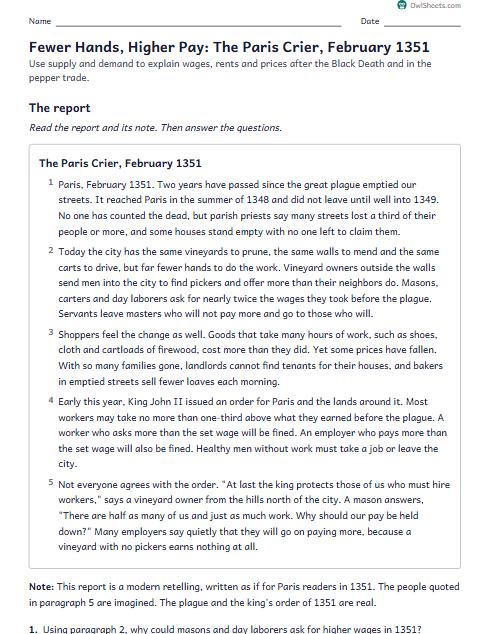
Fewer Hands, Higher Pay: The Paris Crier, February 1351
Grade 7 · ECO.7.3
14 questionsPremium
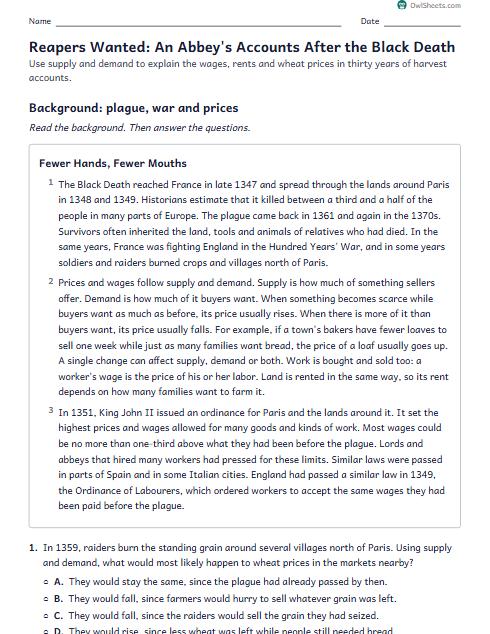
Reapers Wanted: An Abbey's Accounts After the Black Death
Grade 7 · ECO.7.3
14 questionsPremium
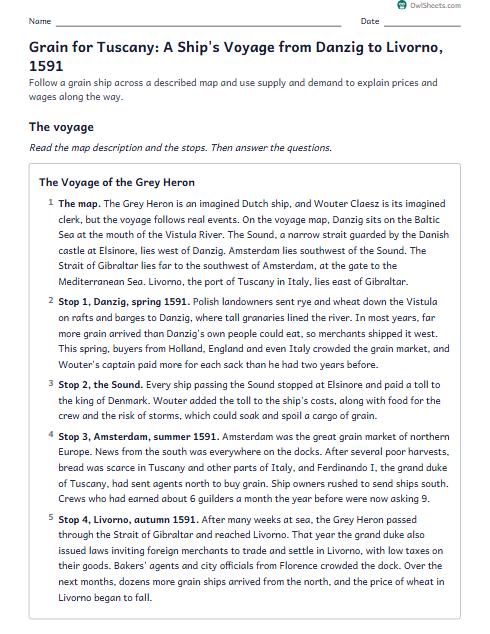
Grain for Tuscany: A Ship's Voyage from Danzig to Livorno, 1591
Grade 7 · ECO.7.3
13 questionsPremium
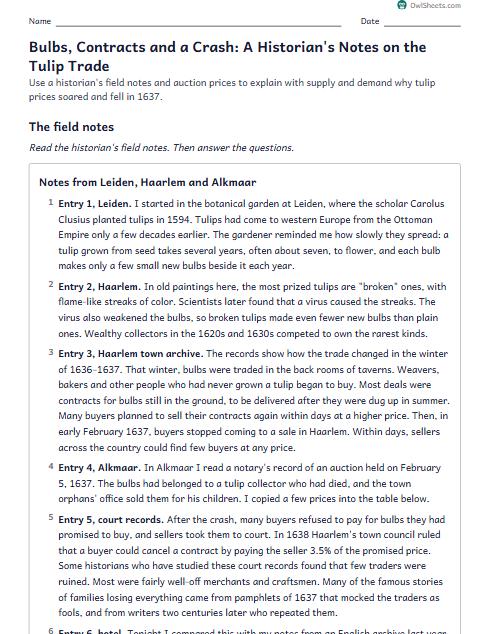
Bulbs, Contracts and a Crash: A Historian's Notes on the Tulip Trade
Grade 7 · ECO.7.3
13 questionsPremium
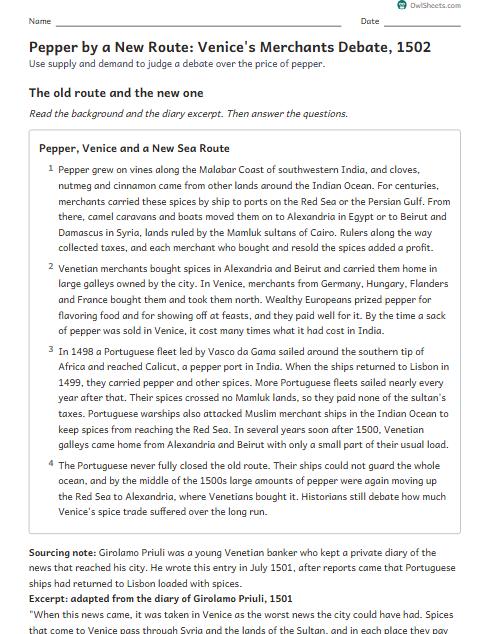
Pepper by a New Route: Venice's Merchants Debate, 1502
Grade 7 · ECO.7.3
12 questionsPremium
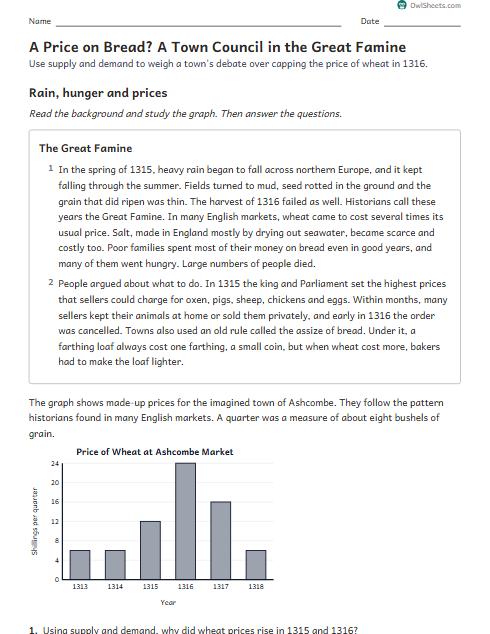
A Price on Bread? A Town Council in the Great Famine
Grade 7 · ECO.7.3
12 questionsPremium