Grade 7 · Social StudiesHIS.7.1Premium
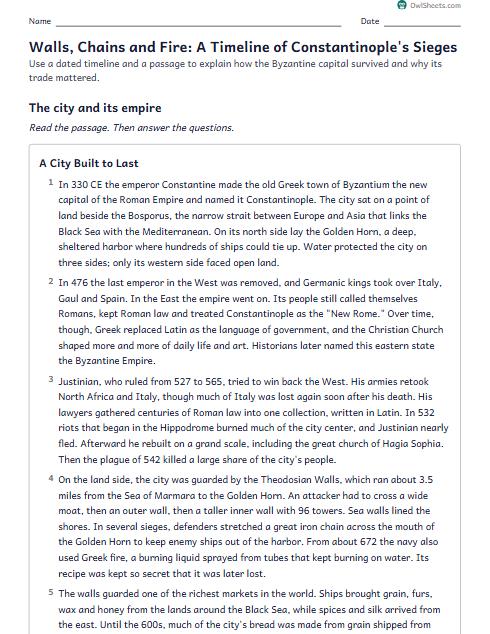
Walls, Chains and Fire: A Timeline of Constantinople's Sieges
Grade 7 history: a timeline of Constantinople's walls and sieges from 330 to 1453 shows the Byzantine Empire after Rome, Justinian and the city's trade.
Preview
OwlSheets.com
Walls, Chains and Fire: A Timeline of Constantinople's Sieges
Use a dated timeline and a passage to explain how the Byzantine capital survived and why its trade mattered.
The city and its empire
Read the passage. Then answer the questions.
A City Built to Last
1In 330 CE the emperor Constantine made the old Greek town of Byzantium the new capital of the Roman Empire and named it Constantinople. The city sat on a point of land beside the Bosporus, the narrow strait between Europe and Asia that links the Black Sea with the Mediterranean. On its north side lay the Golden Horn, a deep, sheltered harbor where hundreds of ships could tie up. Water protected the city on three sides; only its western side faced open land.
2In 476 the last emperor in the West was removed, and Germanic kings took over Italy, Gaul and Spain. In the East the empire went on. Its people still called themselves Romans, kept Roman law and treated Constantinople as the "New Rome." Over time, though, Greek replaced Latin as the language of government, and the Christian Church shaped more and more of daily life and art. Historians later named this eastern state the Byzantine Empire.
3Justinian, who ruled from 527 to 565, tried to win back the West. His armies retook North Africa and Italy, though much of Italy was lost again soon after his death. His lawyers gathered centuries of Roman law into one collection, written in Latin. In 532 riots that began in the Hippodrome burned much of the city center, and Justinian nearly fled. Afterward he rebuilt on a grand scale, including the great church of Hagia Sophia. Then the plague of 542 killed a large share of the city's people.
4On the land side, the city was guarded by the Theodosian Walls, which ran about 3.5 miles from the Sea of Marmara to the Golden Horn. An attacker had to cross a wide moat, then an outer wall, then a taller inner wall with 96 towers. Sea walls lined the shores. In several sieges, defenders stretched a great iron chain across the mouth of the Golden Horn to keep enemy ships out of the harbor. From about 672 the navy also used Greek fire, a burning liquid sprayed from tubes that kept burning on water. Its recipe was kept so secret that it was later lost.
5The walls guarded one of the richest markets in the world. Ships brought grain, furs, wax and honey from the lands around the Black Sea, while spices and silk arrived from the east. Until the 600s, much of the city's bread was made from grain shipped from Egypt. In later centuries, officials at customs posts on the straits, at Abydos and Hieron, collected about a tenth of the value of the goods carried past them, whether or not the ships stopped in the city. Merchants from Venice, Egypt and the lands of the Rus came to buy silk cloth woven in the city's workshops.
- A. Justinian wrote his laws for the Germanic kings who ruled the West.
- B. Roman ways such as its law lasted while the empire's language changed.
- C. Latin speakers from Italy ran the empire's government after 476.
- D. The empire gave up Roman law once Greek became the main language.
- A. That his rule was strong again after he nearly lost the city
- B. That he would now share his power with the rioters' leaders
- C. That the Church would from then on choose the emperors
- D. That he planned to move his capital back to the city of Rome
The preview shows the first questions. Unlock the worksheet to see all of it.
Related worksheets
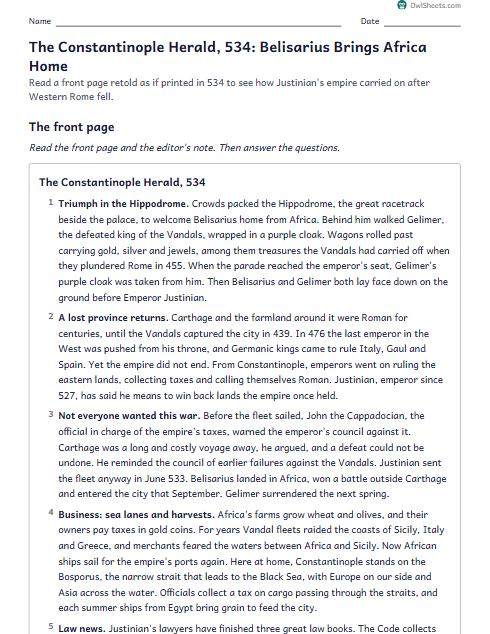
The Constantinople Herald, 534: Belisarius Brings Africa Home
Grade 7 · HIS.7.1
13 questionsPremium
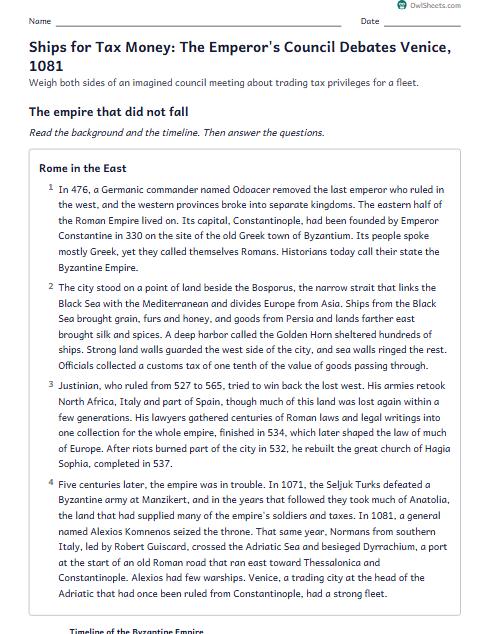
Ships for Tax Money: The Emperor's Council Debates Venice, 1081
Grade 7 · HIS.7.1
15 questionsPremium
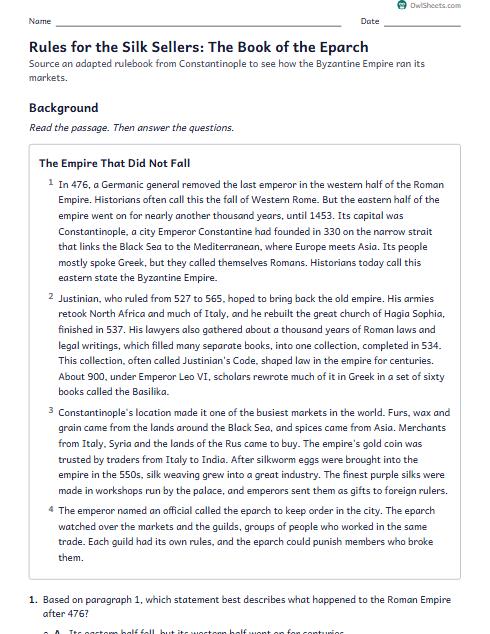
Rules for the Silk Sellers: The Book of the Eparch
Grade 7 · HIS.7.1
14 questionsPremium
Eggs in a Hollow Cane: Two Accounts of Byzantine Silk
Grade 7 · HIS.7.1
14 questionsPremium
Gold Coins and Crowds: The Byzantine Empire by the Numbers
Grade 7 · HIS.7.1
12 questionsPremium
Water, Domes and a Silver Dish: A Historian's Byzantine Field Notes
Grade 7 · HIS.7.1
11 questionsPremium