Grade 7 · Social StudiesHIS.7.1Premium
Ships for Tax Money: The Emperor's Council Debates Venice, 1081
Grade 7 history: trace the Byzantine Empire from Constantinople's founding and Justinian to 1081, then weigh a mock council debate on Venice's trade grant.
Preview
OwlSheets.com
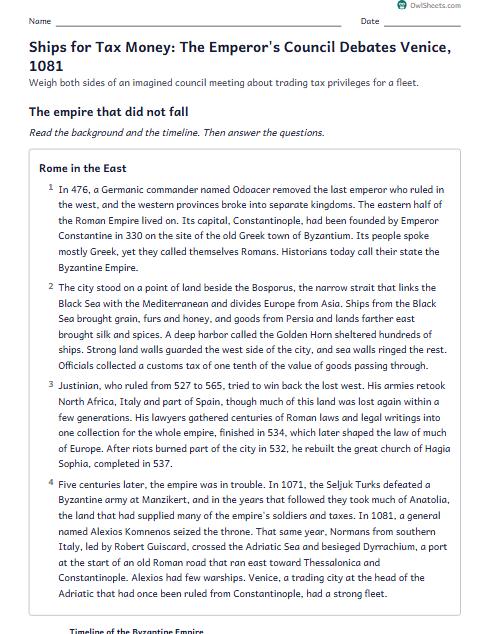
Ships for Tax Money: The Emperor's Council Debates Venice, 1081
Weigh both sides of an imagined council meeting about trading tax privileges for a fleet.
The empire that did not fall
Read the background and the timeline. Then answer the questions.
Rome in the East
1In 476, a Germanic commander named Odoacer removed the last emperor who ruled in the west, and the western provinces broke into separate kingdoms. The eastern half of the Roman Empire lived on. Its capital, Constantinople, had been founded by Emperor Constantine in 330 on the site of the old Greek town of Byzantium. Its people spoke mostly Greek, yet they called themselves Romans. Historians today call their state the Byzantine Empire.
2The city stood on a point of land beside the Bosporus, the narrow strait that links the Black Sea with the Mediterranean and divides Europe from Asia. Ships from the Black Sea brought grain, furs and honey, and goods from Persia and lands farther east brought silk and spices. A deep harbor called the Golden Horn sheltered hundreds of ships. Strong land walls guarded the west side of the city, and sea walls ringed the rest. Officials collected a customs tax of one tenth of the value of goods passing through.
3Justinian, who ruled from 527 to 565, tried to win back the lost west. His armies retook North Africa, Italy and part of Spain, though much of this land was lost again within a few generations. His lawyers gathered centuries of Roman laws and legal writings into one collection for the whole empire, finished in 534, which later shaped the law of much of Europe. After riots burned part of the city in 532, he rebuilt the great church of Hagia Sophia, completed in 537.
4Five centuries later, the empire was in trouble. In 1071, the Seljuk Turks defeated a Byzantine army at Manzikert, and in the years that followed they took much of Anatolia, the land that had supplied many of the empire's soldiers and taxes. In 1081, a general named Alexios Komnenos seized the throne. That same year, Normans from southern Italy, led by Robert Guiscard, crossed the Adriatic Sea and besieged Dyrrachium, a port at the start of an old Roman road that ran east toward Thessalonica and Constantinople. Alexios had few warships. Venice, a trading city at the head of the Adriatic that had once been ruled from Constantinople, had a strong fleet.
| Year | Event |
|---|---|
| 330 | Constantine founds Constantinople |
| 476 | Last emperor in the west is removed |
| 527 | Justinian becomes emperor |
| 534 | Justinian's law collection finished |
| 537 | Hagia Sophia is completed |
| 1071 | Seljuks win the battle of Manzikert |
| 1081 | Alexios I crowned; Normans attack |
| 1082 | Grant to Venice (usual date) |
| 1171 | Manuel I arrests Venetians |
| 1204 | Crusaders capture Constantinople |
| 1261 | Byzantines retake the city |
| 1453 | Ottomans capture Constantinople |
- A. Germanic kingdoms took over the western provinces after 476.
- B. Emperors went on ruling from Constantinople for centuries.
- C. Constantinople was built on the site of an old Greek town.
- D. The people of Constantinople spoke mostly Greek, not Latin.
The preview shows the first questions. Unlock the worksheet to see all of it.
Related worksheets
The Constantinople Herald, 534: Belisarius Brings Africa Home
Grade 7 · HIS.7.1
13 questionsPremium
Walls, Chains and Fire: A Timeline of Constantinople's Sieges
Grade 7 · HIS.7.1
15 questionsPremium
Rules for the Silk Sellers: The Book of the Eparch
Grade 7 · HIS.7.1
14 questionsPremium
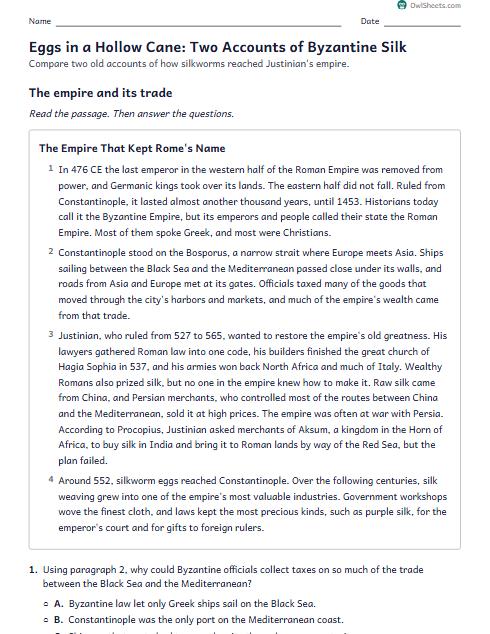
Eggs in a Hollow Cane: Two Accounts of Byzantine Silk
Grade 7 · HIS.7.1
14 questionsPremium
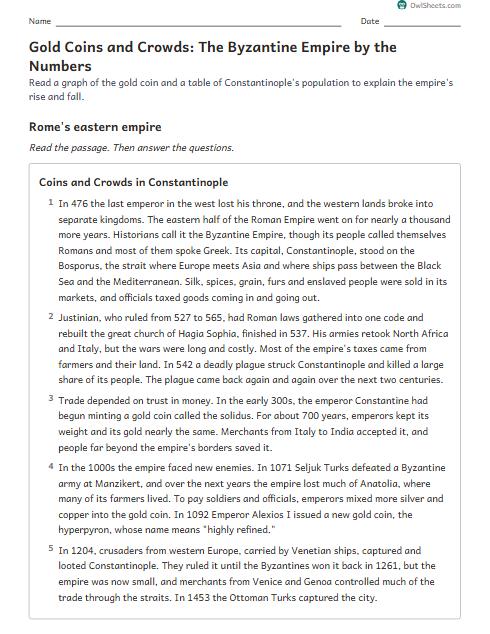
Gold Coins and Crowds: The Byzantine Empire by the Numbers
Grade 7 · HIS.7.1
12 questionsPremium
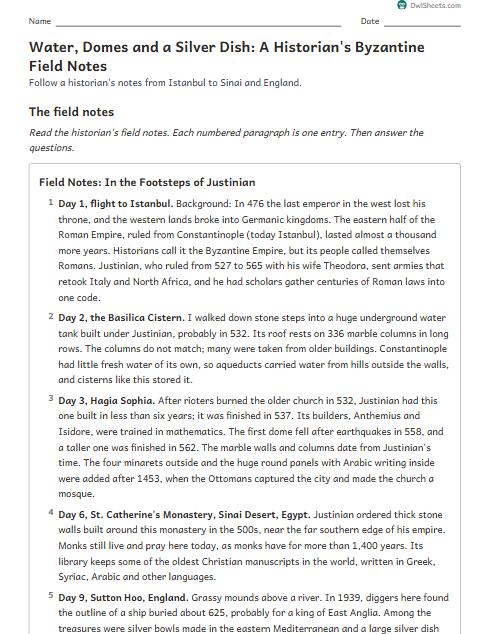
Water, Domes and a Silver Dish: A Historian's Byzantine Field Notes
Grade 7 · HIS.7.1
11 questionsPremium