Grade 7 · Social StudiesHIS.7.1Premium
Rules for the Silk Sellers: The Book of the Eparch
Grade 7 history: read about Constantinople and Justinian, then source adapted rules from the Book of the Eparch to see how Byzantine trade was controlled.
Preview
OwlSheets.com
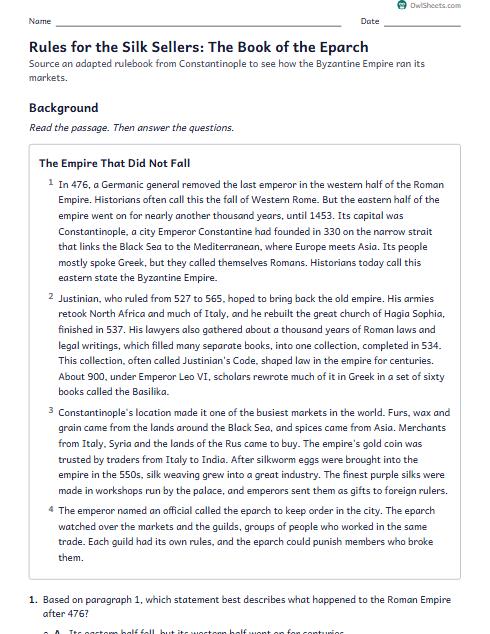
Rules for the Silk Sellers: The Book of the Eparch
Source an adapted rulebook from Constantinople to see how the Byzantine Empire ran its markets.
Background
Read the passage. Then answer the questions.
The Empire That Did Not Fall
1In 476, a Germanic general removed the last emperor in the western half of the Roman Empire. Historians often call this the fall of Western Rome. But the eastern half of the empire went on for nearly another thousand years, until 1453. Its capital was Constantinople, a city Emperor Constantine had founded in 330 on the narrow strait that links the Black Sea to the Mediterranean, where Europe meets Asia. Its people mostly spoke Greek, but they called themselves Romans. Historians today call this eastern state the Byzantine Empire.
2Justinian, who ruled from 527 to 565, hoped to bring back the old empire. His armies retook North Africa and much of Italy, and he rebuilt the great church of Hagia Sophia, finished in 537. His lawyers also gathered about a thousand years of Roman laws and legal writings, which filled many separate books, into one collection, completed in 534. This collection, often called Justinian's Code, shaped law in the empire for centuries. About 900, under Emperor Leo VI, scholars rewrote much of it in Greek in a set of sixty books called the Basilika.
3Constantinople's location made it one of the busiest markets in the world. Furs, wax and grain came from the lands around the Black Sea, and spices came from Asia. Merchants from Italy, Syria and the lands of the Rus came to buy. The empire's gold coin was trusted by traders from Italy to India. After silkworm eggs were brought into the empire in the 550s, silk weaving grew into a great industry. The finest purple silks were made in workshops run by the palace, and emperors sent them as gifts to foreign rulers.
4The emperor named an official called the eparch to keep order in the city. The eparch watched over the markets and the guilds, groups of people who worked in the same trade. Each guild had its own rules, and the eparch could punish members who broke them.
- A. Its eastern half fell, but its western half went on for centuries.
- B. The empire moved its capital from Constantinople back to Rome.
- C. The whole empire fell, and Constantinople was captured soon after.
- D. Its western half fell, but its eastern half went on for centuries.
- A. The laws filled many separate books and were hard to use.
- B. Most Roman laws had been lost when Western Rome fell.
- C. Before Justinian, the Romans had no written laws at all.
- D. The laws were in Greek, which judges in Italy could not read.
The preview shows the first questions. Unlock the worksheet to see all of it.
Related worksheets
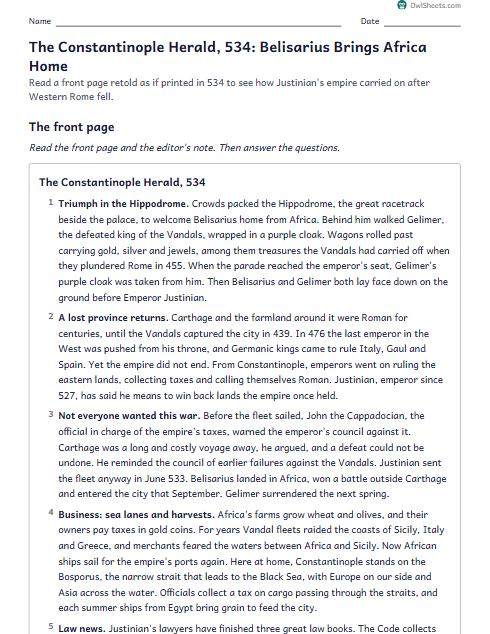
The Constantinople Herald, 534: Belisarius Brings Africa Home
Grade 7 · HIS.7.1
13 questionsPremium
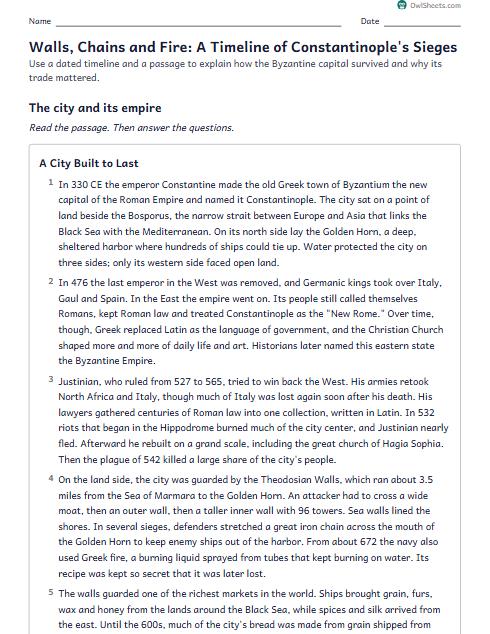
Walls, Chains and Fire: A Timeline of Constantinople's Sieges
Grade 7 · HIS.7.1
15 questionsPremium
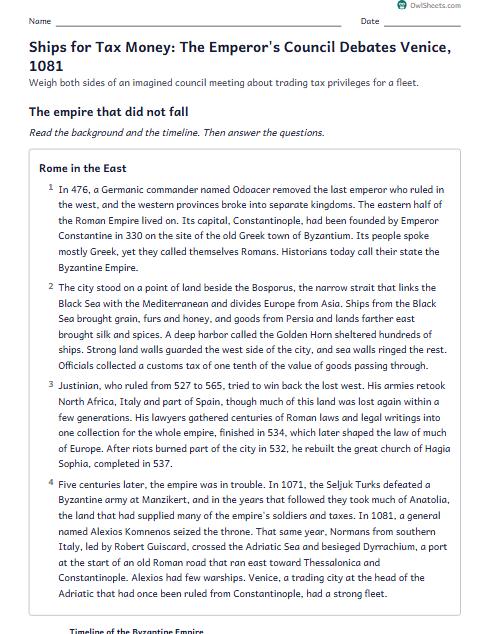
Ships for Tax Money: The Emperor's Council Debates Venice, 1081
Grade 7 · HIS.7.1
15 questionsPremium
Eggs in a Hollow Cane: Two Accounts of Byzantine Silk
Grade 7 · HIS.7.1
14 questionsPremium
Gold Coins and Crowds: The Byzantine Empire by the Numbers
Grade 7 · HIS.7.1
12 questionsPremium
Water, Domes and a Silver Dish: A Historian's Byzantine Field Notes
Grade 7 · HIS.7.1
11 questionsPremium