Grade 7 · Social StudiesHIS.7.1Premium
Eggs in a Hollow Cane: Two Accounts of Byzantine Silk
Grade 7 history: read two disagreeing accounts of how silkworm eggs reached Constantinople and use them to explain the Byzantine Empire's role in trade.
Preview
OwlSheets.com
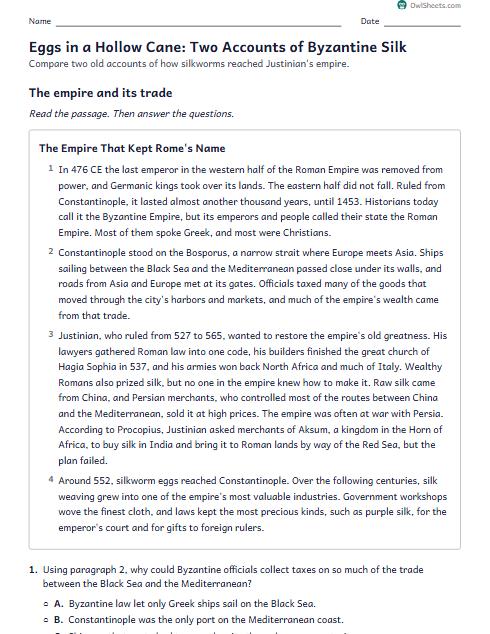
Eggs in a Hollow Cane: Two Accounts of Byzantine Silk
Compare two old accounts of how silkworms reached Justinian's empire.
The empire and its trade
Read the passage. Then answer the questions.
The Empire That Kept Rome's Name
1In 476 CE the last emperor in the western half of the Roman Empire was removed from power, and Germanic kings took over its lands. The eastern half did not fall. Ruled from Constantinople, it lasted almost another thousand years, until 1453. Historians today call it the Byzantine Empire, but its emperors and people called their state the Roman Empire. Most of them spoke Greek, and most were Christians.
2Constantinople stood on the Bosporus, a narrow strait where Europe meets Asia. Ships sailing between the Black Sea and the Mediterranean passed close under its walls, and roads from Asia and Europe met at its gates. Officials taxed many of the goods that moved through the city's harbors and markets, and much of the empire's wealth came from that trade.
3Justinian, who ruled from 527 to 565, wanted to restore the empire's old greatness. His lawyers gathered Roman law into one code, his builders finished the great church of Hagia Sophia in 537, and his armies won back North Africa and much of Italy. Wealthy Romans also prized silk, but no one in the empire knew how to make it. Raw silk came from China, and Persian merchants, who controlled most of the routes between China and the Mediterranean, sold it at high prices. The empire was often at war with Persia. According to Procopius, Justinian asked merchants of Aksum, a kingdom in the Horn of Africa, to buy silk in India and bring it to Roman lands by way of the Red Sea, but the plan failed.
4Around 552, silkworm eggs reached Constantinople. Over the following centuries, silk weaving grew into one of the empire's most valuable industries. Government workshops wove the finest cloth, and laws kept the most precious kinds, such as purple silk, for the emperor's court and for gifts to foreign rulers.
- A. Byzantine law let only Greek ships sail on the Black Sea.
- B. Constantinople was the only port on the Mediterranean coast.
- C. Ships on that route had to pass the city through a narrow strait.
- D. Merchants from Asia were required to live inside the city walls.
- A. It would become harder to find and would cost even more.
- B. Imperial workshops would weave more of it from local silkworms.
- C. Persian merchants would sell more of it to win Roman friends.
- D. Chinese merchants would sail it straight to the city's harbor.
The preview shows the first questions. Unlock the worksheet to see all of it.
Related worksheets
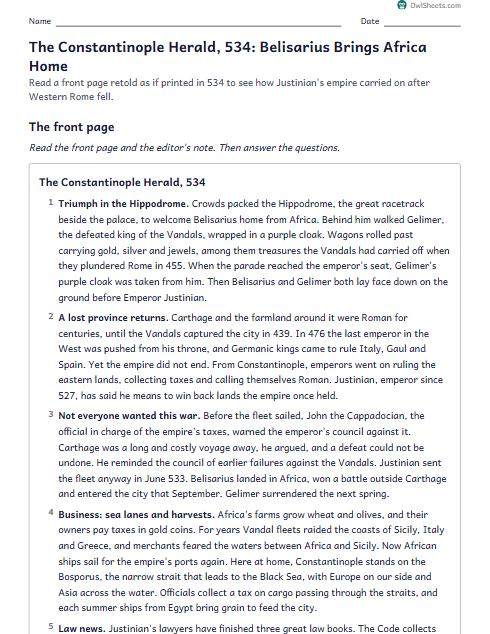
The Constantinople Herald, 534: Belisarius Brings Africa Home
Grade 7 · HIS.7.1
13 questionsPremium
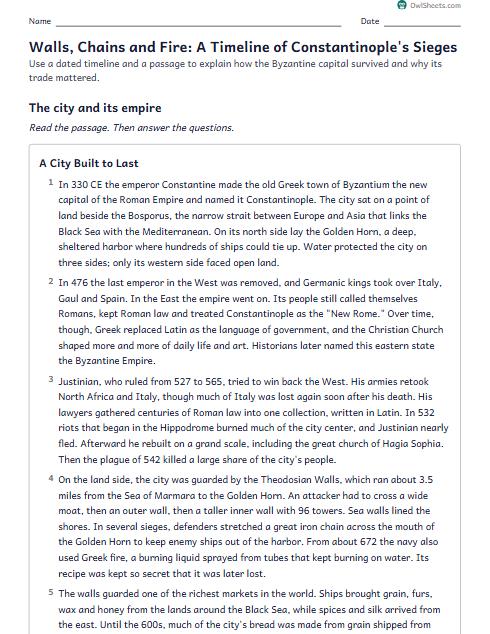
Walls, Chains and Fire: A Timeline of Constantinople's Sieges
Grade 7 · HIS.7.1
15 questionsPremium
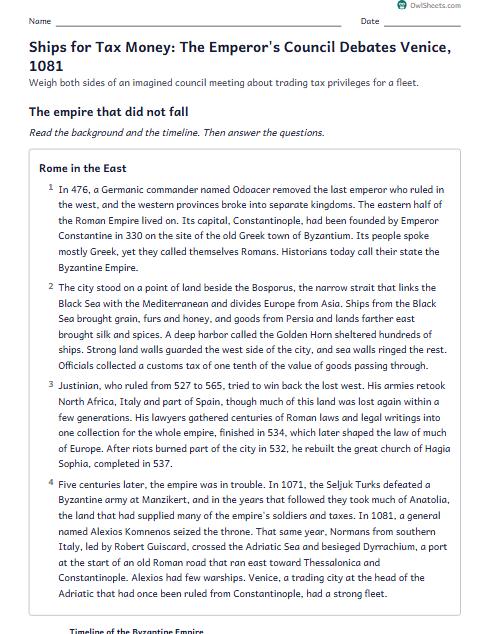
Ships for Tax Money: The Emperor's Council Debates Venice, 1081
Grade 7 · HIS.7.1
15 questionsPremium
Rules for the Silk Sellers: The Book of the Eparch
Grade 7 · HIS.7.1
14 questionsPremium
Gold Coins and Crowds: The Byzantine Empire by the Numbers
Grade 7 · HIS.7.1
12 questionsPremium
Water, Domes and a Silver Dish: A Historian's Byzantine Field Notes
Grade 7 · HIS.7.1
11 questionsPremium