Grade 7 · Social StudiesHIS.7.6Premium
From Palenque to Nojpetén: A Timeline of Three Civilizations
Grade 7 history: a timeline from 250 to 1697 and notes trace Maya, Mexica and Inca cities, rule and achievements and a conquest that took 176 years.
Preview
OwlSheets.com
From Palenque to Nojpetén: A Timeline of Three Civilizations
Use a timeline and notes to trace the Maya, Mexica and Inca from their great cities to a long Spanish conquest.
Cities, rulers and achievements
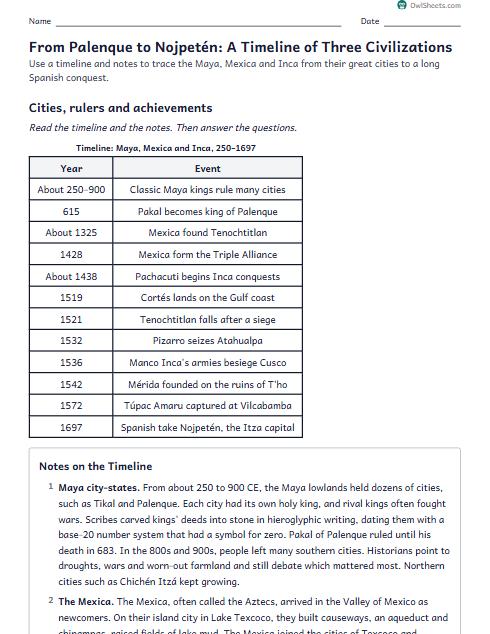
Read the timeline and the notes. Then answer the questions.
| Year | Event |
|---|---|
| About 250–900 | Classic Maya kings rule many cities |
| 615 | Pakal becomes king of Palenque |
| About 1325 | Mexica found Tenochtitlan |
| 1428 | Mexica form the Triple Alliance |
| About 1438 | Pachacuti begins Inca conquests |
| 1519 | Cortés lands on the Gulf coast |
| 1521 | Tenochtitlan falls after a siege |
| 1532 | Pizarro seizes Atahualpa |
| 1536 | Manco Inca's armies besiege Cusco |
| 1542 | Mérida founded on the ruins of T'ho |
| 1572 | Túpac Amaru captured at Vilcabamba |
| 1697 | Spanish take Nojpetén, the Itza capital |
Notes on the Timeline
1Maya city-states. From about 250 to 900 CE, the Maya lowlands held dozens of cities, such as Tikal and Palenque. Each city had its own holy king, and rival kings often fought wars. Scribes carved kings' deeds into stone in hieroglyphic writing, dating them with a base-20 number system that had a symbol for zero. Pakal of Palenque ruled until his death in 683. In the 800s and 900s, people left many southern cities. Historians point to droughts, wars and worn-out farmland and still debate which mattered most. Northern cities such as Chichén Itzá kept growing.
2The Mexica. The Mexica, often called the Aztecs, arrived in the Valley of Mexico as newcomers. On their island city in Lake Texcoco, they built causeways, an aqueduct and chinampas, raised fields of lake mud. The Mexica joined the cities of Texcoco and Tlacopan in the Triple Alliance, and its armies conquered dozens of city-states. Conquered cities usually kept their own rulers but sent tribute such as cloth, cacao and maize. A council of nobles chose each new huey tlatoani, or ruler, from the royal family. The Tlaxcalans were never conquered and stayed bitter enemies of the Mexica.
3The Inca. Cusco was a small Andean kingdom until Pachacuti's conquests began. Within a century, the Inca ruled some 2,500 miles of the Andes. One ruler, the Sapa Inca, was honored as a descendant of the Sun. The Inca used no coins; families paid the state with turns of work, called mit'a, on roads, fields and buildings. Officials kept counts on khipu, knotted cords. Pachacuti had Cusco rebuilt with stone blocks fitted so closely that no mortar was needed, and historians think Machu Picchu, high on a mountain ridge, was one of his royal estates.
4The conquest begins. Hernán Cortés landed on the Gulf coast in 1519 with about 500 soldiers. Tens of thousands of Native allies, above all the Tlaxcalans, joined him against the Mexica. Smallpox, a disease the Spanish brought, struck Tenochtitlan in 1520 and killed many people, including the new huey tlatoani. After a siege of almost three months, the city fell in August 1521. In the Andes, a disease that was probably smallpox spread ahead of the Spanish, and the Sapa Inca Huayna Capac died in about 1527, probably from it. His sons Huáscar and Atahualpa then fought a civil war for the throne. In November 1532, just after Atahualpa's armies had won, Francisco Pizarro and 168 men seized him at Cajamarca.
5A long conquest. In 1533 the Spanish crowned Manco Inca, another son of Huayna Capac, expecting him to obey. In 1536 he turned against them, and his armies besieged Cusco for months. After the siege failed, he withdrew to Vilcabamba, where Inca rulers kept an independent state until 1572. The Maya had no single capital to capture. Spanish captains fought town by town in Yucatán for about fifteen years before founding Mérida in 1542, and the Itza Maya held their island capital of Nojpetén until 1697. Today millions of people still speak Maya languages, Quechua or Nahuatl.
- A. The Inca Empire was already old when the Mexica founded Tenochtitlan.
- B. Both grew into large empires in the hundred years before the Spanish came.
- C. Pachacuti began his conquests after hearing that Tenochtitlan had fallen.
- D. The Mexica Empire had fallen before Pachacuti began his conquests.
The preview shows the first questions. Unlock the worksheet to see all of it.
Related worksheets
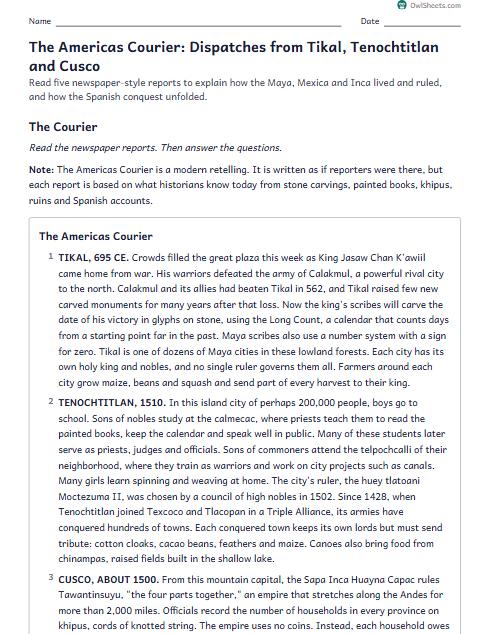
The Americas Courier: Dispatches from Tikal, Tenochtitlan and Cusco
Grade 7 · HIS.7.6
15 questionsPremium
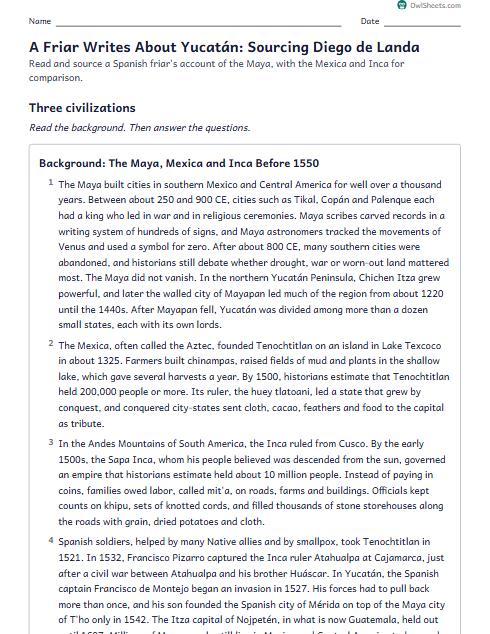
A Friar Writes About Yucatán: Sourcing Diego de Landa
Grade 7 · HIS.7.6
16 questionsPremium
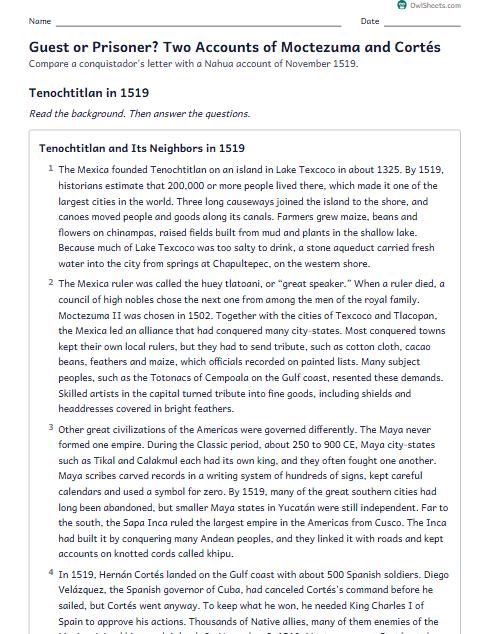
Guest or Prisoner? Two Accounts of Moctezuma and Cortés
Grade 7 · HIS.7.6
15 questionsPremium
Big Cities, Small Armies: The Americas in Numbers
Grade 7 · HIS.7.6
13 questionsPremium
Under the Streets of Mexico City: A Historian's Field Notes
Grade 7 · HIS.7.6
12 questionsPremium
Along the Royal Road: A Journey Through the Inca Empire
Grade 7 · HIS.7.6
12 questionsPremium