Grade 7 · Social StudiesHIS.7.6Premium
A Friar Writes About Yucatán: Sourcing Diego de Landa
Grade 7 history: source Diego de Landa's account of Maya government, calendar and books, and compare Maya, Mexica and Inca cities and the Spanish conquest.
Preview
OwlSheets.com
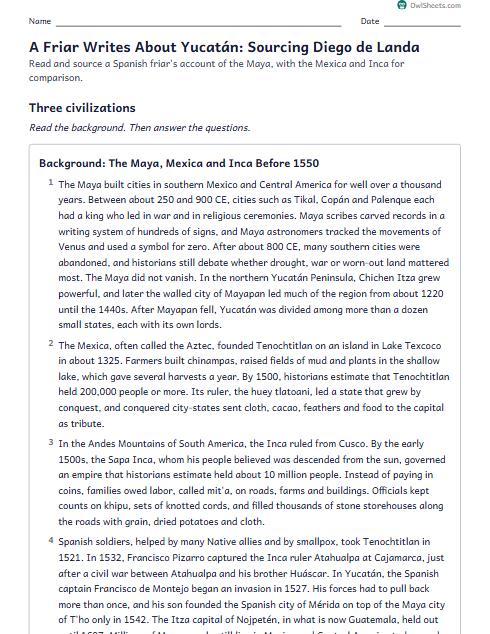
A Friar Writes About Yucatán: Sourcing Diego de Landa
Read and source a Spanish friar's account of the Maya, with the Mexica and Inca for comparison.
Three civilizations
Read the background. Then answer the questions.
Background: The Maya, Mexica and Inca Before 1550
1The Maya built cities in southern Mexico and Central America for well over a thousand years. Between about 250 and 900 CE, cities such as Tikal, Copán and Palenque each had a king who led in war and in religious ceremonies. Maya scribes carved records in a writing system of hundreds of signs, and Maya astronomers tracked the movements of Venus and used a symbol for zero. After about 800 CE, many southern cities were abandoned, and historians still debate whether drought, war or worn-out land mattered most. The Maya did not vanish. In the northern Yucatán Peninsula, Chichen Itza grew powerful, and later the walled city of Mayapan led much of the region from about 1220 until the 1440s. After Mayapan fell, Yucatán was divided among more than a dozen small states, each with its own lords.
2The Mexica, often called the Aztec, founded Tenochtitlan on an island in Lake Texcoco in about 1325. Farmers built chinampas, raised fields of mud and plants in the shallow lake, which gave several harvests a year. By 1500, historians estimate that Tenochtitlan held 200,000 people or more. Its ruler, the huey tlatoani, led a state that grew by conquest, and conquered city-states sent cloth, cacao, feathers and food to the capital as tribute.
3In the Andes Mountains of South America, the Inca ruled from Cusco. By the early 1500s, the Sapa Inca, whom his people believed was descended from the sun, governed an empire that historians estimate held about 10 million people. Instead of paying in coins, families owed labor, called mit'a, on roads, farms and buildings. Officials kept counts on khipu, sets of knotted cords, and filled thousands of stone storehouses along the roads with grain, dried potatoes and cloth.
4Spanish soldiers, helped by many Native allies and by smallpox, took Tenochtitlan in 1521. In 1532, Francisco Pizarro captured the Inca ruler Atahualpa at Cajamarca, just after a civil war between Atahualpa and his brother Huáscar. In Yucatán, the Spanish captain Francisco de Montejo began an invasion in 1527. His forces had to pull back more than once, and his son founded the Spanish city of Mérida on top of the Maya city of T'ho only in 1542. The Itza capital of Nojpetén, in what is now Guatemala, held out until 1697. Millions of Maya people still live in Mexico and Central America today, and many speak Maya languages.
- A. In 1350 a Mexica governor ruled the region; by 1500 Maya lords had taken it back.
- B. In 1350 Maya families farmed the region; by 1500 the Maya had moved away from Yucatán.
- C. In 1350 most lords looked to Mayapan; by 1500 many small states had their own lords.
- D. In 1350 many small states had their own lords; by 1500 Mayapan led most of the region.
- A. They gave the city a way to save rainwater for the dry months.
- B. They brought cacao and feathers to the city from conquered towns.
- C. They let farmers grow food right beside a crowded island city.
- D. They held the stone storehouses where the city kept its grain.
The preview shows the first questions. Unlock the worksheet to see all of it.
Related worksheets
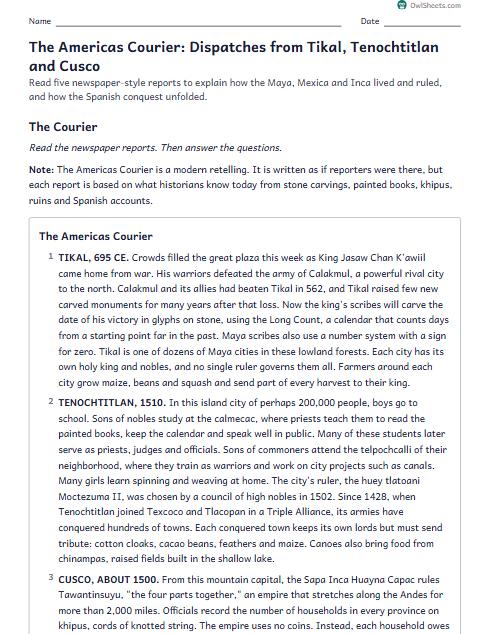
The Americas Courier: Dispatches from Tikal, Tenochtitlan and Cusco
Grade 7 · HIS.7.6
15 questionsPremium
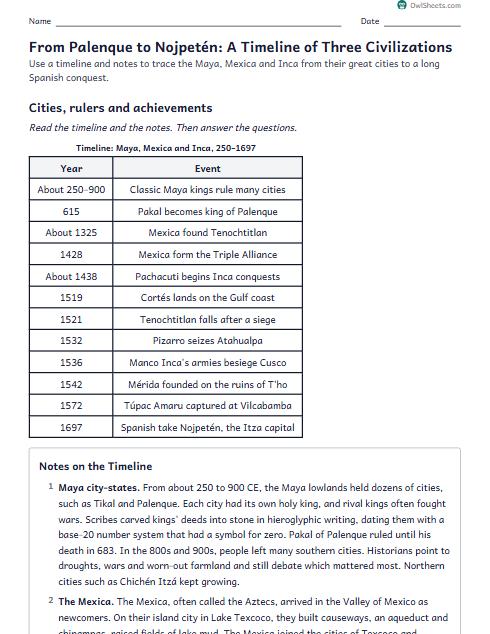
From Palenque to Nojpetén: A Timeline of Three Civilizations
Grade 7 · HIS.7.6
15 questionsPremium
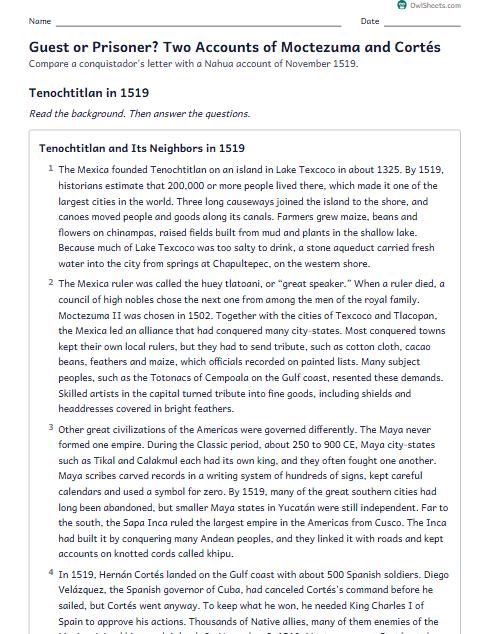
Guest or Prisoner? Two Accounts of Moctezuma and Cortés
Grade 7 · HIS.7.6
15 questionsPremium
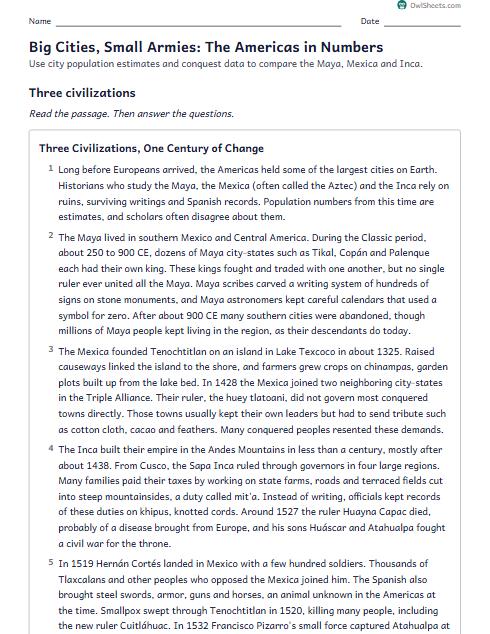
Big Cities, Small Armies: The Americas in Numbers
Grade 7 · HIS.7.6
13 questionsPremium
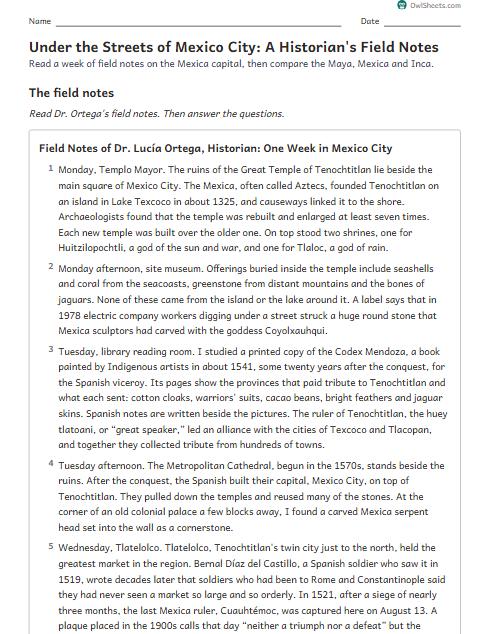
Under the Streets of Mexico City: A Historian's Field Notes
Grade 7 · HIS.7.6
12 questionsPremium
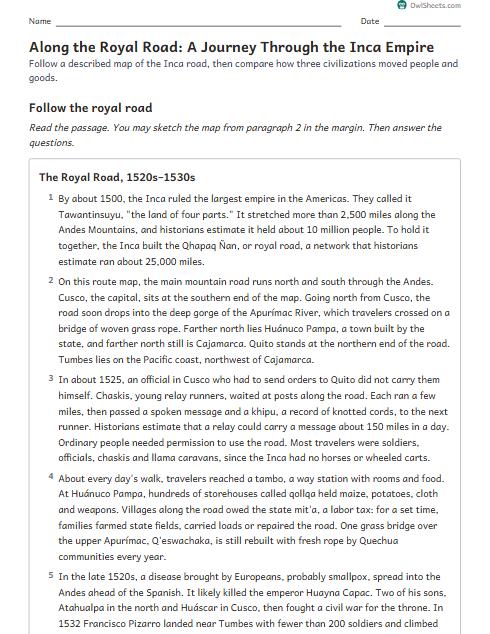
Along the Royal Road: A Journey Through the Inca Empire
Grade 7 · HIS.7.6
12 questionsPremium