Grade 7 · Social StudiesHIS.7.6Premium
The Americas Courier: Dispatches from Tikal, Tenochtitlan and Cusco
Grade 7 history: a modern newspaper retelling with reports from Tikal, Tenochtitlan, Cusco and Mérida on Maya, Mexica and Inca rule and the Spanish conquest.
Preview
OwlSheets.com
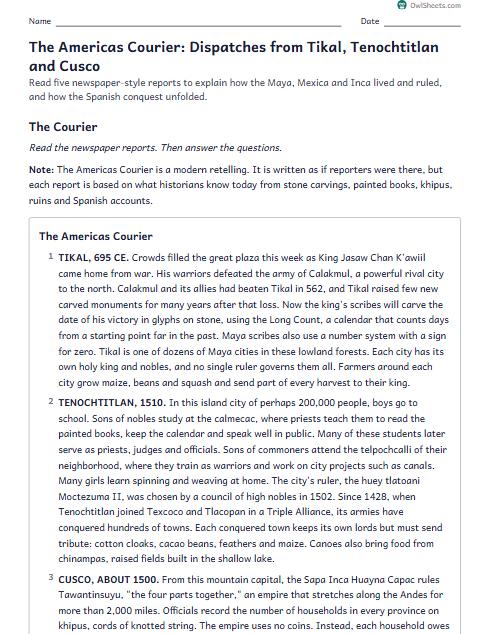
The Americas Courier: Dispatches from Tikal, Tenochtitlan and Cusco
Read five newspaper-style reports to explain how the Maya, Mexica and Inca lived and ruled, and how the Spanish conquest unfolded.
The Courier
Read the newspaper reports. Then answer the questions.
The Americas Courier
1TIKAL, 695 CE. Crowds filled the great plaza this week as King Jasaw Chan K'awiil came home from war. His warriors defeated the army of Calakmul, a powerful rival city to the north. Calakmul and its allies had beaten Tikal in 562, and Tikal raised few new carved monuments for many years after that loss. Now the king's scribes will carve the date of his victory in glyphs on stone, using the Long Count, a calendar that counts days from a starting point far in the past. Maya scribes also use a number system with a sign for zero. Tikal is one of dozens of Maya cities in these lowland forests. Each city has its own holy king and nobles, and no single ruler governs them all. Farmers around each city grow maize, beans and squash and send part of every harvest to their king.
2TENOCHTITLAN, 1510. In this island city of perhaps 200,000 people, boys go to school. Sons of nobles study at the calmecac, where priests teach them to read the painted books, keep the calendar and speak well in public. Many of these students later serve as priests, judges and officials. Sons of commoners attend the telpochcalli of their neighborhood, where they train as warriors and work on city projects such as canals. Many girls learn spinning and weaving at home. The city's ruler, the huey tlatoani Moctezuma II, was chosen by a council of high nobles in 1502. Since 1428, when Tenochtitlan joined Texcoco and Tlacopan in a Triple Alliance, its armies have conquered hundreds of towns. Each conquered town keeps its own lords but must send tribute: cotton cloaks, cacao beans, feathers and maize. Canoes also bring food from chinampas, raised fields built in the shallow lake.
3CUSCO, ABOUT 1500. From this mountain capital, the Sapa Inca Huayna Capac rules Tawantinsuyu, "the four parts together," an empire that stretches along the Andes for more than 2,000 miles. Officials record the number of households in every province on khipus, cords of knotted string. The empire uses no coins. Instead, each household owes the state turns of labor, called mit'a: men build roads and bridges, farm state fields or serve in the army, and households weave cloth for the state. Food and cloth fill rows of storehouses along the roads. When a province rebels, the Inca often move families who are loyal to them, called mitmaq, into it and send some of the rebels to live far away. Across the empire, officials use Quechua as the language of government.
4CUSCO, 1534. Spanish soldiers led by Francisco Pizarro now hold the Inca capital. Their victory began with a disaster that arrived before they did. A disease that most historians think was smallpox, brought to the Americas by Europeans, spread south into the Andes and killed Huayna Capac in the late 1520s. Two of his sons, Huáscar and Atahualpa, then fought a civil war for the throne. Atahualpa had just won when Pizarro, with fewer than 200 men, seized him at Cajamarca in November 1532. To win his freedom, Atahualpa had a room filled with gold and silver objects, but the Spanish executed him in 1533 anyway. In November 1533 they marched into Cusco. Soldiers stripped the gold plates from the walls of the Coricancha, the Temple of the Sun, and melted them into bars. Pizarro then crowned Manco Inca, a young son of Huayna Capac, as the new Sapa Inca.
5MÉRIDA, 1542. Far to the north, in Yucatán, Francisco de Montejo the Younger has founded a Spanish town on top of the Maya city of T'Hó, building with stones from its old temples. Spanish captains have fought here since 1527 and were forced to pull back more than once. The Maya of Yucatán have no emperor and no single capital. Each province has its own lords, and many Maya still live in towns the Spanish do not control. (Editor's note from today: deep in the southern forests, the Itza Maya kingdom at Nojpetén stayed independent until 1697.)
- A. The king of Tikal, since his victory made him ruler of the Maya cities
- B. A council of farmers chosen by the people of the lowland Maya cities
- C. The king of Calakmul, since each Maya city still had its own ruler
- D. The scribes of Tikal, who collected harvests to pay for carved monuments
The preview shows the first questions. Unlock the worksheet to see all of it.
Related worksheets
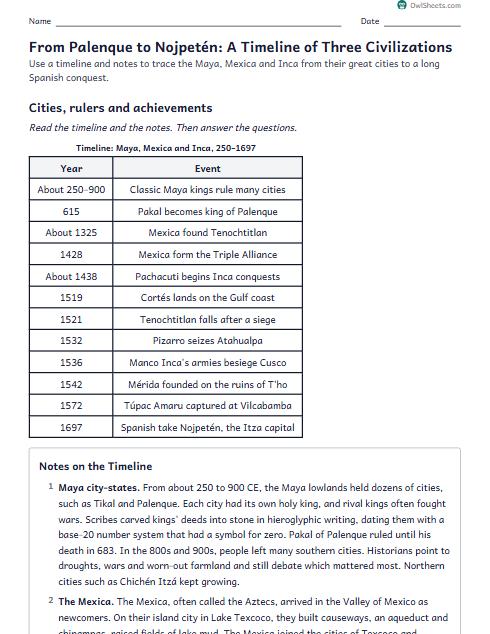
From Palenque to Nojpetén: A Timeline of Three Civilizations
Grade 7 · HIS.7.6
15 questionsPremium
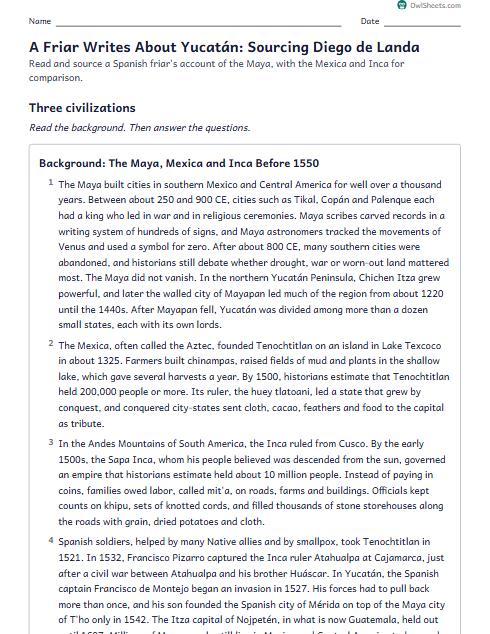
A Friar Writes About Yucatán: Sourcing Diego de Landa
Grade 7 · HIS.7.6
16 questionsPremium
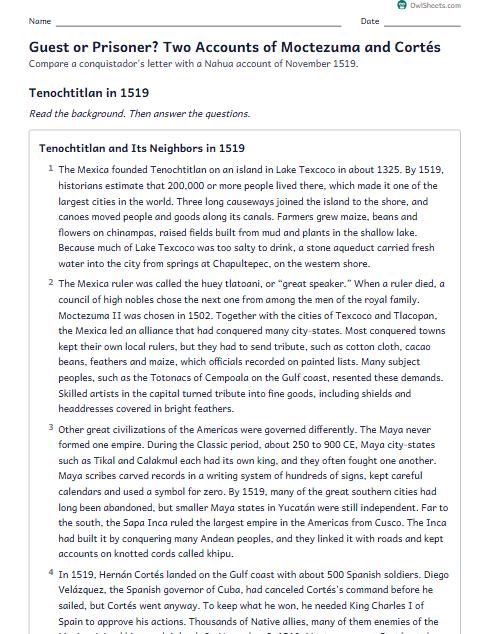
Guest or Prisoner? Two Accounts of Moctezuma and Cortés
Grade 7 · HIS.7.6
15 questionsPremium
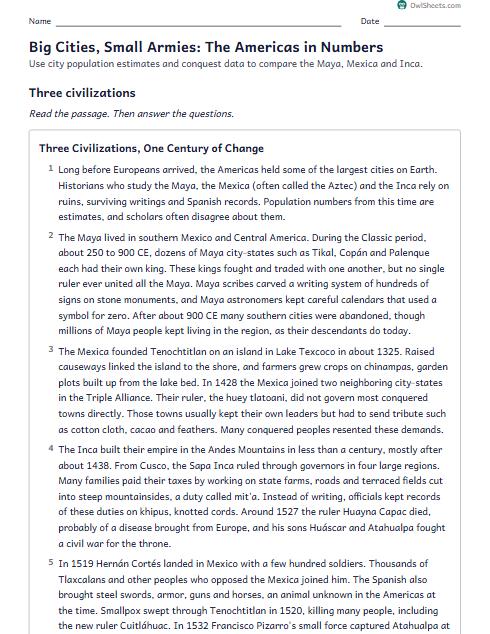
Big Cities, Small Armies: The Americas in Numbers
Grade 7 · HIS.7.6
13 questionsPremium
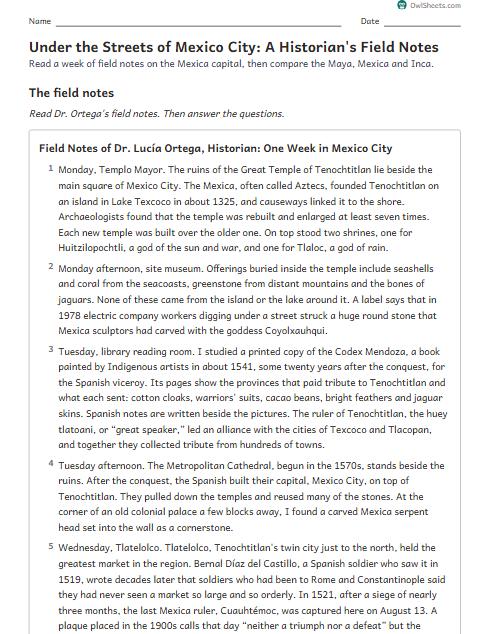
Under the Streets of Mexico City: A Historian's Field Notes
Grade 7 · HIS.7.6
12 questionsPremium
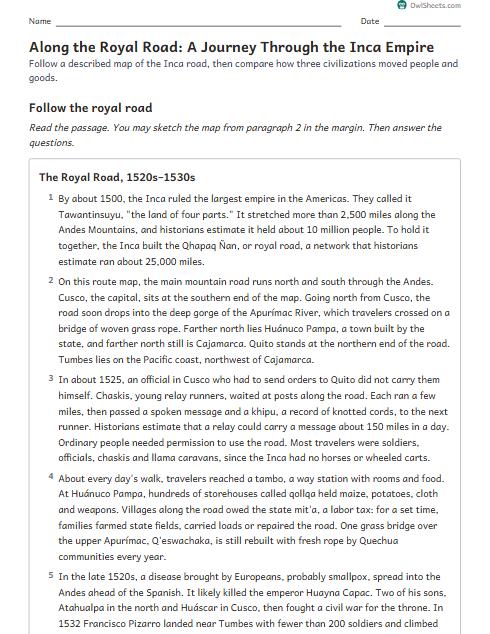
Along the Royal Road: A Journey Through the Inca Empire
Grade 7 · HIS.7.6
12 questionsPremium