Grade 7 · Social StudiesHIS.7.6Premium
Big Cities, Small Armies: The Americas in Numbers
Grade 7 history: a bar graph of city sizes and a table of Spanish forces show the Maya, Aztec and Inca cities, governments, achievements and conquest.
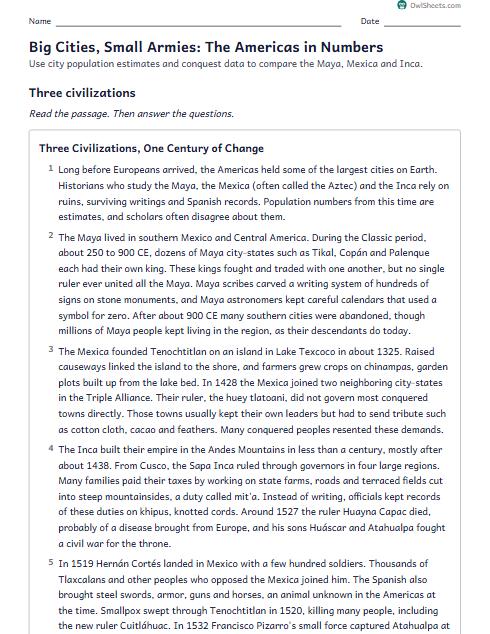
Preview
OwlSheets.com
Big Cities, Small Armies: The Americas in Numbers
Use city population estimates and conquest data to compare the Maya, Mexica and Inca.
Three civilizations
Read the passage. Then answer the questions.
Three Civilizations, One Century of Change
1Long before Europeans arrived, the Americas held some of the largest cities on Earth. Historians who study the Maya, the Mexica (often called the Aztec) and the Inca rely on ruins, surviving writings and Spanish records. Population numbers from this time are estimates, and scholars often disagree about them.
2The Maya lived in southern Mexico and Central America. During the Classic period, about 250 to 900 CE, dozens of Maya city-states such as Tikal, Copán and Palenque each had their own king. These kings fought and traded with one another, but no single ruler ever united all the Maya. Maya scribes carved a writing system of hundreds of signs on stone monuments, and Maya astronomers kept careful calendars that used a symbol for zero. After about 900 CE many southern cities were abandoned, though millions of Maya people kept living in the region, as their descendants do today.
3The Mexica founded Tenochtitlan on an island in Lake Texcoco in about 1325. Raised causeways linked the island to the shore, and farmers grew crops on chinampas, garden plots built up from the lake bed. In 1428 the Mexica joined two neighboring city-states in the Triple Alliance. Their ruler, the huey tlatoani, did not govern most conquered towns directly. Those towns usually kept their own leaders but had to send tribute such as cotton cloth, cacao and feathers. Many conquered peoples resented these demands.
4The Inca built their empire in the Andes Mountains in less than a century, mostly after about 1438. From Cusco, the Sapa Inca ruled through governors in four large regions. Many families paid their taxes by working on state farms, roads and terraced fields cut into steep mountainsides, a duty called mit'a. Instead of writing, officials kept records of these duties on khipus, knotted cords. Around 1527 the ruler Huayna Capac died, probably of a disease brought from Europe, and his sons Huáscar and Atahualpa fought a civil war for the throne.
5In 1519 Hernán Cortés landed in Mexico with a few hundred soldiers. Thousands of Tlaxcalans and other peoples who opposed the Mexica joined him. The Spanish also brought steel swords, armor, guns and horses, an animal unknown in the Americas at the time. Smallpox swept through Tenochtitlan in 1520, killing many people, including the new ruler Cuitláhuac. In 1532 Francisco Pizarro's small force captured Atahualpa at Cajamarca, soon after Atahualpa's armies had defeated Huáscar. The Maya, divided into many small states, resisted for far longer, one town at a time.
- A. Ask the ruler in Tikal, who governed every Maya city, to decide
- B. Wait for an assembly of all Maya citizens to vote on the land
- C. Send a request to the governor of his region of the empire
- D. Fight or bargain with the king of the nearby city himself
- A. Ask the townspeople to vote on how much they will send
- B. Remove the town's leaders and rule the town himself
- C. Call the town's men to build roads as their only tax
- D. Collect the cloth, cacao or feathers the town owed
The preview shows the first questions. Unlock the worksheet to see all of it.
Related worksheets
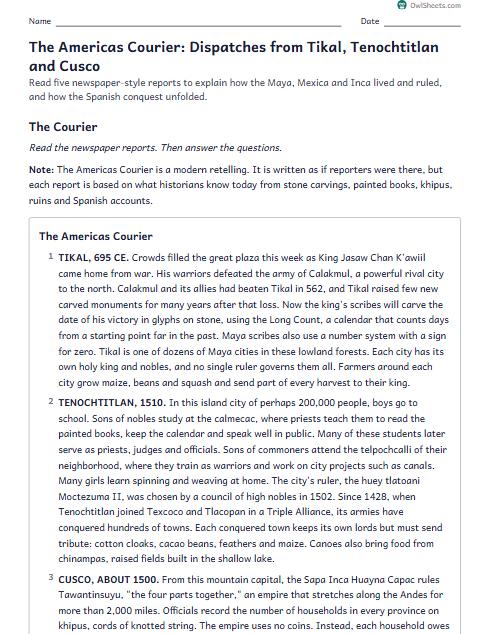
The Americas Courier: Dispatches from Tikal, Tenochtitlan and Cusco
Grade 7 · HIS.7.6
15 questionsPremium
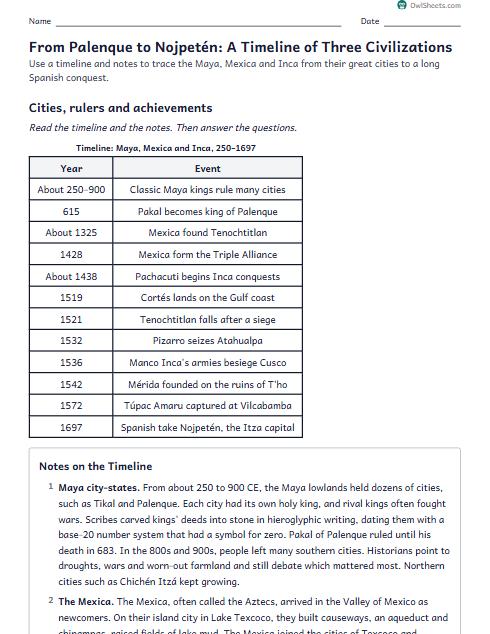
From Palenque to Nojpetén: A Timeline of Three Civilizations
Grade 7 · HIS.7.6
15 questionsPremium
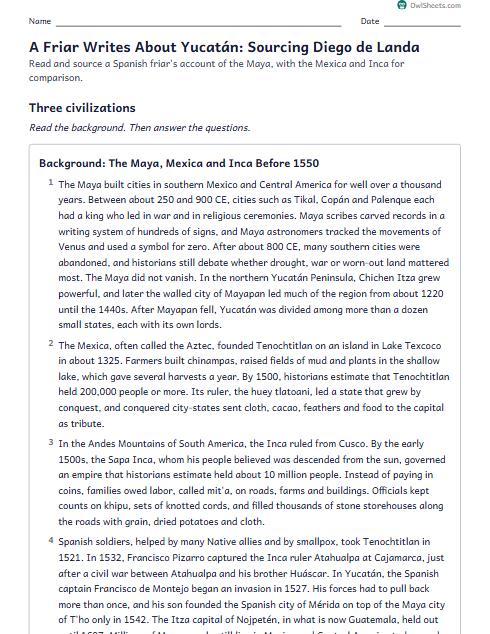
A Friar Writes About Yucatán: Sourcing Diego de Landa
Grade 7 · HIS.7.6
16 questionsPremium
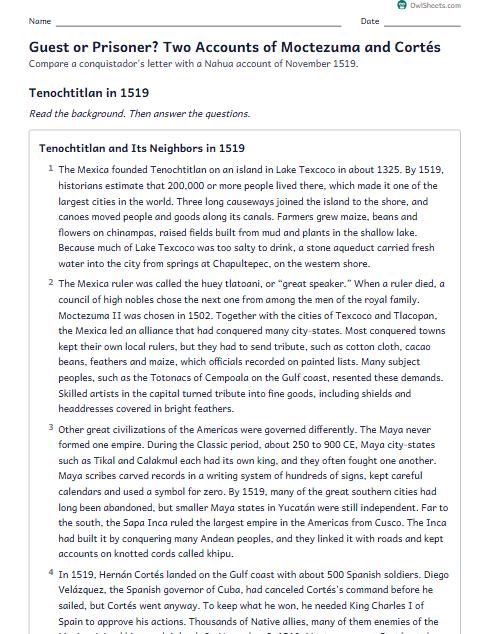
Guest or Prisoner? Two Accounts of Moctezuma and Cortés
Grade 7 · HIS.7.6
15 questionsPremium
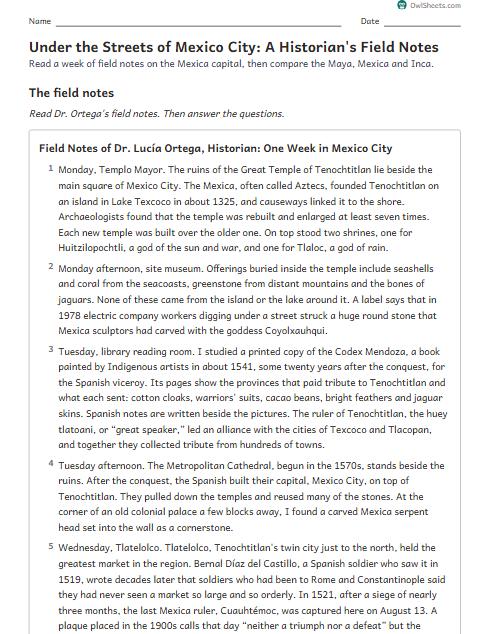
Under the Streets of Mexico City: A Historian's Field Notes
Grade 7 · HIS.7.6
12 questionsPremium
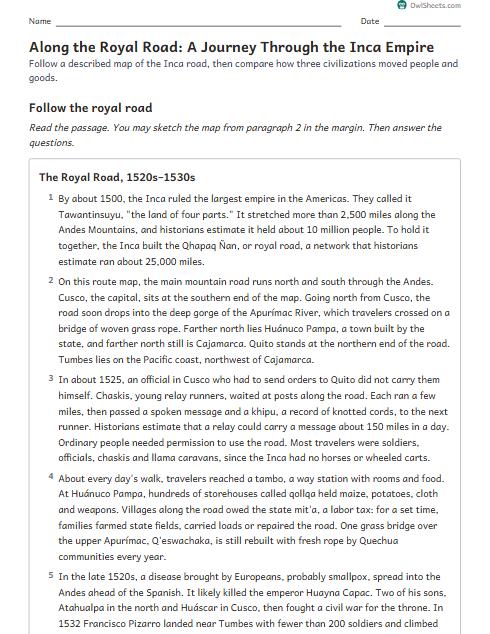
Along the Royal Road: A Journey Through the Inca Empire
Grade 7 · HIS.7.6
12 questionsPremium