Grade 7 · Social StudiesECO.7.2Premium
Silk for Silver: Europeans at Nagasaki, 1543–1715
Grade 7 economics: a timeline of European trade at Nagasaki shows how the Age of Exploration, joint-stock companies and mercantilism changed trade.
Preview
OwlSheets.com
Silk for Silver: Europeans at Nagasaki, 1543–1715
Use a dated timeline to see how sea routes, joint-stock companies and mercantilist fears shaped trade with Japan.
Ships, silk and silver
Read the passage. Then answer the questions.
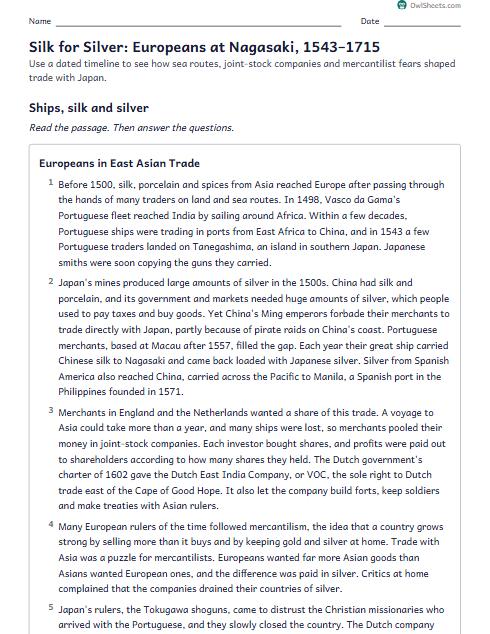
Europeans in East Asian Trade
1Before 1500, silk, porcelain and spices from Asia reached Europe after passing through the hands of many traders on land and sea routes. In 1498, Vasco da Gama's Portuguese fleet reached India by sailing around Africa. Within a few decades, Portuguese ships were trading in ports from East Africa to China, and in 1543 a few Portuguese traders landed on Tanegashima, an island in southern Japan. Japanese smiths were soon copying the guns they carried.
2Japan's mines produced large amounts of silver in the 1500s. China had silk and porcelain, and its government and markets needed huge amounts of silver, which people used to pay taxes and buy goods. Yet China's Ming emperors forbade their merchants to trade directly with Japan, partly because of pirate raids on China's coast. Portuguese merchants, based at Macau after 1557, filled the gap. Each year their great ship carried Chinese silk to Nagasaki and came back loaded with Japanese silver. Silver from Spanish America also reached China, carried across the Pacific to Manila, a Spanish port in the Philippines founded in 1571.
3Merchants in England and the Netherlands wanted a share of this trade. A voyage to Asia could take more than a year, and many ships were lost, so merchants pooled their money in joint-stock companies. Each investor bought shares, and profits were paid out to shareholders according to how many shares they held. The Dutch government's charter of 1602 gave the Dutch East India Company, or VOC, the sole right to Dutch trade east of the Cape of Good Hope. It also let the company build forts, keep soldiers and make treaties with Asian rulers.
4Many European rulers of the time followed mercantilism, the idea that a country grows strong by selling more than it buys and by keeping gold and silver at home. Trade with Asia was a puzzle for mercantilists. Europeans wanted far more Asian goods than Asians wanted European ones, and the difference was paid in silver. Critics at home complained that the companies drained their countries of silver.
5Japan's rulers, the Tokugawa shoguns, came to distrust the Christian missionaries who arrived with the Portuguese, and they slowly closed the country. The Dutch company sent no missionaries. By 1640, its merchants were the only Europeans still trading in Japan. In 1641 they were moved to Dejima, a small fan-shaped island built in Nagasaki harbor, and they could not leave it without permission. Chinese merchants also kept trading at Nagasaki. Later, Japanese officials worried that too much of the country's silver and copper was flowing out. The VOC traded at Dejima until the company itself was dissolved in 1799.
- A. Portuguese law required Japanese silver to be shipped to Macau.
- B. China's taxes and markets needed silver, and Japan's mines had plenty.
- C. Japan's rulers taxed silk heavily, so traders paid them in silver.
- D. Spanish ships carried Japanese silver across the Pacific to Manila.
- A. Japanese buyers paid only in silk, so he needed Portuguese silver.
- B. Chinese ships of the time could not sail as far as Japan's ports.
- C. Ming law did not let Chinese merchants trade directly with Japan.
- D. The VOC had been given the right to all trade between the two.
The preview shows the first questions. Unlock the worksheet to see all of it.
Related worksheets
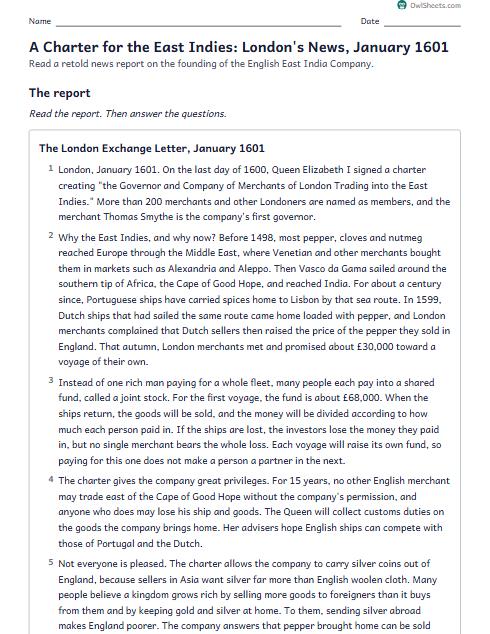
A Charter for the East Indies: London's News, January 1601
Grade 7 · ECO.7.2
14 questionsPremium
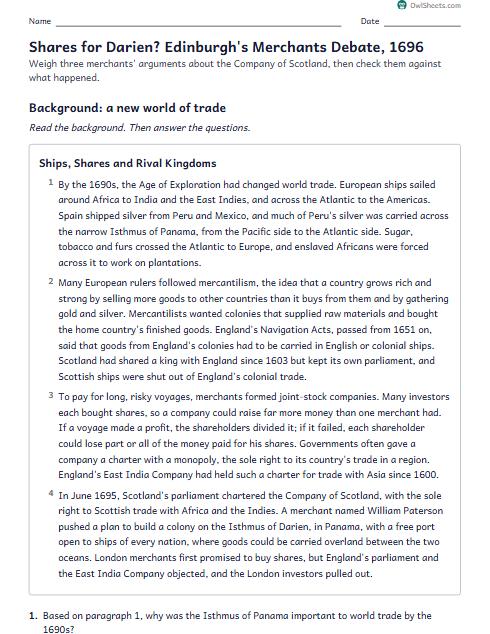
Shares for Darien? Edinburgh's Merchants Debate, 1696
Grade 7 · ECO.7.2
15 questionsPremium
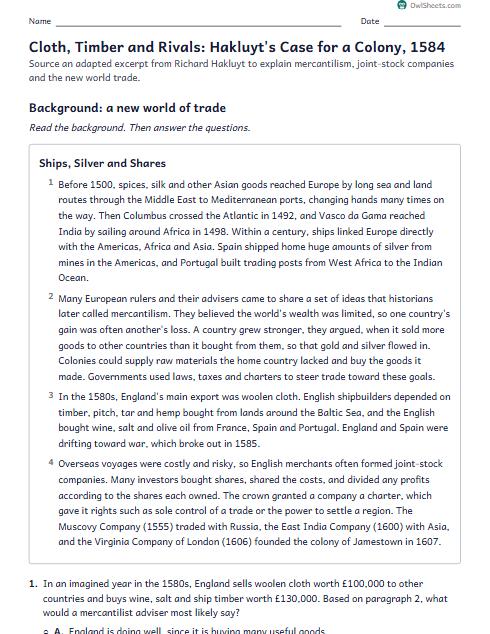
Cloth, Timber and Rivals: Hakluyt's Case for a Colony, 1584
Grade 7 · ECO.7.2
14 questionsPremium
Tea, Silver and a Shipwreck: The Swedish East India Company
Grade 7 · ECO.7.2
15 questionsPremium
Gold, Ships and Shares: Colbert and Adam Smith Disagree
Grade 7 · ECO.7.2
12 questionsPremium
Royal Port or Chartered Company? Two Ways to Run World Trade
Grade 7 · ECO.7.2
12 questionsPremium