Grade 7 · Social StudiesECO.7.2Premium
Shares for Darien? Edinburgh's Merchants Debate, 1696
Grade 7 economics: an imagined 1696 Edinburgh merchants' debate on the Company of Scotland explains mercantilism, joint-stock companies and world trade.
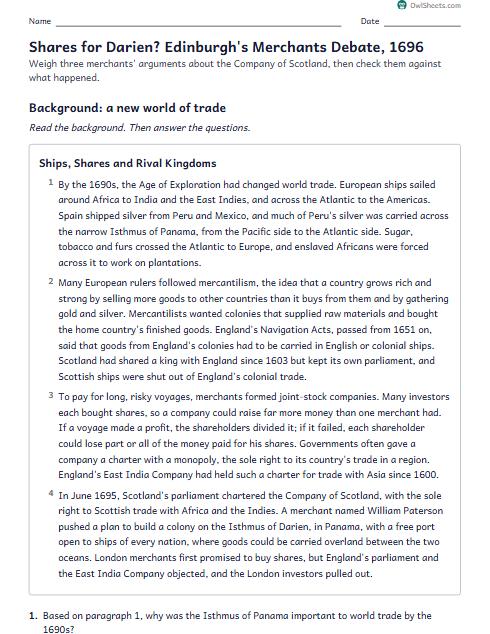
Preview
OwlSheets.com
Shares for Darien? Edinburgh's Merchants Debate, 1696
Weigh three merchants' arguments about the Company of Scotland, then check them against what happened.
Background: a new world of trade
Read the background. Then answer the questions.
Ships, Shares and Rival Kingdoms
1By the 1690s, the Age of Exploration had changed world trade. European ships sailed around Africa to India and the East Indies, and across the Atlantic to the Americas. Spain shipped silver from Peru and Mexico, and much of Peru's silver was carried across the narrow Isthmus of Panama, from the Pacific side to the Atlantic side. Sugar, tobacco and furs crossed the Atlantic to Europe, and enslaved Africans were forced across it to work on plantations.
2Many European rulers followed mercantilism, the idea that a country grows rich and strong by selling more goods to other countries than it buys from them and by gathering gold and silver. Mercantilists wanted colonies that supplied raw materials and bought the home country's finished goods. England's Navigation Acts, passed from 1651 on, said that goods from England's colonies had to be carried in English or colonial ships. Scotland had shared a king with England since 1603 but kept its own parliament, and Scottish ships were shut out of England's colonial trade.
3To pay for long, risky voyages, merchants formed joint-stock companies. Many investors each bought shares, so a company could raise far more money than one merchant had. If a voyage made a profit, the shareholders divided it; if it failed, each shareholder could lose part or all of the money paid for his shares. Governments often gave a company a charter with a monopoly, the sole right to its country's trade in a region. England's East India Company had held such a charter for trade with Asia since 1600.
4In June 1695, Scotland's parliament chartered the Company of Scotland, with the sole right to Scottish trade with Africa and the Indies. A merchant named William Paterson pushed a plan to build a colony on the Isthmus of Darien, in Panama, with a free port open to ships of every nation, where goods could be carried overland between the two oceans. London merchants first promised to buy shares, but England's parliament and the East India Company objected, and the London investors pulled out.
- A. English and Scottish ships met there to trade furs.
- B. Ships rounding Africa stopped there on the way to India.
- C. Peru's silver crossed there from the Pacific to the Atlantic.
- D. Most of Europe's sugar and tobacco was grown there.
- A. So Scottish ships could carry England's silver to Asia
- B. So the profits of colonial trade stayed in England
- C. So the colonies could sell their goods to any buyer
- D. So Scotland's parliament could make its own trade laws
The preview shows the first questions. Unlock the worksheet to see all of it.
Related worksheets
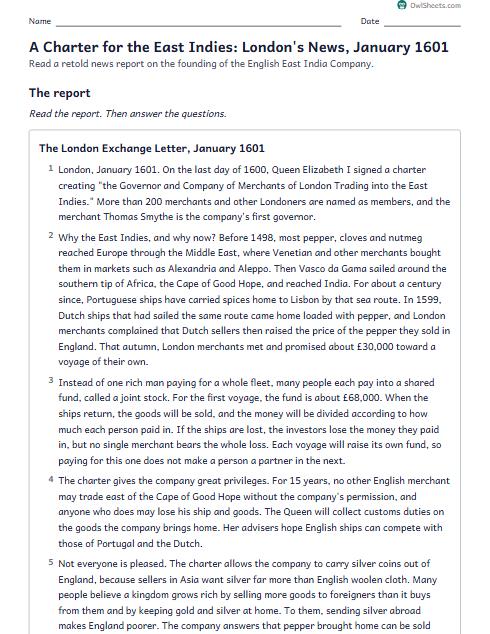
A Charter for the East Indies: London's News, January 1601
Grade 7 · ECO.7.2
14 questionsPremium
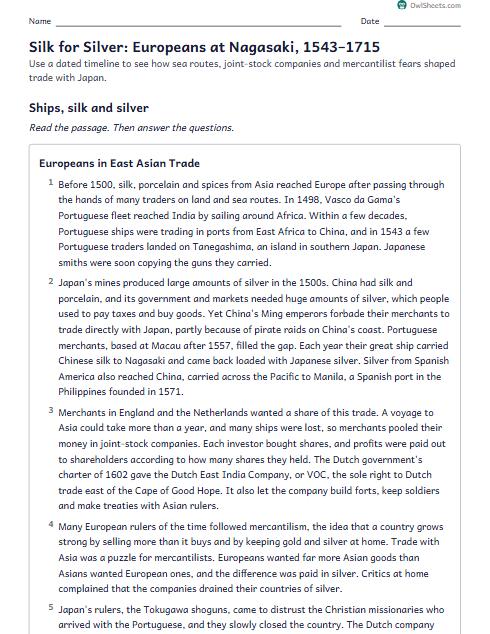
Silk for Silver: Europeans at Nagasaki, 1543–1715
Grade 7 · ECO.7.2
14 questionsPremium
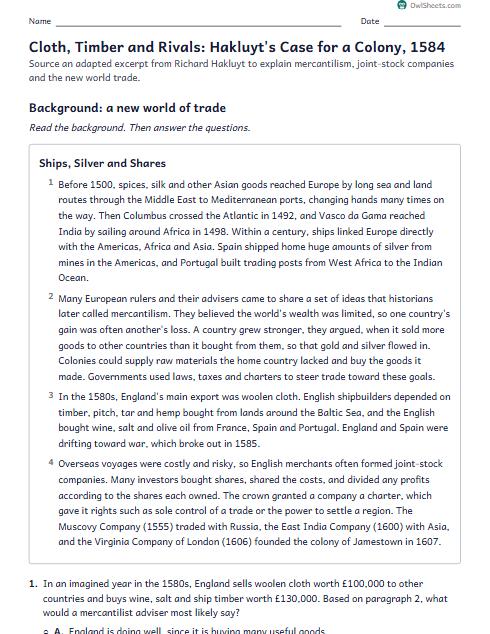
Cloth, Timber and Rivals: Hakluyt's Case for a Colony, 1584
Grade 7 · ECO.7.2
14 questionsPremium
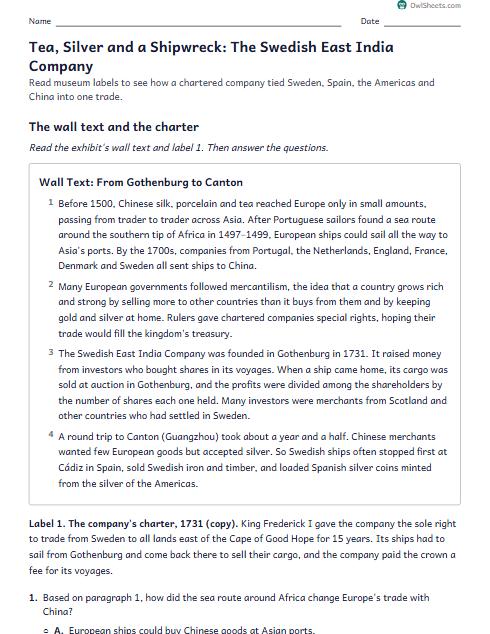
Tea, Silver and a Shipwreck: The Swedish East India Company
Grade 7 · ECO.7.2
15 questionsPremium
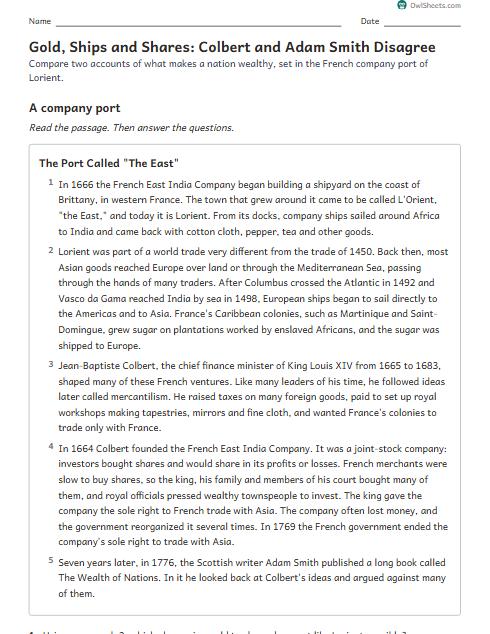
Gold, Ships and Shares: Colbert and Adam Smith Disagree
Grade 7 · ECO.7.2
12 questionsPremium
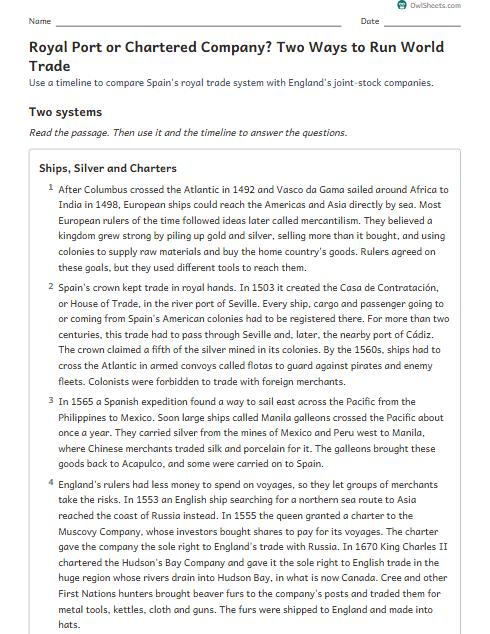
Royal Port or Chartered Company? Two Ways to Run World Trade
Grade 7 · ECO.7.2
12 questionsPremium