Grade 7 · Social StudiesECO.7.2Premium
Cloth, Timber and Rivals: Hakluyt's Case for a Colony, 1584
Grade 7 economics: source an adapted excerpt from Hakluyt's 1584 Discourse of Western Planting to explain mercantilism and joint-stock companies.
Preview
OwlSheets.com
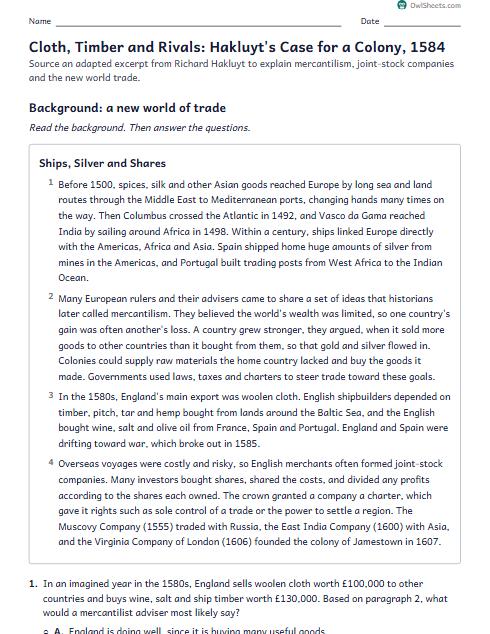
Cloth, Timber and Rivals: Hakluyt's Case for a Colony, 1584
Source an adapted excerpt from Richard Hakluyt to explain mercantilism, joint-stock companies and the new world trade.
Background: a new world of trade
Read the background. Then answer the questions.
Ships, Silver and Shares
1Before 1500, spices, silk and other Asian goods reached Europe by long sea and land routes through the Middle East to Mediterranean ports, changing hands many times on the way. Then Columbus crossed the Atlantic in 1492, and Vasco da Gama reached India by sailing around Africa in 1498. Within a century, ships linked Europe directly with the Americas, Africa and Asia. Spain shipped home huge amounts of silver from mines in the Americas, and Portugal built trading posts from West Africa to the Indian Ocean.
2Many European rulers and their advisers came to share a set of ideas that historians later called mercantilism. They believed the world's wealth was limited, so one country's gain was often another's loss. A country grew stronger, they argued, when it sold more goods to other countries than it bought from them, so that gold and silver flowed in. Colonies could supply raw materials the home country lacked and buy the goods it made. Governments used laws, taxes and charters to steer trade toward these goals.
3In the 1580s, England's main export was woolen cloth. English shipbuilders depended on timber, pitch, tar and hemp bought from lands around the Baltic Sea, and the English bought wine, salt and olive oil from France, Spain and Portugal. England and Spain were drifting toward war, which broke out in 1585.
4Overseas voyages were costly and risky, so English merchants often formed joint-stock companies. Many investors bought shares, shared the costs, and divided any profits according to the shares each owned. The crown granted a company a charter, which gave it rights such as sole control of a trade or the power to settle a region. The Muscovy Company (1555) traded with Russia, the East India Company (1600) with Asia, and the Virginia Company of London (1606) founded the colony of Jamestown in 1607.
- A. England is doing well, since it is buying many useful goods.
- B. England is losing silver and should make more of what it buys.
- C. England's trade matters little as long as its cloth is good.
- D. England should stop selling cloth and keep its wool at home.
- A. A charter let the crown take all of the company's profits.
- B. Joint-stock voyages were safer from storms than royal ones.
- C. A company could raise an army larger than the queen's.
- D. Shareholders carried the costs, and England gained the trade.
The preview shows the first questions. Unlock the worksheet to see all of it.
Related worksheets
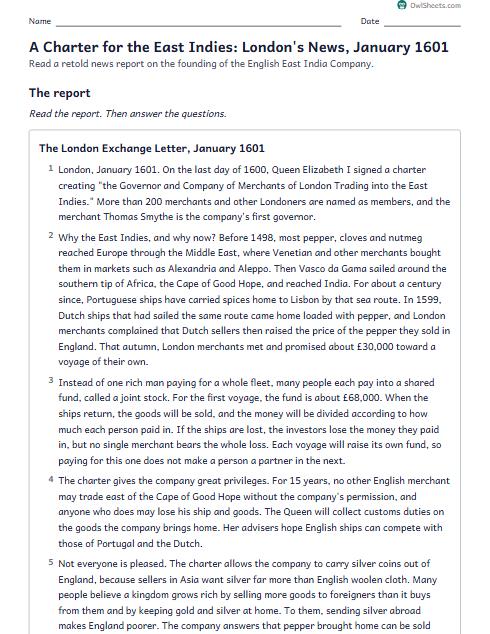
A Charter for the East Indies: London's News, January 1601
Grade 7 · ECO.7.2
14 questionsPremium
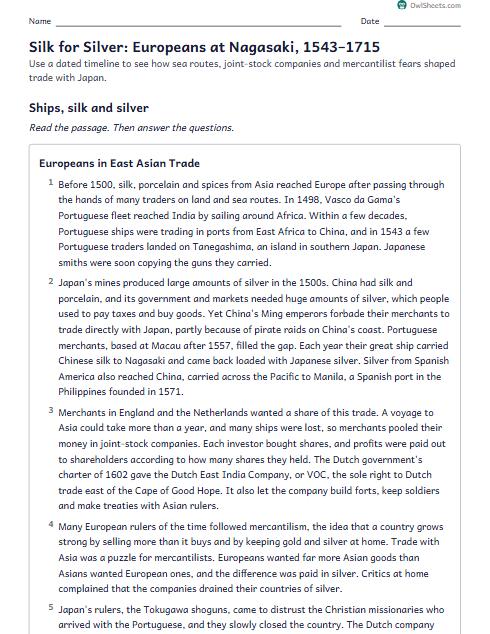
Silk for Silver: Europeans at Nagasaki, 1543–1715
Grade 7 · ECO.7.2
14 questionsPremium
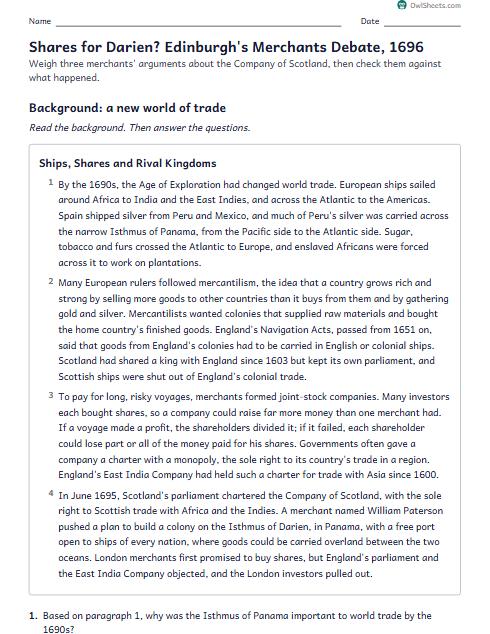
Shares for Darien? Edinburgh's Merchants Debate, 1696
Grade 7 · ECO.7.2
15 questionsPremium
Tea, Silver and a Shipwreck: The Swedish East India Company
Grade 7 · ECO.7.2
15 questionsPremium
Gold, Ships and Shares: Colbert and Adam Smith Disagree
Grade 7 · ECO.7.2
12 questionsPremium
Royal Port or Chartered Company? Two Ways to Run World Trade
Grade 7 · ECO.7.2
12 questionsPremium