Grade 7 · Social StudiesECO.7.2Premium
A Charter for the East Indies: London's News, January 1601
Grade 7 economics: a retold 1601 London news report on the East India Company's charter, its joint stock, its monopoly and the debate over silver.
Preview
OwlSheets.com
A Charter for the East Indies: London's News, January 1601
Read a retold news report on the founding of the English East India Company.
The report
Read the report. Then answer the questions.
The London Exchange Letter, January 1601
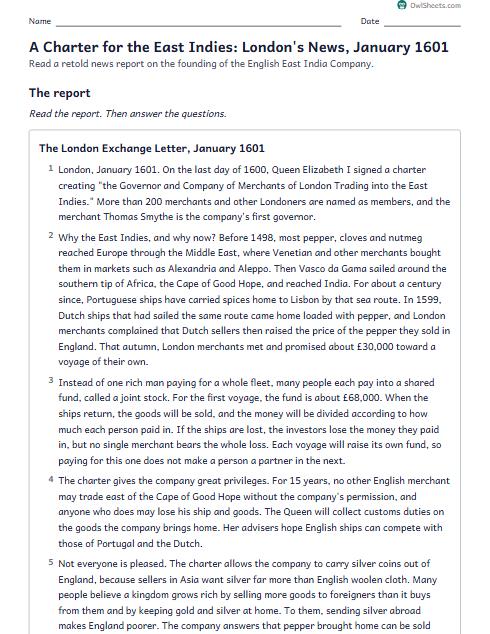
1London, January 1601. On the last day of 1600, Queen Elizabeth I signed a charter creating "the Governor and Company of Merchants of London Trading into the East Indies." More than 200 merchants and other Londoners are named as members, and the merchant Thomas Smythe is the company's first governor.
2Why the East Indies, and why now? Before 1498, most pepper, cloves and nutmeg reached Europe through the Middle East, where Venetian and other merchants bought them in markets such as Alexandria and Aleppo. Then Vasco da Gama sailed around the southern tip of Africa, the Cape of Good Hope, and reached India. For about a century since, Portuguese ships have carried spices home to Lisbon by that sea route. In 1599, Dutch ships that had sailed the same route came home loaded with pepper, and London merchants complained that Dutch sellers then raised the price of the pepper they sold in England. That autumn, London merchants met and promised about £30,000 toward a voyage of their own.
3Instead of one rich man paying for a whole fleet, many people each pay into a shared fund, called a joint stock. For the first voyage, the fund is about £68,000. When the ships return, the goods will be sold, and the money will be divided according to how much each person paid in. If the ships are lost, the investors lose the money they paid in, but no single merchant bears the whole loss. Each voyage will raise its own fund, so paying for this one does not make a person a partner in the next.
4The charter gives the company great privileges. For 15 years, no other English merchant may trade east of the Cape of Good Hope without the company's permission, and anyone who does may lose his ship and goods. The Queen will collect customs duties on the goods the company brings home. Her advisers hope English ships can compete with those of Portugal and the Dutch.
5Not everyone is pleased. The charter allows the company to carry silver coins out of England, because sellers in Asia want silver far more than English woolen cloth. Many people believe a kingdom grows rich by selling more goods to foreigners than it buys from them and by keeping gold and silver at home. To them, sending silver abroad makes England poorer. The company answers that pepper brought home can be sold again in other countries of Europe for more silver than the voyage took out.
6Four ships, the Red Dragon, the Hector, the Ascension and the Susan, are being made ready to sail around the Cape next month under James Lancaster, a captain who has sailed to the East before. Besides silver, they will carry iron, lead and English cloth to trade.
- A. So they could buy pepper at its source, not from Dutch sellers
- B. So the Queen could stop English people from eating pepper
- C. So Venice would stop buying spices in Alexandria and Aleppo
- D. So Portugal would let English ships use its ports in Lisbon
The preview shows the first questions. Unlock the worksheet to see all of it.
Related worksheets
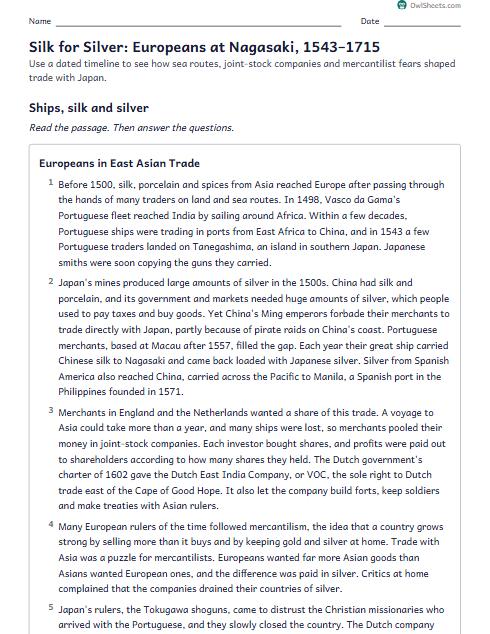
Silk for Silver: Europeans at Nagasaki, 1543–1715
Grade 7 · ECO.7.2
14 questionsPremium
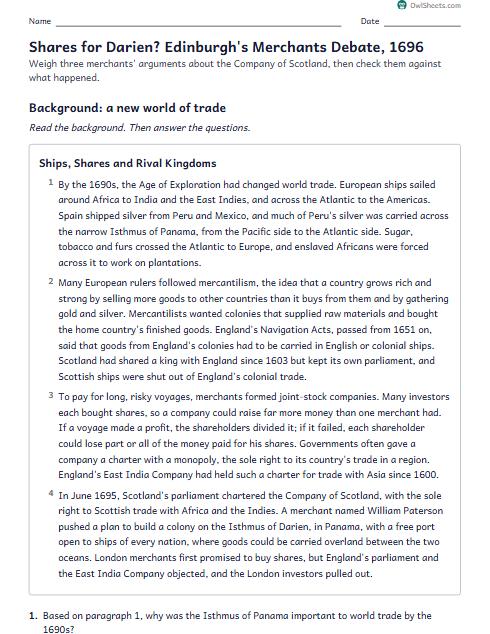
Shares for Darien? Edinburgh's Merchants Debate, 1696
Grade 7 · ECO.7.2
15 questionsPremium
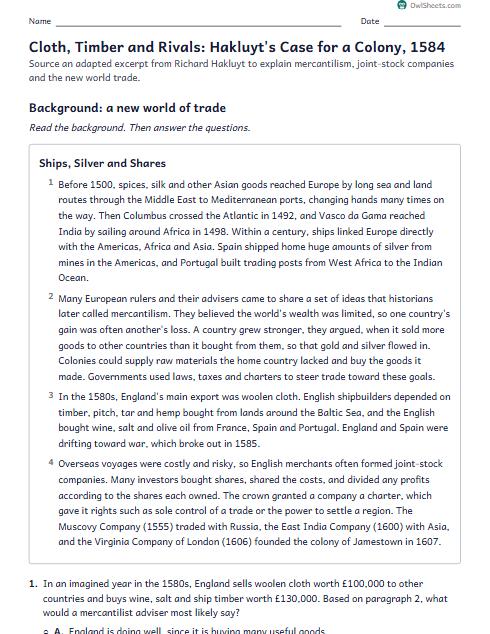
Cloth, Timber and Rivals: Hakluyt's Case for a Colony, 1584
Grade 7 · ECO.7.2
14 questionsPremium
Tea, Silver and a Shipwreck: The Swedish East India Company
Grade 7 · ECO.7.2
15 questionsPremium
Gold, Ships and Shares: Colbert and Adam Smith Disagree
Grade 7 · ECO.7.2
12 questionsPremium
Royal Port or Chartered Company? Two Ways to Run World Trade
Grade 7 · ECO.7.2
12 questionsPremium