Grade 7 · Social StudiesECO.7.2Premium
Tea, Silver and a Shipwreck: The Swedish East India Company
Grade 7 economics: museum labels on the Swedish East India Company, the wrecked Götheborg, American silver and Canton tea explain mercantilism.
Preview
OwlSheets.com
Tea, Silver and a Shipwreck: The Swedish East India Company
Read museum labels to see how a chartered company tied Sweden, Spain, the Americas and China into one trade.
The wall text and the charter
Read the exhibit's wall text and label 1. Then answer the questions.
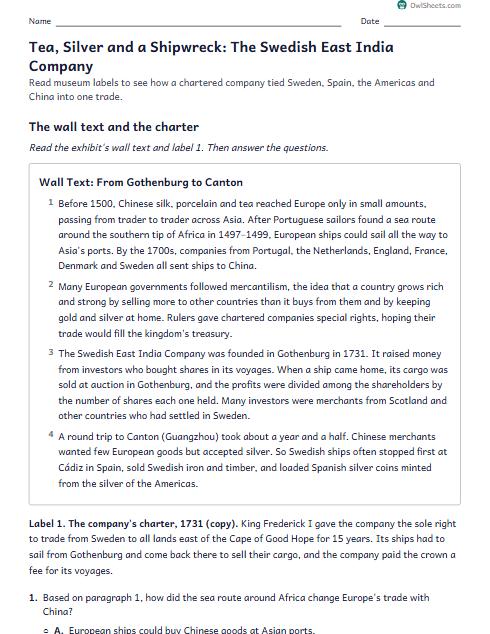
Wall Text: From Gothenburg to Canton
1Before 1500, Chinese silk, porcelain and tea reached Europe only in small amounts, passing from trader to trader across Asia. After Portuguese sailors found a sea route around the southern tip of Africa in 1497–1499, European ships could sail all the way to Asia's ports. By the 1700s, companies from Portugal, the Netherlands, England, France, Denmark and Sweden all sent ships to China.
2Many European governments followed mercantilism, the idea that a country grows rich and strong by selling more to other countries than it buys from them and by keeping gold and silver at home. Rulers gave chartered companies special rights, hoping their trade would fill the kingdom's treasury.
3The Swedish East India Company was founded in Gothenburg in 1731. It raised money from investors who bought shares in its voyages. When a ship came home, its cargo was sold at auction in Gothenburg, and the profits were divided among the shareholders by the number of shares each one held. Many investors were merchants from Scotland and other countries who had settled in Sweden.
4A round trip to Canton (Guangzhou) took about a year and a half. Chinese merchants wanted few European goods but accepted silver. So Swedish ships often stopped first at Cádiz in Spain, sold Swedish iron and timber, and loaded Spanish silver coins minted from the silver of the Americas.
- A. European ships could buy Chinese goods at Asian ports.
- B. Overland traders carried more silk across Asia than before.
- C. Chinese ships began carrying tea all the way to Sweden.
- D. Europe stopped buying Chinese goods and made its own.
The preview shows the first questions. Unlock the worksheet to see all of it.
Related worksheets
A Charter for the East Indies: London's News, January 1601
Grade 7 · ECO.7.2
14 questionsPremium
Silk for Silver: Europeans at Nagasaki, 1543–1715
Grade 7 · ECO.7.2
14 questionsPremium
Shares for Darien? Edinburgh's Merchants Debate, 1696
Grade 7 · ECO.7.2
15 questionsPremium
Cloth, Timber and Rivals: Hakluyt's Case for a Colony, 1584
Grade 7 · ECO.7.2
14 questionsPremium
Gold, Ships and Shares: Colbert and Adam Smith Disagree
Grade 7 · ECO.7.2
12 questionsPremium
Royal Port or Chartered Company? Two Ways to Run World Trade
Grade 7 · ECO.7.2
12 questionsPremium